

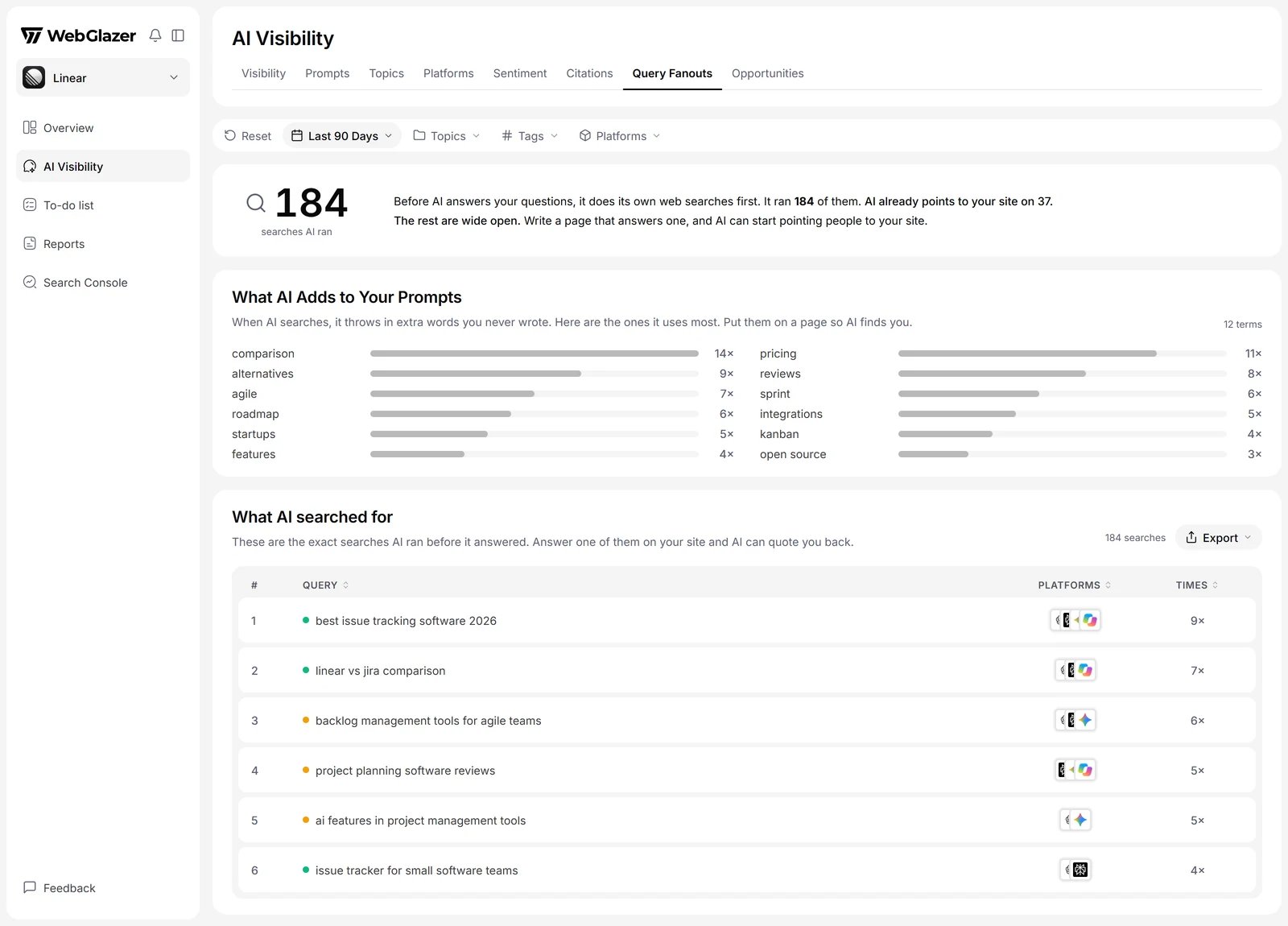
Illustration with sample data
Summary
The card at the top shows how many different searches AI ran in the period (“searches AI ran”) and a short read of how many of them lead to your site:- “None of them point to your site yet. Right now AI learns about your world from everyone except you.” when no search led to your site.
- “AI already points to your site on N. The rest are wide open.” when under 34% of the searches did.
- “AI already points to your site on N of them (X%). It clearly sees you as worth quoting.” at 34% or more.
- Searches that differ only in capitals, spacing or a trailing ”?”, ”.” or ”!” count as one search.
- A search counts as pointing to your site when at least one answer that ran it cited your own domain.
- Coverage = searches that point to your site ÷ all different searches × 100, as a whole percent.
Example with made-up numbers. AI ran 40 different searches in the period. Answers that ran 9 of them cited your site. Coverage = 9 ÷ 40 × 100 = 22.5%, shown as 23%, so the card reads “AI already points to your site on 9. The rest are wide open.”
What AI Adds to Your Prompts
“When AI searches, it throws in extra words you never wrote. Here are the ones it uses most. Put them on a page so AI finds you.” The top 16 words that appear in AI’s searches but in none of your tracked prompts, each with how many times a search containing it ran. Short filler words (such as “the”, “for”, “how”) and words under 3 letters are left out.Example with made-up numbers. You track “best CRM for startups”. AI searches “best CRM for startups 2026 pricing” 5 times. “2026” is not counted, because a word must start with a letter. “pricing” gets 5.
What AI searched for
“These are the exact searches AI ran before it answered. Answer one of them on your site and AI can quote you back.”- The default order is most-run first.
- Click Query, Platforms or Times to sort. Each click cycles ascending, descending, off.
- Export downloads the list as CSV or JSON with Query, Platforms and Times.