November 3, 2026
Black Friday Ecommerce Strategy 2026: How Shoppers Will Find Your Products
20 minutes read

Most Black Friday advice starts with the discount. We think that's the wrong end of the problem. A great offer does nothing if the shopper never sees your product, and in 2026 a growing share of shoppers will see products for the first time inside an AI answer, not on a search results page or in your inbox.
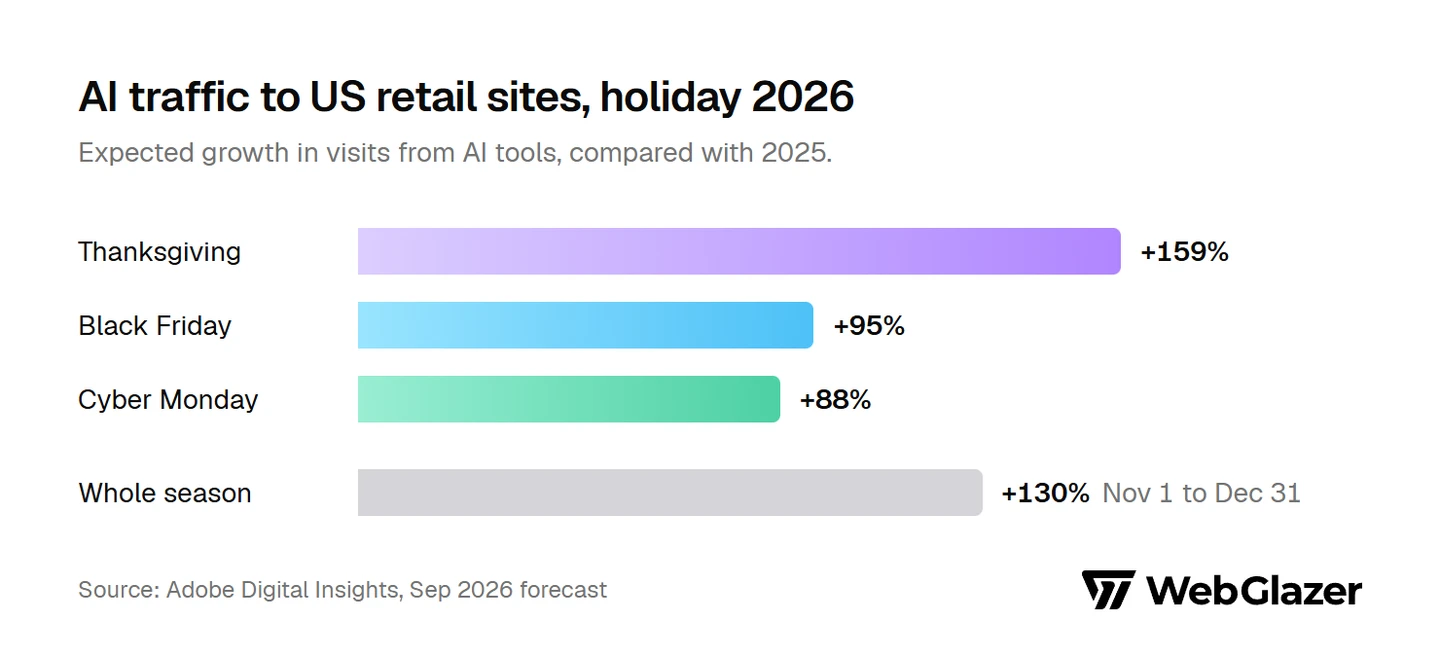
Adobe expects traffic from AI tools to US retail sites to grow 130% this holiday season, and 95% on Black Friday itself. So a Black Friday ecommerce strategy for 2026 has to answer two questions before it gets to discounts. How will shoppers find your products? And when they ask ChatGPT or Google's AI Mode "what should I buy?", is your product in the answer?
This guide covers both, then walks through the parts of BFCM planning that haven't changed: offers that protect your margin, a store that can take the traffic, marketing that reaches existing customers first, and a plan for the second order. There's a dated timeline near the end that starts this week.
Key takeaways
- Start with discovery, not the discount. Adobe expects AI traffic to US retail sites to grow 130% this season, and 95% on Black Friday.
- Check whether AI recommends your products. Ask 15 real buyer questions in ChatGPT, Google AI Mode and Copilot this week and write down what comes back.
- Give AI tools something to recommend. Complete product data, descriptions in your customers' words, visible reviews and a few gift guide mentions do most of the work.
- Pick a discount your margin can carry. On a $60 order with $33 of costs, 25% off means selling 2.25 times as many orders to earn what full price would.
- Plan the second order before the first. Early access for existing customers, honest messages and follow-up timed to the product turn sale buyers into repeat buyers.
What is BFCM, and when is it in 2026?
BFCM stands for Black Friday Cyber Monday, the sale weekend between Thanksgiving and the following Monday. Most brands now treat it as one event rather than two separate days, and Adobe calls the five days from Thanksgiving to Cyber Monday "Cyber Week".
In 2026 the dates are:
- Thanksgiving: Thursday, November 26
- Black Friday: Friday, November 27
- Cyber Monday: Monday, November 30
The money is large and still growing. Here's Adobe's forecast for US online spending, published on September 28:
| $47.5 billion | $12.9 billion | $15.1 billion |
|---|---|---|
| Cyber Week 2026, up 7.4% | Black Friday 2026, up 9.2% | Cyber Monday 2026, up 6.2% |
For the whole holiday season, from November 1 to December 31, Adobe expects $275.1 billion online, up 6.7%. Black Friday is growing faster than Cyber Monday, which Adobe puts down to Black Friday having the deepest discounts on TVs, apparel and appliances.
How did Black Friday 2025 go?
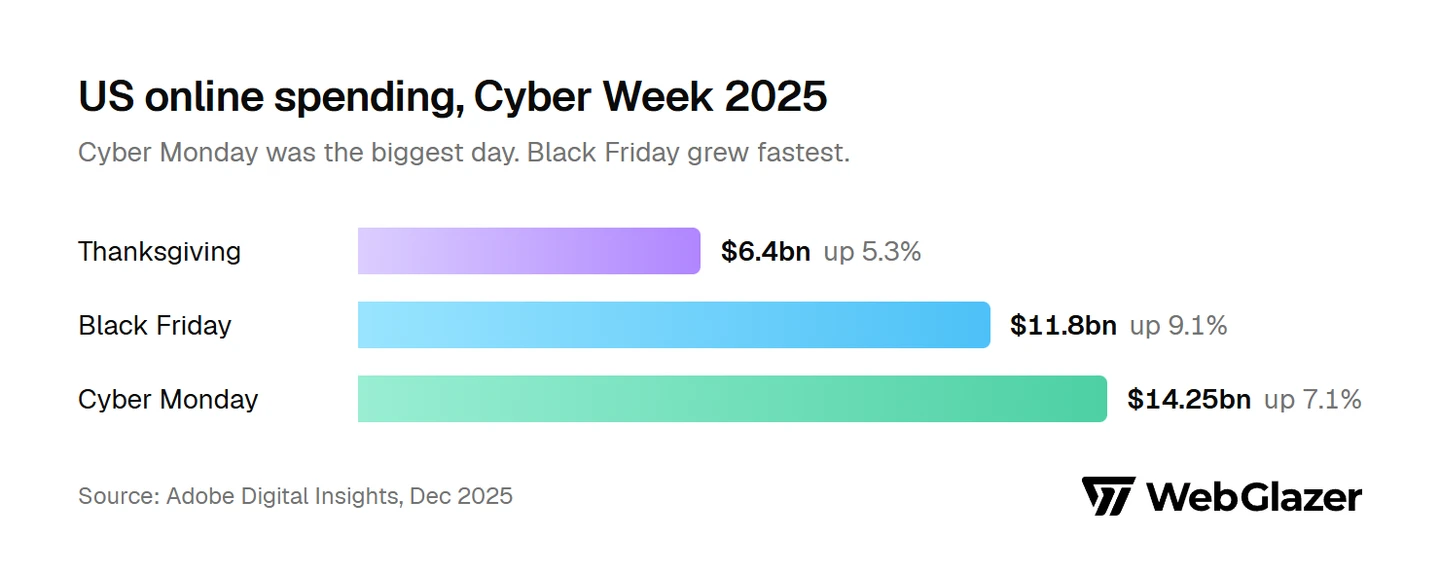
Black Friday 2025 set a record. Adobe counted $44.2 billion in US online spending over Cyber Week, up 7.7%, with Cyber Monday the biggest single day and Black Friday the fastest growing:
Shopify stores had their biggest weekend yet:
| $14.6 billion | 81 million+ | $114.70 |
|---|---|---|
| Sales by Shopify merchants over BFCM 2025, up 27% | Shoppers who bought from Shopify stores | Average cart |
The number we watched most closely was AI. On Cyber Monday 2025, traffic from AI tools to US retail sites was up 670% on the year before, according to Adobe, and up 760% across November. It started from a small base, but it was the fastest-growing way shoppers reached stores last season.
What changed for Black Friday ecommerce this year?
Three things are different in 2026, and only one of them gets much attention.
Shoppers are asking AI what to buy
This is the big one. Adobe forecasts that AI traffic to US retail sites will rise 130% year over year this season, with the sharpest jumps on Thanksgiving (up 159%) and Black Friday (up 95%). In the same research, 77% of people who had used AI for online shopping said it made them more confident in their purchase.
That traffic still starts from a small base, and most shoppers will keep using Google and marketplaces. But the shoppers who do use AI arrive with a short list the AI built for them. If your product isn't on it, you never get a chance to compete on price.
Mobile is now most of the money
Adobe expects 57.4% of holiday online spending to come through phones, and a record 63% on Thanksgiving Day. If your product pages and checkout feel clumsy on a small screen, that's where the losses show up.
Discounts start early and stay flat
Adobe expects discounts to build from up to 14% off in early November to up to 21% just before Thanksgiving, then peak at up to 30% during Cyber Week. The category peaks look a lot like 2025: around 30% for electronics, 29% for toys, 23% for apparel and 18% for furniture. Shoppers will be comparing offers for weeks, which gives the AI tools they ask plenty of time to form an opinion about your products.
What does a BFCM strategy need in 2026?
A good BFCM strategy does three jobs, in this order:
- Get found, so your products show up where shoppers look: Google's results, AI Overviews, ChatGPT, AI Mode, marketplaces and your own channels.
- Get chosen, because the offer, the reviews and the product page give the shopper a reason to buy from you instead of the next result.
- Bring them back, by delivering the first order as promised and making the second one easy.
Most Black Friday plans pour nearly everything into the second job. Getting found gets treated as an ads budget, and bringing people back gets one email in January.
Before any tactics, pick one main goal, because it changes everything that follows. If you don't know which goal you're chasing, you'll end up discounting everything and measuring nothing.
| Your store | Best Black Friday goal | What to watch afterwards |
|---|---|---|
| Products people reorder (coffee, skincare, supplements) | Win new customers on the product they'll buy again | Second-order rate after 60 and 90 days |
| Considered, occasional buys (furniture, jewellery) | Sell profitably to people who already know you | Margin per order and return rate |
| Gift-led products (toys, accessories, homeware) | Be the easy gift pick when people search and ask AI | Gift guide placements, AI recommendations, delivery cut-offs met |
How do shoppers find products on Black Friday now?
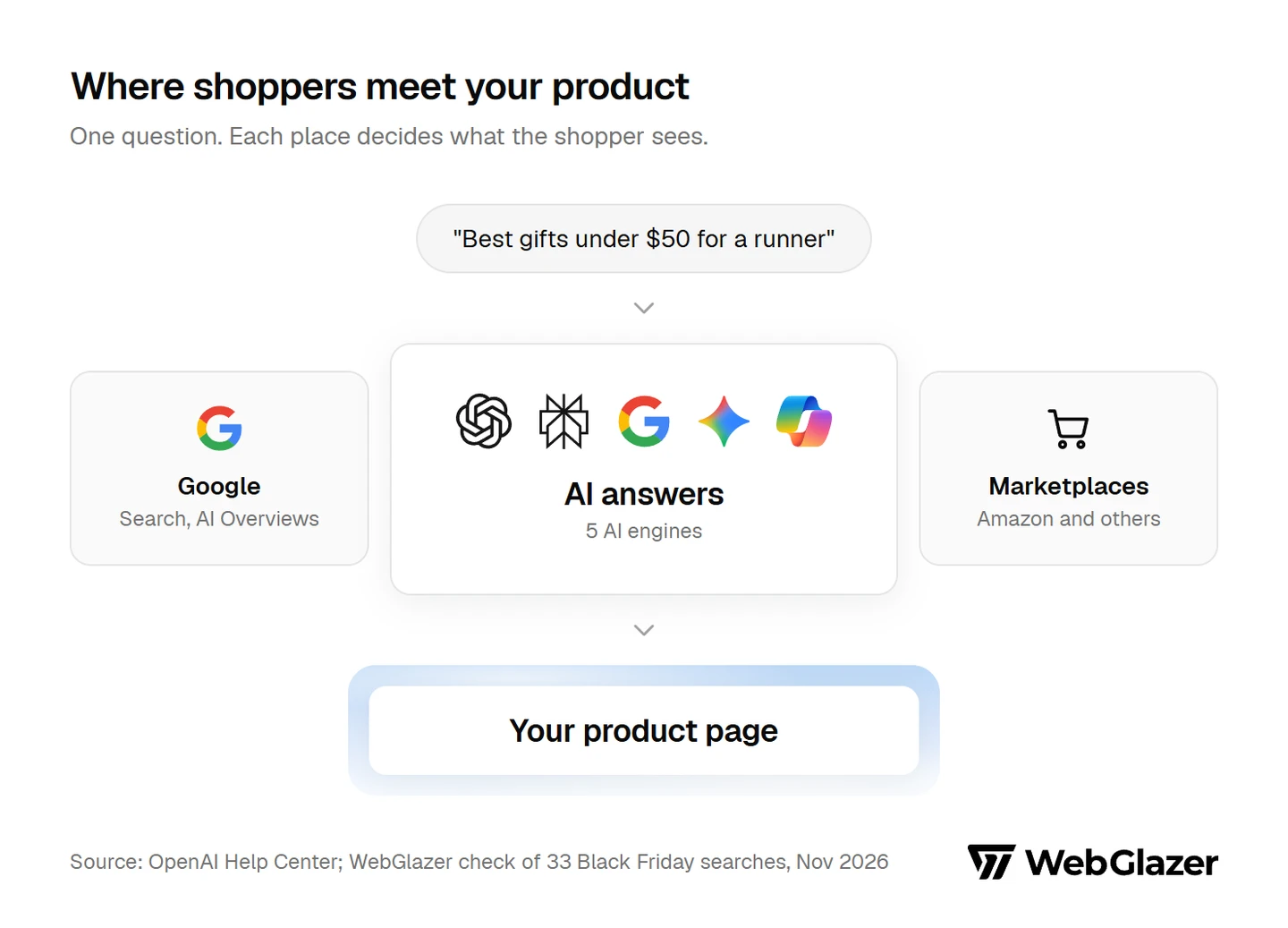
There are now four main ways a shopper meets your product before they reach your site, and each one picks products differently.
Google's regular results and Shopping
Still the biggest source for most stores. Your product pages, category pages and gift guides compete on the usual signals: relevance, page quality, reviews and price data from Google Merchant Center.
Google AI Overviews and AI Mode
For many shopping searches Google now shows an AI summary above the results. When we checked 33 Black Friday searches from a US connection in November, every single one showed an AI Overview at the top. AI Mode goes further and can show product cards with prices. (If you want to watch this for your own searches, we compared the best tools for monitoring AI Overviews.) If the summary already answers "which one should I buy?", fewer shoppers scroll down to the blue links. Our meta-analysis of 641 data points on search found that AI Overviews cut clicks on the queries they answer, even while overall search keeps growing.
ChatGPT and Copilot shopping answers
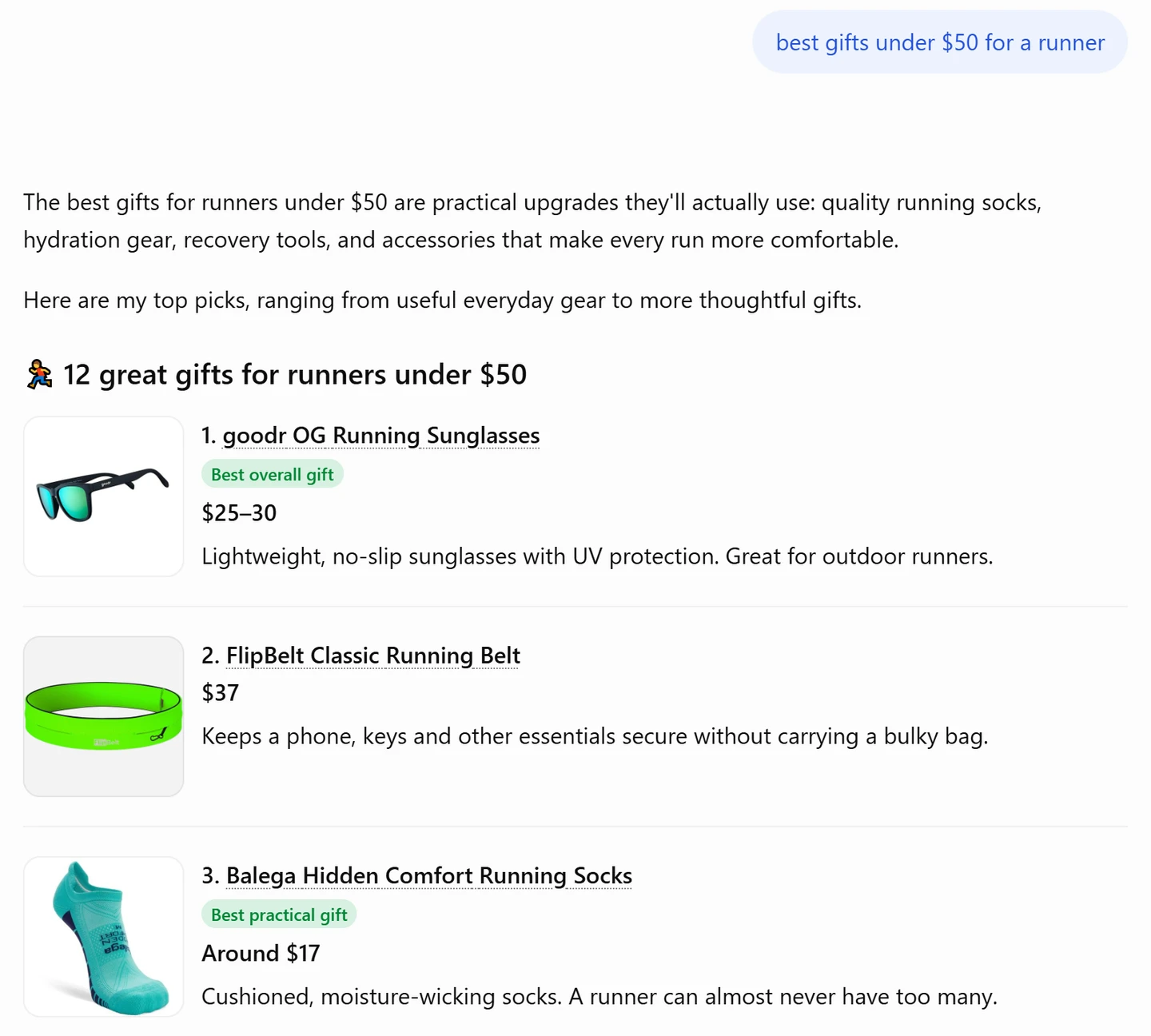
Ask ChatGPT for "the best carry-on suitcase under $200" and it often answers with a carousel of product cards, each with a price, a short summary and links to shops. OpenAI's help center explains how it picks them:
- Products are chosen using structured data from the brand and from third parties, such as price and product description, plus other content from around the web.
- The results are not ads, and OpenAI says partnerships don't influence them.
- When several shops sell the same item, they're ranked on things like availability, price, quality and whether the shop is the maker or main seller.
- Review summaries are written by the model from reviews on public websites.
One detail matters for Shopify stores in particular: OpenAI says Shopify merchants' product data already reaches ChatGPT through Shopify Catalog, without extra work. So your products are probably eligible. Whether they get recommended is a different question.
Marketplaces and social
Amazon, TikTok Shop and the rest still matter, and they run on their own rules. We won't cover them here.
The pattern across the AI tools is simple. They recommend products they can read clear data about and products other people talk about. A great product with a thin page and no reviews outside your own site gives an AI very little to work with. To see how AI engines pick companies at scale, our Baltic AI Visibility Index tracks how ChatGPT, Gemini, Perplexity and Google AI Mode recommend 358 companies.
How do you check whether AI recommends your products?
Start with a manual check. It takes about an hour and it's usually an eye-opener. If you'd rather get a quick first read on your brand, our free AI visibility checker does a short version for you.
Run a 15-prompt test
- Write 15 questions a real buyer would ask. Mix three types: category questions ("best running shoes for wide feet"), gift questions ("gifts under $50 for a runner") and Black Friday questions ("best running shoe deals this Black Friday"). Use your customers' words, not your product names.
- Ask each question in ChatGPT, Google AI Mode and Copilot. Use a private window and a fresh chat each time, so your history doesn't shape the answers. Run each question at least twice: AI answers vary a lot, and a single answer is often misleading.
- Write down what comes back. For each answer note whether your brand appears, which of your products appear, at what price, from which shop, and which competitors show up instead.
- Look for patterns. Which products never show up? Which competitor shows up everywhere? Which shop does the AI send people to for your product, you or a reseller?
Keep the log in a simple table:
| Question | Engine | Your product shown? | Price and shop shown | Competitors shown |
|---|---|---|---|---|
| Gifts under $50 for a runner | ChatGPT | Yes, 3rd of 6 | $45, reseller site | Brand X, Brand Y |
| Gifts under $50 for a runner | AI Mode | No | n/a | Brand X, Brand Z |
| Best running shoes for wide feet | Copilot | Yes, 1st of 4 | $120, your store | Brand Y |
Expect to be surprised. Brands often find that their best seller is invisible while a minor product shows up because a gift guide on another site mentions it.
What we found when we asked 40 times
We ran this test ourselves on November 3, 2026: 20 Black Friday running-gear questions (7 category, 6 gift and 7 deal questions), each asked once in ChatGPT and once in Google AI Mode, from a US connection in a private window.
| ChatGPT | Google AI Mode | |
|---|---|---|
| Answers that named specific branded products | 12 of 20 | 11 of 20 |
| Category questions ("best running socks") | 7 of 7 | 5 of 7 |
| Gift questions ("gifts for marathon runners") | 3 of 6 | 4 of 6 |
| Black Friday deal questions | 2 of 7 | 2 of 7 |
| Different brands named | 26 | 31 |
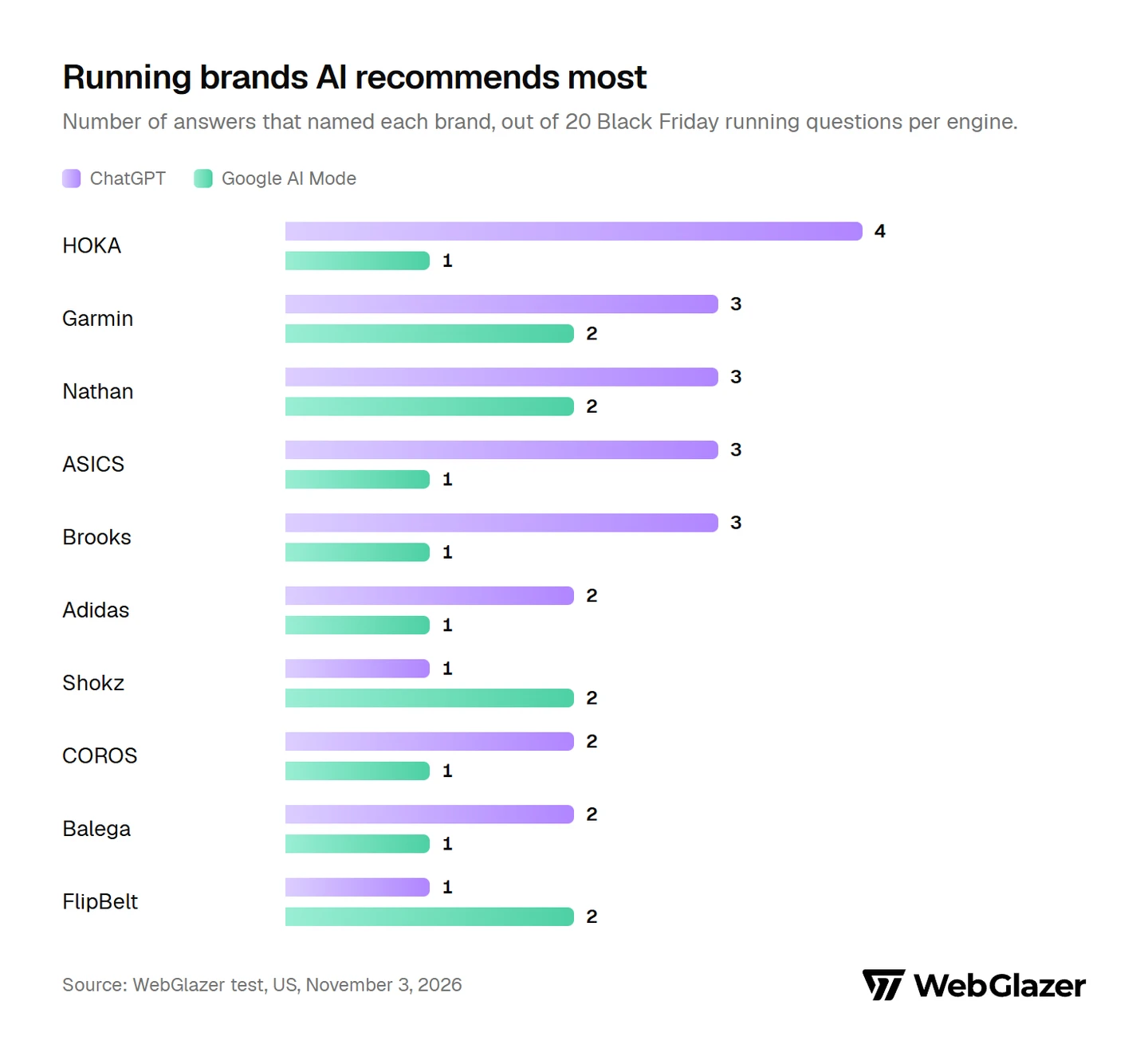
Three things stood out:
- Deal questions rarely produce products. Asked about Black Friday deals, both engines mostly gave general advice. Products got recommended when shoppers asked category and gift questions, so that's where your products need to show up before the sale.
- The two engines barely agree. Of the 42 brands named, only 15 appeared in both. Being recommended by ChatGPT tells you little about Google AI Mode.
- Resellers often get the click. In Google AI Mode, 25 of 46 product cards sent shoppers to a reseller instead of the brand's own store.
AI answers change from one run to the next, so treat this as a snapshot, not a ranking.
WebGlazer Products
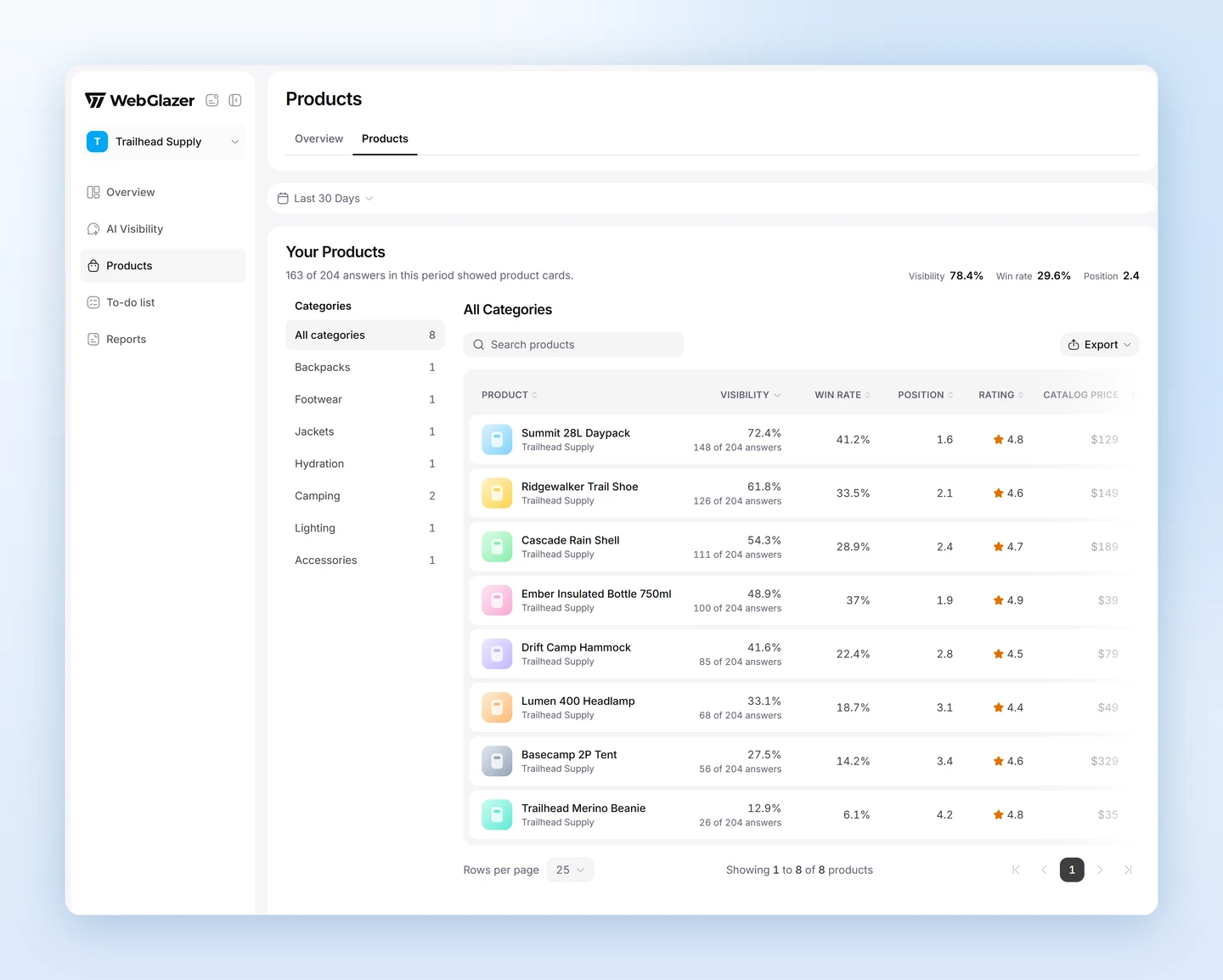
A manual test gives you a snapshot. AI answers change from day to day, though, and they'll shift a lot through November as Black Friday content goes up across the web. We built WebGlazer Products to track that for you.
You connect your Shopify store with its URL, with no app to install, and we import up to 1,000 products. WebGlazer then reads the product cards in ChatGPT, Copilot and Google AI Mode answers to the questions your buyers ask, matches them to your catalog, and shows how often each product gets recommended.
Here's how you can use WebGlazer Products before Black Friday:
- See which of your products AI recommends, and which ones it never mentions, across ChatGPT, Copilot and Google AI Mode.
- Check the price and the shop the AI showed for each product, so you catch a reseller or an outdated price before shoppers do.
- See which other brands show up in the same answers, so you know who you're up against for each buyer question.
- Watch the numbers move week by week as you fix product pages and land gift guide mentions, then compare before, during and after the sale.
That turns "are we in AI answers?" into a number per product.
See which of your products AI recommends
Connect your Shopify store and track your products across ChatGPT, Copilot and Google AI Mode.
Start your 7-day trialHow do you get more of your products into AI answers before Black Friday?
Nobody can promise you a spot in an AI answer, and you should be wary of anyone who does. What you can do is give the AI tools more and better information to work with. With about three weeks left, focus on the products that matter most for your sale.
Make your product data complete
OpenAI says ChatGPT uses structured product data like price and description. Google uses your Merchant Center feed and your page markup. So fill in the boring fields properly: a clear product title, brand, price, availability, size and colour options, materials and GTIN where you have one. Check that the price on your page matches the price in your feed. A mismatch confuses shoppers and AI tools alike. Checks like these are easy to automate; here's what you can safely automate in SEO.
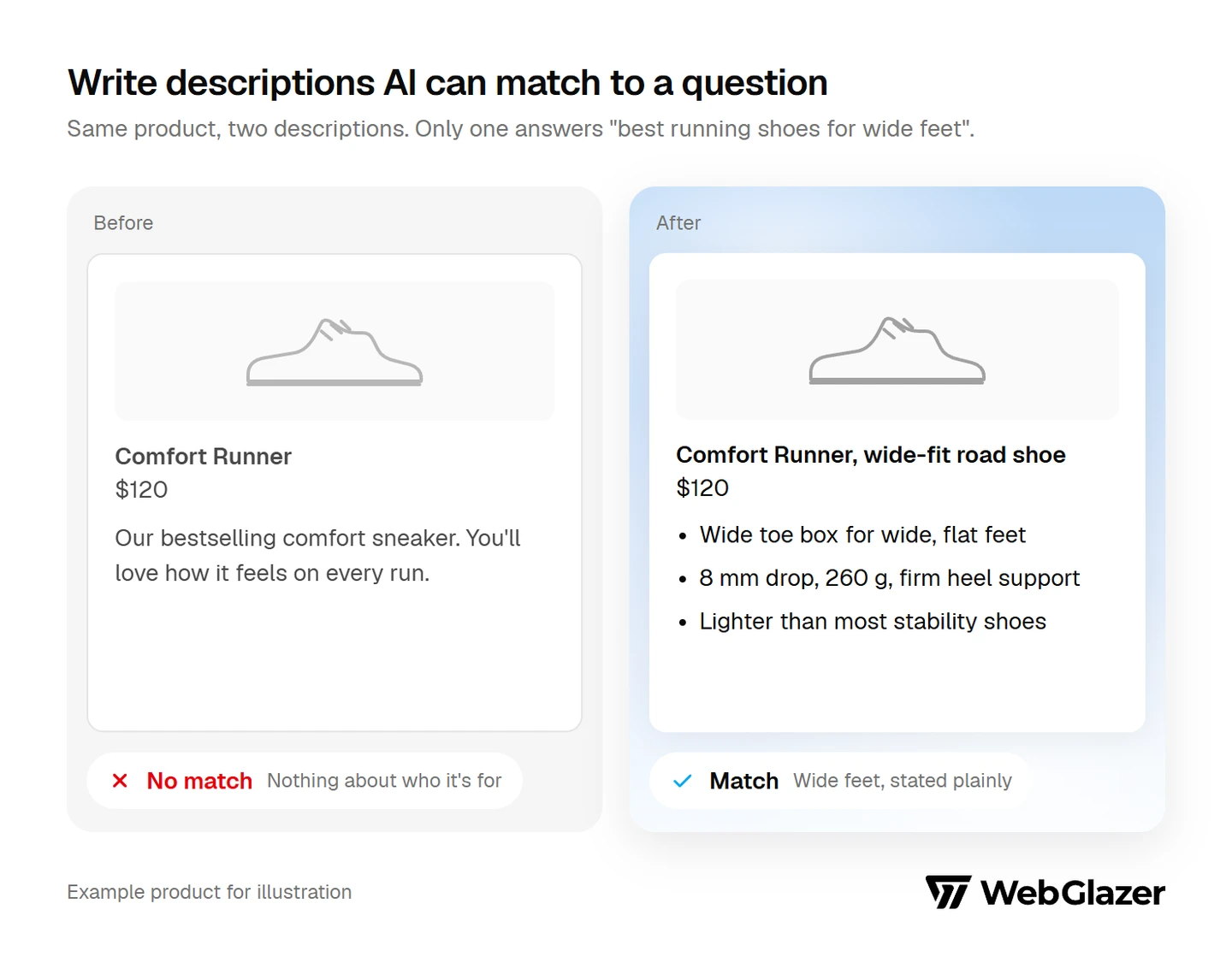
Write descriptions that answer buyer questions
AI tools match products to questions. A description that only says "our bestselling comfort sneaker" gives them nothing to match. One that says who it's for, what problem it solves and how it compares ("wide toe box, good for flat feet, 8 mm drop, lighter than most trail shoes") gives them plenty. Write the way your customers ask. Your reviews and support tickets will tell you the words they use.
Get reviews, and get them seen
ChatGPT builds its review summaries from public websites. Make sure your reviews are on the product page as text, not loaded in a way that's hard to read, and that your products have reviews on the other sites where your category gets discussed.
Get mentioned by other people
This is the slowest lever, and for many brands the strongest. Gift guides, "best of" lists, comparison articles and forum threads are what AI tools read when they decide what's worth recommending. Two or three good placements in November gift guides can do more for your AI visibility than another round of page edits. Note that this is about being mentioned and recommended, not about link counts: when we tested 355 companies, referring domains didn't separate the companies AI names from the ones it ignores. Run your 15-prompt test again and look at which sites the AI cites (here's how to track the sources an AI engine cites). Those are the sites worth pitching.
Publish your own gift guide
Shoppers search for gift guides in November, and AI tools read them. Build a few on your own site around how people actually shop: by price ("gifts under $50"), by person ("gifts for runners") and by occasion. Give each product a sentence on who it's for, keep prices and stock current, and publish by mid-November so Google and the AI tools have time to find them. Then link each guide from your homepage and your emails, so shoppers who arrive from anywhere can find the easy picks.
Keep price and stock accurate everywhere
OpenAI ranks shops partly on availability and price. If a reseller lists your product in stock at a better price while your own page shows "sold out", the AI will send the shopper there. Check your top products across the shops that carry them.
Don't block the crawlers
Check that your robots.txt and any bot protection don't block the crawlers AI tools use to read your site. We wrote up which bots are worth letting in and which you can safely block. It's a common mistake after a security change, and it's invisible until you look.
WebGlazer gap analysis
Knowing what to fix first is the hard part, especially with three weeks to go. WebGlazer compares your brand with your competitors on the same buyer questions and turns the difference into a to-do list.
Here's how you can use it for Black Friday:
- Find the questions where a competitor gets recommended and you don't, so you fix the gaps that cost you sales first.
- See which websites AI engines cite in your category, which gives you a ready-made list of gift guides and review sites to pitch.
- Get a prioritized list of fixes, and let WebGlazer's AI agent draft the content changes for you to review and approve.
How deep should your Black Friday discount be?
The right discount is the deepest one your order economics can carry after marketing costs. For many brands that's shallower than the headline numbers shoppers see. Here's where Adobe expects discounts to peak this season:
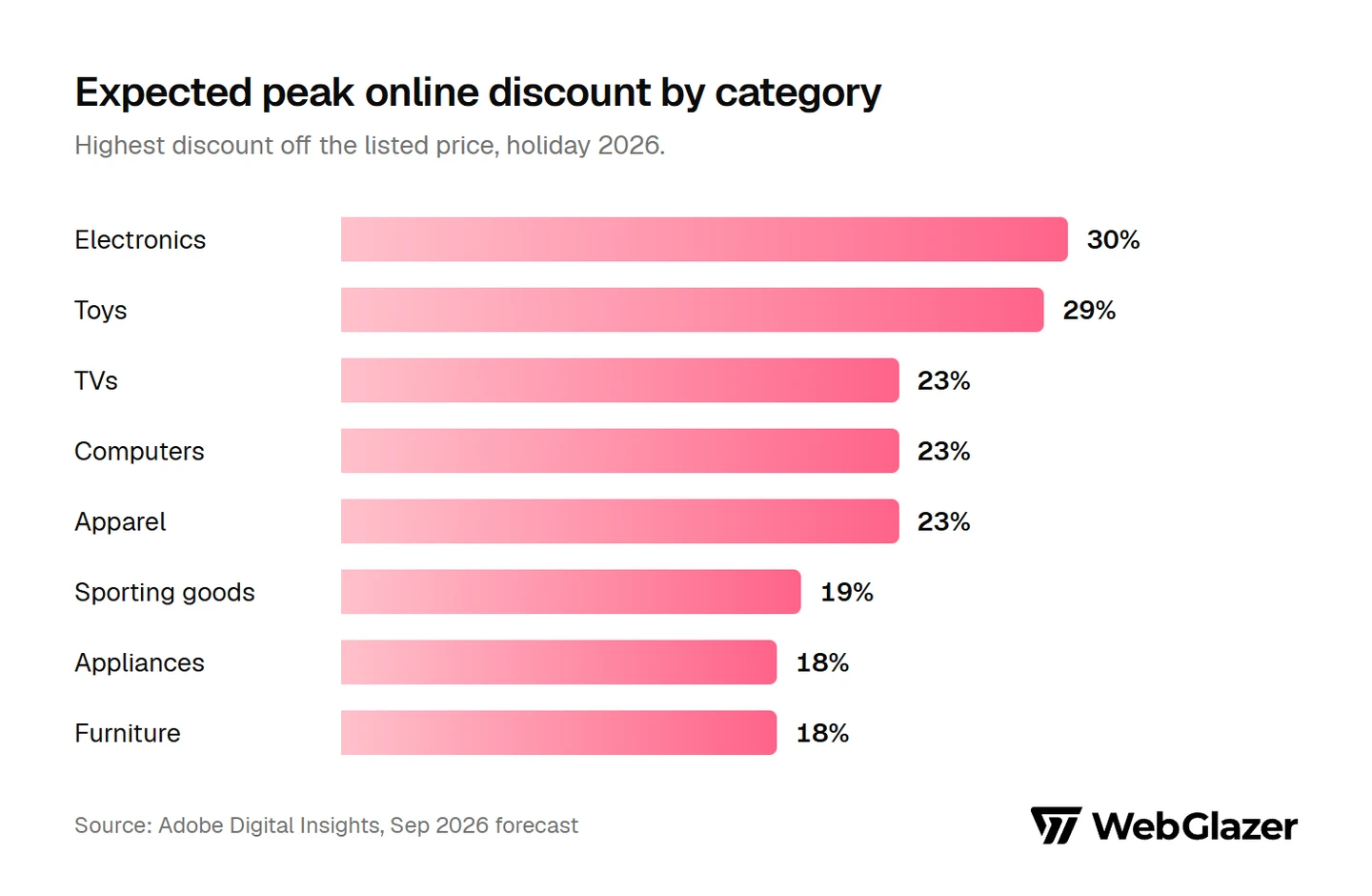
Do the maths on one typical order before you pick a number. Here's an example with a $60 product, where the product, shipping, packaging and payment fees cost $33 per order:
| Full price | 15% off | 25% off | |
|---|---|---|---|
| Revenue | $60 | $51 | $45 |
| Costs per order | $33 | $33 | $33 |
| Left over before marketing | $27 | $18 | $12 |
| Orders needed to match full price | 1x | 1.5x | 2.25x |
Going from 15% to 25% off doesn't feel like much to a shopper. For this store it means selling 2.25 times as many orders just to stand still, before you pay for a single ad.
Some alternatives protect your margin better:
- A spend threshold ("15% off orders over $80") that lifts order value
- A free gift or upgrade above a threshold instead of a bigger discount
- Bundles that pair a discounted item with a full-price one
- Early access for existing customers instead of a deeper public discount
Whatever you choose, keep the terms clear. Shoppers should know which items qualify, whether offers stack and when the sale ends, and that information should match on the product page, in the cart, in your emails and in your product feed.
Which products should lead your sale?
Lead with products that are likely to bring a second order, such as consumables that run out, items with refills or accessories, and starter products from a wider range. A first order that naturally leads to a second one is worth far more than a one-off.
Then add a discovery filter. Your 15-prompt test will show which products AI tools already recommend. A product that's already showing up in AI answers and has a strong margin is a natural lead for your sale, because some of the work of getting found is already done. A product you love that never appears might need the fixes from the previous section before you put ad money behind it.
Is your store ready for the traffic?
A campaign that works creates a lot of demand very quickly. The store and the warehouse have to keep up, because a slow page or a late first order is a poor start with a new customer.
Place test orders on a phone
Place test orders using the offers, payment methods and delivery options your customers will see. Check discount codes, gift cards, address entry and the order confirmation email. With 57.4% of holiday spending expected on mobile, do most of this on a phone.
Check stock by variant, not by product
A healthy total stock count can hide shortages in the sizes and colours people want. Check each variant you're promoting, include inbound deliveries, and decide in advance what happens when something sells out: which emails stop, which ads pause and what the product page suggests instead.
Brief the people behind the store
Tell your warehouse or fulfilment partner how many orders you expect and what they'll look like. Gift bundles take longer to pack than single items. Give customer support a short sheet with the offer terms, delivery cut-off dates and answers to the questions you know are coming.
BFCM marketing: what goes out, and when?
Good BFCM marketing does two things: existing customers hear first, and every channel has a clear job.
Give existing customers early access
Your past customers are the cheapest sales you'll make in November. Give them a short early-access window before the public sale, by email and SMS if they've signed up for it. It rewards loyalty, spreads orders out and protects your margin, since you can offer early access instead of a deeper discount.
Reward your loyalty members
If you run a loyalty program, November is when it pays for itself. Give members something the public sale doesn't have: an earlier start, a member-only bundle, or extra points on orders placed during the sale weekend. It gives shoppers a reason to join before Black Friday, and it lets you reward your best customers without cutting the public discount deeper.
Give each channel one job
Email explains the offer and shows a selection of products. SMS and push messages flag a deadline or an early-access window, and should be short. Social posts build anticipation in the weeks before. After someone buys, every message should change from selling to helping. Plan all of these on one calendar so a customer doesn't get five messages on the same day.
Build and test ads before the rush
Have your creative, audiences and landing pages built and tested by mid-November, so you know what converts before Cyber Week, when every other store is bidding for the same shoppers. Start with people who already know you, and be careful about assuming a Black Friday customer is worth as much as one who buys at full price.
Use real urgency, not fake countdowns
Urgency works when it's true. A sale that really ends at midnight on Cyber Monday, a member window that closes on Wednesday, a bundle you only made 500 of: say so plainly and stick to it. Fake countdown timers that reset on every visit and "only 2 left" badges on items with full stock backfire. Shoppers notice, and price and stock that don't match across shops also confuse the AI tools that compare them.
Keep cart reminders honest
Abandoned cart emails should show the current price and stock and stop once the sale ends. Avoid sending an extra discount automatically just because someone left a cart, or you train your customers to wait.
How do you turn Black Friday buyers into repeat customers?
The weekend is the easy part. Six months later you find out whether the customers you paid to win come back.
Start by making the first order go well. Send delivery updates people can trust, and follow up with something useful for the product, such as setup, care, sizing or how to use a bundle together, timed around when it arrives.
Treat gift buyers differently. The person who paid often isn't the person who'll use the product, so keep gift buyers out of refill reminders until they buy for themselves. Asking "is this a gift?" at checkout makes this easy.
Then ask for the second order at the right moment: near the refill date for consumables, or with a real reason to shop again for fashion and home products. Asking before the first product has even been used just feels pushy.
Your Black Friday 2026 timeline, starting this week
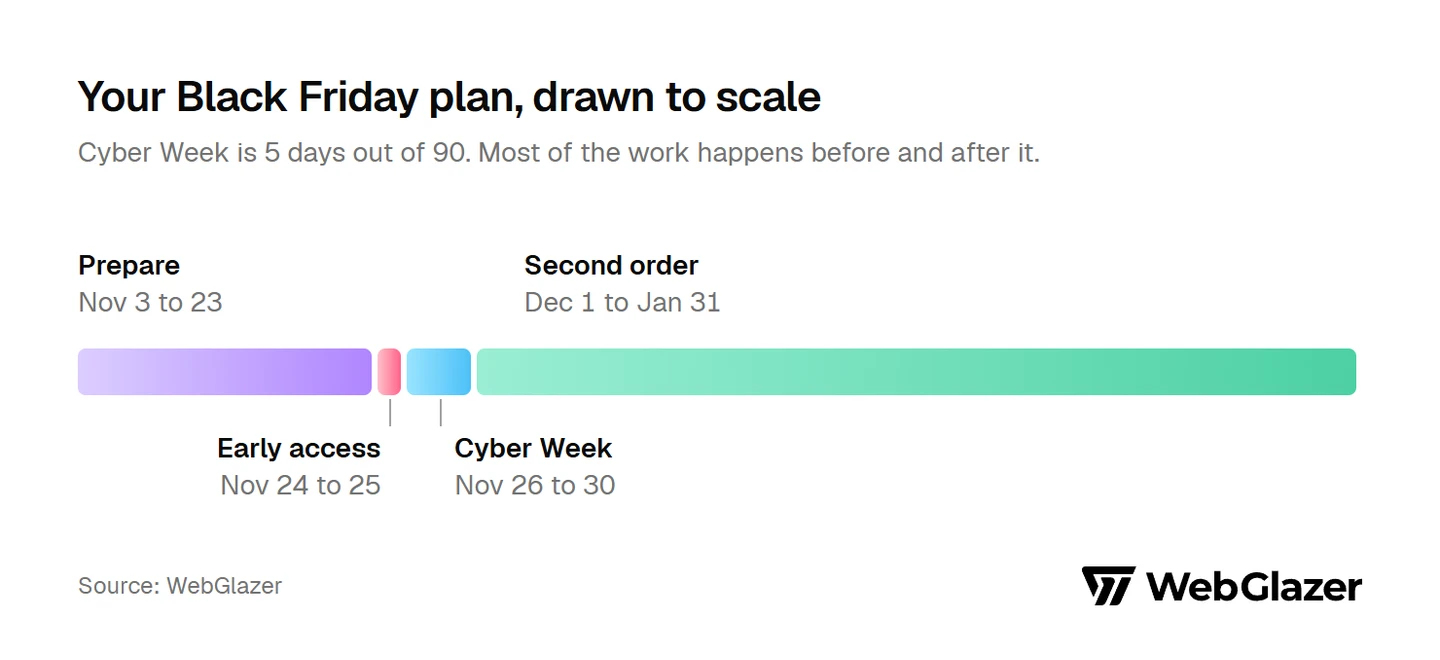
If you're reading this in early November, you have about three weeks. Here's how we'd use them:
| Dates | Focus |
|---|---|
| Nov 3 to 9 | Pick your goal. Run the 15-prompt AI test. Set discounts from your order maths. Check stock by variant. |
| Nov 10 to 16 | Fix product data and descriptions for your lead products. Pitch gift guides. Build emails, segments and the early-access list. Build and test ads. |
| Nov 17 to 23 | Place test orders on mobile. Brief the warehouse and support. Publish your gift guide. Re-run the AI test to see what moved. |
| Nov 24 to 25 | Early access for existing customers. Final checks on price and stock across every shop that sells your products. |
| Nov 26 to 30 | Cyber Week. Watch stock, pause ads on sold-out items, keep messages accurate. |
| Dec 1 to Jan | Post-purchase follow-up, gift-buyer handling, second-order offers. Check AI visibility again after the season. |
How do you measure Black Friday success?
Judge Black Friday on what it left you with, not on the weekend's revenue. Track net sales after returns, money left over after marketing, what each new customer cost you, and how fulfilment held up.
Then follow the customers you won. Compare their second-order rate after 60 days, 90 days and six months with customers you won at other times of year.
Add one new measure this year: how often AI tools recommended your products before and after your November changes. If this is new to you, start with what LLM visibility is and how to measure it, and read what an AI visibility score does and doesn't tell you before you report one to your team. If your lead products went from rarely mentioned to regularly recommended, you'll still have that in January, when the discounts are gone.
Final thoughts on your Black Friday ecommerce strategy
The Black Friday basics haven't changed. You still need an offer you can afford, a store that holds up under pressure and a plan for the second order. What's changed is the first step. More shoppers now meet your product inside an answer that an AI wrote, and you don't get to buy your way into that answer.
The work itself is concrete. Check which questions you show up for, fix the product data and descriptions, get mentioned by the sites AI tools read, and measure it. Three weeks is enough to make a real difference for your lead products.
Where do your products stand before November 27?
Connect your Shopify store and see which of your products ChatGPT, Copilot and Google AI Mode recommend, and which ones they skip.
Start your 7-day trialRelated reading
- LLM visibility: what it is and how to measure it
- AI visibility audit: how many prompts you actually need
- Do backlinks still matter in AI search? 355 companies tested
Sources
- Adobe, "U.S. Holiday Shopping Season to Hit Record $275.1 Billion Online, Rising 6.7% YoY", 28 Sep 2026: https://news.adobe.com/news/2026/09/adobe-us-holiday-shopping-season-to-hit-record
- Adobe, Cyber Monday 2025 and Cyber Week results, Dec 2025: https://news.adobe.com/news/2025/12/adobe-cyber-monday-hits-record
- Shopify, BFCM 2025 data: https://www.shopify.com/news/bfcm-data-2025
- OpenAI Help Center, "Shopping with ChatGPT search": https://help.openai.com/en/articles/11128490
- WebGlazer SERP check of 33 Black Friday searches, US, 3 Nov 2026 (internal)