From the WebGlazer blog ·  Martins Mozga · October 13, 2026 · 16 min read
Do backlinks still matter in AI search? We joined SEO data to 20,200 AI answers
We pulled domain rating, backlinks, traffic and brand search data for 355 Baltic companies and matched it against how often ChatGPT, Gemini, Perplexity and Google AI name them. Link counts alone predict almost nothing. Where the links point matters more.
We pulled domain rating, backlinks, organic traffic and brand search volume for 355 Baltic companies and matched them against how often ChatGPT, Gemini, Perplexity and Google AI name each one. Link counts on their own predict almost nothing. Which domain the links point at predicts a lot.
Three things worth knowing
Referring domains do not separate the invisible from the visible
The 56 companies no engine ever named have a median of 694 referring domains. The 196 named reliably have 950. That difference is statistical noise (p = 0.42).
On your own national domain, authority tracks visibility closely
The strongest quarter by domain rank is named in 55% of its category's answers, and not one of those 53 companies was invisible.
On an international domain the same authority buys nothing locally
Median domain rank is identical to the national-domain group, yet 28.4% of those companies were never named once.
In August 2026 we ran the Baltic AI Visibility Index: 2,530 unbranded buying questions, four engines, four languages, two waves, 25,932 answers about the 358 largest companies in Latvia, Lithuania and Estonia. It told us who AI names. It did not tell us why.
So in October we bought the missing half. For every tracked company we pulled four external measures from DataForSEO: domain rank (a 0 to 1000 referring-domain-weighted authority score, the same family of metric as Moz's Domain Authority or Ahrefs' Domain Rating), the raw count of referring domains and backlinks, estimated organic search traffic in the home country, and monthly search volume for the company's own brand name. Then we joined them, company by company, to 20,200 buying answers.
Company size confounds all of this, so every correlation below is reported with revenue held constant.
Do backlinks still matter?
Not the way the question is usually asked.
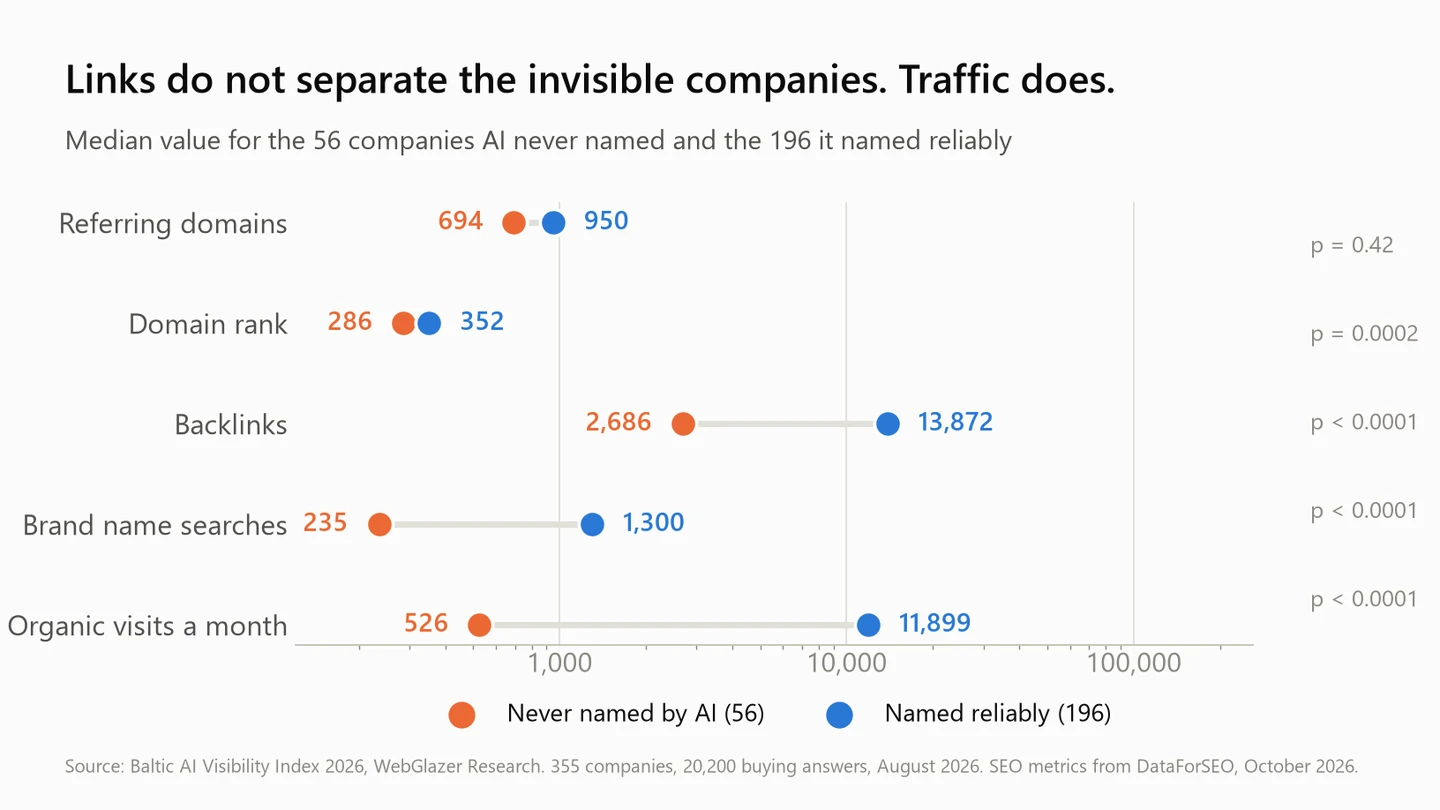
Across all 355 companies, the count of referring domains is the weakest of the four measures we tested, and on its own it fails completely at the thing it is supposed to be good at. Split the companies into the 56 that no engine ever named in their own category and the 196 named in at least 15% of their answers, and the link counts barely move: 694 against 950 referring domains, p = 0.42. You could not tell the two groups apart from that number.
Everything else does separate them. Organic search traffic is the strongest single predictor in the whole dataset (partial rho = 0.52). Brand name searches come next (0.29), then domain rank (0.28), then referring domains (0.20). Spam score runs the other way, as you would expect.
Read that ordering carefully, because it is a demand signal beating a supply signal. Traffic and brand searches measure how many people already want this company. Referring domains measure how many pages point at it. When an assistant has to pick three names out of a category, the first kind of signal wins.
Domain authority only works on your own domain
Then we split the sample by something nobody usually looks at, and the picture sharpened.
Of the 355 companies, 212 answer on their country's own domain (rimi.lv, telia.ee, ignitis.lt). 102 sit on an international domain: scania.com, hostinger.com, epam.com, veriff.com. The remaining 41 share a domain with another company in the study, like the four Tallink entities on tallink.com.
| Where the company answers | Companies | Median domain rank | Median referring domains | Named in | Never named |
|---|---|---|---|---|---|
| Its own national domain | 212 | 312 | 326 | 34.7% | 9.4% |
| An international domain | 102 | 315 | 1,422 | 15.4% | 28.4% |
| A domain shared with a sibling | 41 | 411 | 1,384 | 38.1% | 17.1% |
The two big groups have the same median domain rank. The international group has four times the referring domains. It is named less than half as often and is three times as likely to be invisible.
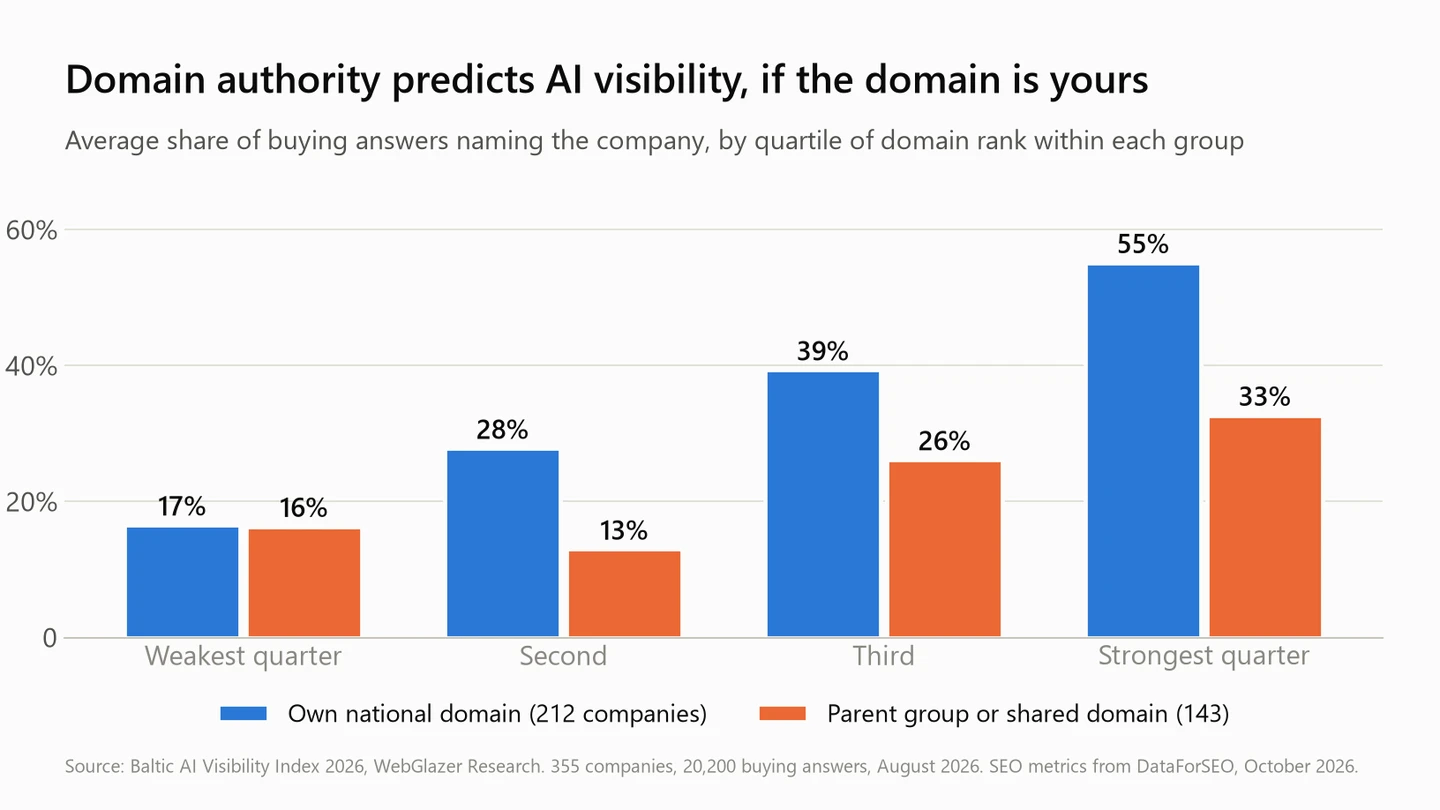
Inside the national-domain group, authority does what the textbook says it should. Mention rate climbs from 17% in the weakest quarter to 55% in the strongest, and invisibility falls from 17% to zero. Not one of the 53 companies in the top authority quartile of their own national domain was missed by every engine. Referring domains, the metric that failed on the pooled sample, is the strongest link metric here (partial rho = 0.47).
Inside the international-domain group, the gradient is flat. The weakest quarter is named in 13% of answers and the strongest in 20%, and better than a fifth of the strongest quarter is never named at all. The correlation between domain rank and visibility in that group is 0.13, which is close enough to nothing.
Part of that gap is composition, and we should say so plainly. Companies on a .com are disproportionately exporters, contract manufacturers and local arms of multinationals, and a Lithuanian buyer asking which supplier to use is less likely to be asking about them in the first place. But composition is not the whole story. In the 30 category cells that contain both kinds of company, the national-domain companies averaged 26.0% against 14.2%, and were ahead in 23 of the 30 cells (paired Wilcoxon p = 0.0013).
Strong domains that AI never named
The clearest way to see it is one company at a time.
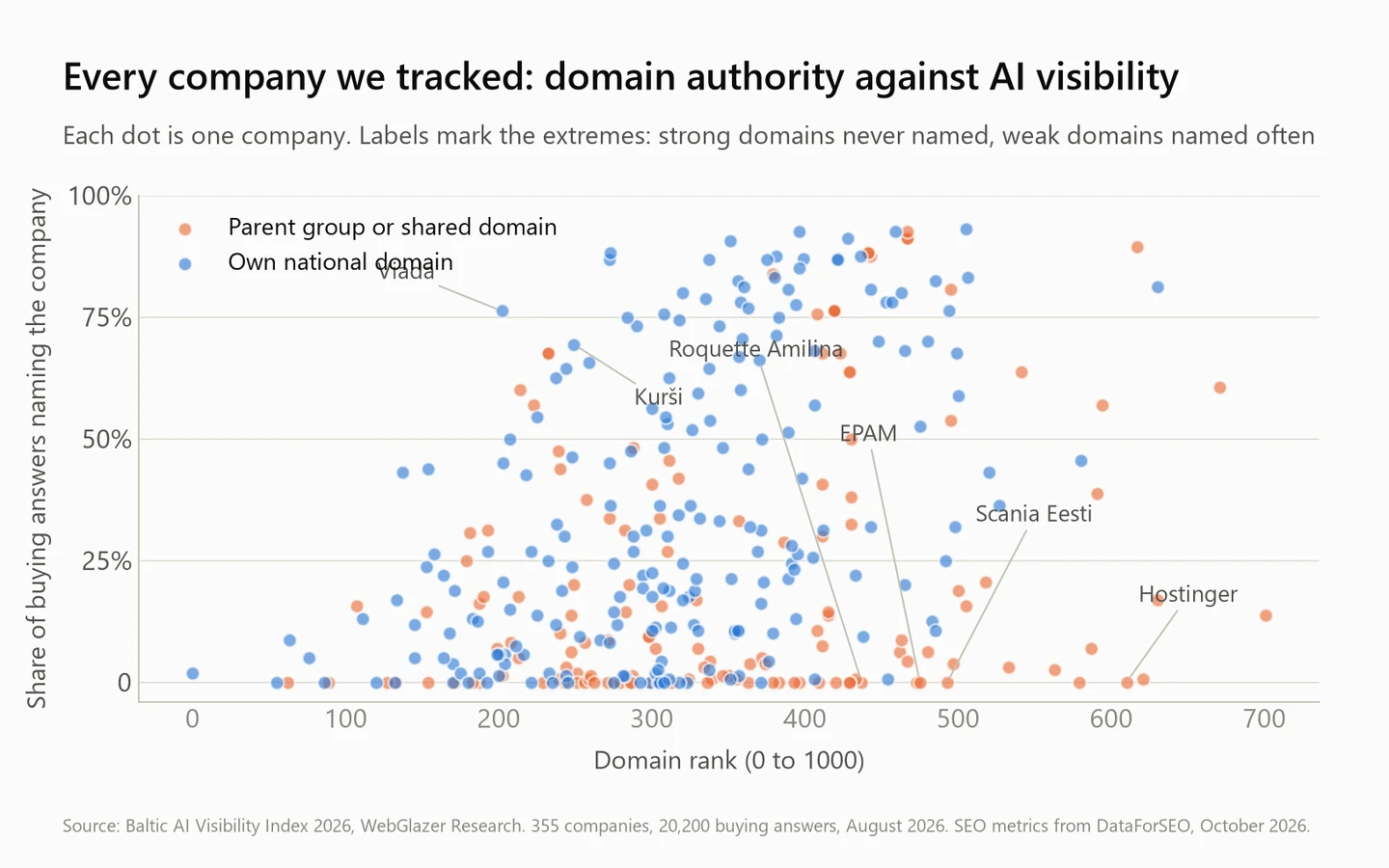
| Company | Domain | Domain rank | Referring domains | Named in |
|---|---|---|---|---|
| Hostinger | hostinger.com | 610 | 118,129 | 0 of 160 |
| Nortal Capacity Services | nortal.com | 579 | 3,189 | 0 of 160 |
| Scania Eesti | scania.com | 493 | 15,043 | 0 of 160 |
| EPAM Sistemos | epam.com | 475 | 12,197 | 0 of 160 |
| Roquette Amilina | roquette.com | 437 | 3,061 | 0 of 160 |
| Veriff | veriff.com | 420 | 7,570 | 0 of 160 |
Hostinger is the extreme case. The domain has a rank of 610 and 118,129 referring domains, which is more authority than almost any Baltic company will ever accumulate, and it was not named once in 160 Lithuanian IT services answers. The authority is real. It was earned as a global hosting brand, and it does not transfer to a question about which IT services company a Lithuanian business should hire. Veriff and EPAM have the same shape of problem.
Now the other direction. These companies are near the bottom of the authority range and near the top of their category.
| Company | Domain | Domain rank | Referring domains | Named in |
|---|---|---|---|---|
| Viada Baltija | viada.lv | 202 | 287 | 76.3% |
| Kurši | kursi.lv | 249 | 785 | 69.4% |
| Tolmets | tolmets.lv | 232 | 368 | 67.5% |
| Laflora | laflora.lv | 244 | 159 | 64.4% |
| Elektrum Eesti | elektrum.ee | 237 | 278 | 62.5% |
Viada has 287 referring domains. Hostinger has four hundred times more. In their own categories, Viada is named in three quarters of the answers and Hostinger in none.
What actually predicts being named
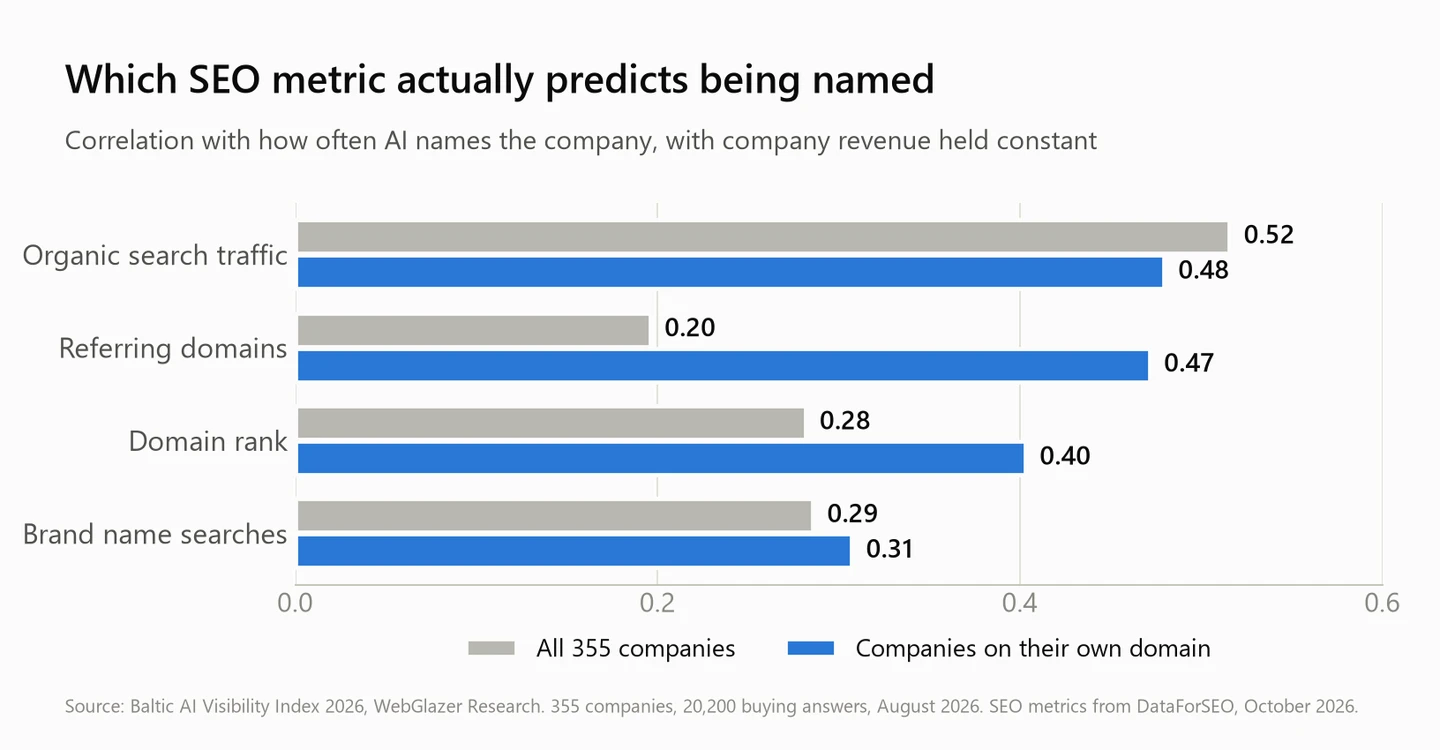
With real covariates in hand we could finally run the model the original study refused to run for lack of them. It predicts the probability that a company is never named, from domain rank, brand search volume, organic traffic and revenue, on the 212 companies with their own national domain. Each standard deviation of domain rank cuts the odds of invisibility by 60% (odds ratio 0.40, p = 0.022), each standard deviation of brand search volume by 63% (0.37, p = 0.005), and revenue by 48% (0.52, p = 0.048). Organic traffic stops being significant once domain rank is in the model, which is the two of them measuring overlapping things rather than traffic not mattering.
On the full mixed sample the same model loses the domain rank effect entirely (p = 0.44). Authority that is not attached to the entity and the market being asked about does not register.
The number we keep coming back to is what the model does not explain. Pseudo R-squared is 0.220 on the clean subset. Size, authority and brand demand together account for about a fifth of the variation in who gets named. The other four fifths sit in category fit, how the company is described on pages it does not own, and the ordinary randomness of generated answers, which we wrote up in one check is not an AI visibility audit.
What survives once you control for traffic
Added 19 October 2026. We went back over this layer with two further tests. Both sharpen the result above rather than overturning it, and one of them retires a finding we had been close to publishing.
The first test adds organic traffic as a second control, alongside revenue, and extends the metric set to eight by adding raw backlink count and the number of keywords a site ranks for. The reason to control traffic needs stating carefully, because it is easy to misread. Links cause rankings and rankings cause traffic, so traffic is not a confounder here, it is the thing links work through. Controlling it asks a narrower question: does this metric tell you anything that traffic has not already told you?
| Metric | Predicts AI mentions | Still predicts once you know traffic |
|---|---|---|
| Organic keywords ranked | +0.53 | +0.17 |
| Organic traffic | +0.52 | it is the control |
| Backlinks, raw count | +0.32 | +0.10, not significant |
| Domain rank | +0.29 | +0.04, not significant |
| Brand search volume | +0.28 | +0.15 |
| Referring domains | +0.19 | +0.04, not significant |
| Spam score | -0.20 | -0.10, not significant |
For every link metric the answer is no. Domain rank goes from +0.29 to +0.04, referring domains from +0.19 to +0.04, raw backlink count from +0.32 to +0.10. None of those survive. That is not links failing to matter. It is links mattering through rankings, and rankings being what the assistant is reading. For diagnosis it means the authority score is a worse version of a number you already have.
Two metrics carry signal of their own. Keyword coverage, the count of queries a site ranks for at all, is the strongest thing in the whole dataset and it holds at +0.17. Breadth of ranking appears to count in its own right, not only for the traffic it brings. Brand search volume holds at +0.15, and it is the one input on the list that is not downstream of your own site.
One number here is weaker than it looks. Referring domains clears the usual significance test on its total effect, but once we resample by industry the interval runs from -0.00 to +0.37. Even before the traffic control we cannot say confidently that referring domains predicts anything.
Does that contradict the model above?
It looked like it for a day, so we re-ran the model to find out. It does not, and the reason is the sample.
The logistic model earlier in this post already had organic traffic in it. On the 212 companies with their own national domain, domain rank still cuts the odds of never being named by 60% (odds ratio 0.40, p = 0.022) with traffic, brand search volume and revenue all in the model. That stands. What the model did not have was keyword coverage, and putting it in makes the estimates unstable rather than clearer: traffic and keyword coverage correlate at 0.88 across those companies and only 20 of them were never named, so the two cannot be separated at that sample size.
The continuous version of the same test is the more honest evidence, and it shows why the pooled table and the model disagree. Inside the own-domain group, authority starts far higher than it does pooled, and it fades without disappearing.
| Metric, own-national-domain companies only | Controlling revenue | Also controlling traffic |
|---|---|---|
| Organic keywords ranked | +0.50 | +0.17 |
| Referring domains | +0.49 | +0.17 |
| Domain rank | +0.41 | +0.12, not significant |
| Brand search volume | +0.30 | +0.12, not significant |
So the two results are the same result seen at two zoom levels. Where the domain belongs to the company being asked about, links keep a small independent association with being named. Pooled across all 355, including the 102 whose authority sits on an international domain, that association is gone. Which is the point this post made from the beginning, now with a tighter bound on how much the links themselves are worth.
One correction to our own published paper, while we are here. Section 3.11 reports domain rank at +0.28 as a predictor of AI visibility. That figure is right for what it measures, a correlation with company size held constant, but it is a total effect and we did not say so clearly enough. With traffic also controlled it is +0.04 and indistinguishable from zero. The paper has been updated.
And one finding dropped. We had measured that the more of a company's third-party coverage consists of company-register and directory records, the less often AI names it, from a 45% mention rate in the least registry-dependent quarter of companies down to 17.8% in the most, surviving a revenue control at -0.26. It does not survive the controls that actually measure online presence: -0.17 adding brand search volume, -0.13 adding organic traffic, -0.08 and not significant adding both. We were measuring the same thing twice, because “most of what exists about you is your company registration” and “AI rarely names you” are both descriptions of being obscure online. So it is not a finding, and we are saying so here rather than quietly dropping it.
The pages AI actually cites have almost no backlinks
The second test looks at authority from the other end: not the company's domain, but the pages the engines quote when they answer.
The dataset holds 220,735 citations. We took the pages cited when we asked each engine directly about a company, dropped every citation pointing at that company's own website, and were left with 24,444 distinct third-party pages. We sampled 300, weighted so the dominant sources and the long tail were both represented, and pulled page-level link data.
Twenty-nine of the 300 had any detected backlinks. That is 9.7%, with a confidence interval of 6.8% to 13.5%, and only nine of the 300 cleared a page link rank of 100.
What the engines were quoting looks like ssb.ee/en/11411278-TERE-AS/liabilities-debts-court, rekvizitai.vz.lt/en/company/baltisches_haus/report/ and firmas.lv/lv/uznemumi/bsw/40203093734. Company register records, directory profiles, credit-report subpages. Nobody links to them and the engines cite them constantly.
We checked the two obvious objections. Many cited URLs are localised duplicates like uk.trustpilot.com or glassdoor.ie whose canonical versions might hold the links, so we pulled the canonical form of fifteen of them: two gained links, moving the headline from 9.7% to 10.3%. And if link authority drove retrieval, then among the pages that did get cited, the heavily cited ones should be the linked ones. They are not. Page link rank against citation count comes out at +0.11, and against the number of distinct engines citing a page at +0.08, neither significant.
Two limits on that, both ours to own. “No backlinks detected” means a crawler found none, which is not the same as proof there are none. And this is a sample of pages that were cited, so it cannot tell you that authority has no influence on retrieval, only that it is nearly absent among the pages the engines picked and does not separate the heavily cited from the barely cited. The stronger claim would need comparable pages that were not cited, drawn from each engine's own retrieval rather than from Google's index. We tried to approximate that with live Google results and abandoned it, because current Google rankings turned out to be a poor stand-in for what four engines retrieved two months earlier.
So how do you rank in ChatGPT
Nothing here says to stop building links. It says the link is a means, and the thing it has to produce is a page that answers the buyer's question on a domain tied to the entity being asked about.
Put the local entity on a domain that answers for it
If your Baltic company lives on a global group domain, the group's authority is not working for you in local buying answers. A country page that is thin, redirected or absent is the most expensive version of this problem, and 28.4% of the companies in that position were never named.
Treat brand search volume as a visibility input, not a vanity metric
It was the second strongest predictor in the pooled data and it survived in the model alongside authority. People searching for you by name is evidence an assistant can use. Links are not.
Spend on pages that earn traffic rather than on the count of domains pointing at you
Organic traffic beat every link metric. A referring domain that sends nobody is doing less for you than a page people actually read.
Check whether your category question has anything to do with what your domain is famous for
Hostinger ranks for hosting, not for IT services in Lithuania. If the gap between those two things is where your buyers are, no amount of domain rank closes it.
How this fits with the other studies
Our result is a correlation inside one region at one point in time, so it is worth lining up against the larger published work.
Google's own guidance says conventional fundamentals still apply, because its generative features use core ranking systems and the Search index, and pages have to be indexable and eligible for normal snippets to show up in them. That matches what we found on national domains, where authority and traffic track visibility cleanly.
The gap opens on how far rank carries. Ahrefs analysed 15,000 prompts and found only about 12% of the URLs cited by ChatGPT, Gemini and Copilot also appeared in Google's top ten for the same prompt, with Perplexity higher at 28.6%. BrightEdge, measuring a different thing, put the overlap between AI Overview citations and organic rankings at 54.5% in September 2025. Those two numbers are not in conflict, they are answers to different questions, and neither is the same as our question, which is about brands named rather than pages cited. PageTraffic's 2026 ecommerce test is the closest to ours: using 162 shopping questions across three engines, it reported that 53% of Baltic store domains ranking on Google's page one never appeared in an AI answer.
The common thread across all four is the one we would stand behind: search performance is the foundation AI answers are built on, and it is not a substitute for measuring whether you get named. For the longer argument about where search as a technology is heading, we wrote that up in is SEO dead.
How we measured it
The visibility half comes from the Baltic AI Visibility Index 2026. 358 companies drawn from the official business registers of all three countries, placed in 49 plain industry categories, each asked about with ten unbranded buying questions in English and the local language, on ChatGPT, Google AI answers, Gemini and Perplexity, twice a week apart. That is 160 answers per company and 20,200 buying answers in total. Name matching was validated against hand-labelled samples at 96.0% precision.
The SEO half was pulled from DataForSEO in October 2026 for the 355 companies with a scored category and a working domain. Domain rank is a 0 to 1000 referring-domain-weighted authority score. Organic traffic is an estimate for the company's home country. Brand search volume is Google Ads exact monthly volume for the company's own name, cleaned of legal forms. Correlations are Spearman rank correlations, partialled on log revenue by the rank-residual method, because revenue correlates with everything here.
Three limits travel with this. The SEO metrics were collected two months after the answers, so a company that changed materially in between is mismeasured. Domain rank, referring domains and traffic are third-party crawler estimates rather than ground truth. And none of this is causal: a well-known company attracts links, traffic and AI mentions at the same time, so what we have identified is which measurable signals accompany visibility, not which actions produce it.
The joined dataset is published as supplementary file S18 in the full research report, and every company's own numbers, including the five SEO columns, are in the company lookup file.
How to cite: WebGlazer Research (2026). Baltic AI Visibility Index 2026, SEO authority supplement.
Does your domain authority translate into AI answers?
WebGlazer runs your buyers' real questions across ChatGPT, Gemini, Perplexity and Google AI every week, and shows which sources the answers were built from.
Start freeFrequently asked questions
Do backlinks still matter in AI search?
Indirectly. In our data the raw count of referring domains did not separate the companies AI never named from the ones it named reliably (median 694 against 950, p = 0.42). On a company's own national domain, where links are actually pointing at the entity being asked about, referring domains became the strongest link metric we measured (partial rho = 0.47). Links matter when they produce traffic and brand recognition for the specific company and market in the question.
Does domain authority matter for AI search?
It depends whose domain it is. Among 212 companies on their own national domain, the strongest authority quartile was named in 55% of relevant answers and none of them was ever invisible. Among 102 companies on an international domain, with the same median domain rank, the gradient was flat and 28.4% were never named.
What is a good domain authority?
There is no universal threshold, and our data argues against chasing one. The companies named most often in their own category sat anywhere from a domain rank of 202 to over 600. Compare yourself with the other companies in your category rather than with a global score, because that is the comparison an AI answer is actually making.
Domain rating vs domain authority: which should I use?
They are competing third-party estimates of the same idea, link-weighted site authority, from Ahrefs and Moz respectively. We used DataForSEO's domain rank, which is the same family of metric on a 0 to 1000 scale. For the purpose in this article it makes little difference. All of them measure links, and links were the weakest of the four signals we tested.
What are the ranking factors for AI search?
Nobody can give you a confirmed list, and anyone who does is guessing. What we can report is which measurable signals accompany being named, with company size held constant: organic search traffic first, brand name searches second, domain authority third, raw link counts last. Together they explain about a fifth of the variation, so most of what decides who gets named lies elsewhere.
How do I check whether AI names my company?
If you are one of the 358 companies in the study, the company lookup file has your row, including your visibility band, your rank in your category, your per-engine results and now your SEO metrics. If not, ask the buying questions your customers would ask, without your brand name, on each engine and in each language, and repeat them. A single check is unreliable, for reasons set out in our AI visibility audit article.
Should I still build links if I want AI visibility?
Yes, but not as a direct lever on AI answers. In our data every link metric stops predicting AI mentions once you account for the organic traffic a site already has: domain rank falls from +0.29 to +0.04, referring domains from +0.19 to +0.04. That makes links redundant rather than irrelevant, because they work through rankings and rankings are what the assistants read. Keyword coverage and brand search volume were the two measures that still predicted visibility independently, so the better framing is to build links that earn rankings across many queries rather than to accumulate referring domains as a target in itself.