From the WebGlazer blog ·  Martins Mozga · October 13, 2026 · 10 min read
AI visibility audit: one check gets the answer wrong 56% of the time
We resampled 56,800 measured AI answers to see how wrong a short visibility check can be. One answer puts a company in the wrong band 56% of the time. Here is what an audit has to do instead.
We took 56,800 measured AI answers and resampled them to find out how wrong a short visibility check can be. Checking one answer puts a company in the wrong visibility band 56% of the time. Here is what it takes to get a number you can act on.
Three things worth knowing
One answer gets the verdict wrong more often than not
Check a single buying answer and you land in the wrong visibility band 56.6% of the time. Half the companies that are genuinely visible read as a flat zero.
Forty answers brings that to 13.1%
The error does not fall off a cliff somewhere convenient. It falls as the square root of the sample, which is the whole problem with screenshot audits.
A one-engine audit is a different study
Of the companies named by at least one engine, 27.7% are missing entirely from another, and the median company is named 2.6 times more often on its best engine than its worst.
Most AI visibility audits we see are a person opening ChatGPT, typing one question and screenshotting the answer. Sometimes it is a tool doing the same thing once a month. We can now say precisely how much that is worth, because we have a dataset where the right answer is known.
In August 2026 we ran the Baltic AI Visibility Index: 2,530 unbranded buying questions put to ChatGPT, Google AI answers, Gemini and Perplexity, in four languages, twice, about the 358 largest companies in Latvia, Lithuania and Estonia. Each company ended up with exactly 160 relevant answers, 56,800 company-answer observations in total. That gives every company a reference rate measured over 160 tries.
So we could do the experiment that short audits cannot do on themselves. Draw k answers at random, compute the visibility rate you would have reported from just those, and compare it with the rate over all 160. Six hundred draws per company, every company, for k from 1 to 80.
What an AI visibility audit is actually measuring
Worth being precise about the quantity first, because a lot of confusion comes from skipping this.
AI visibility is not a rank and it is not a score the engine holds about you. It is a probability. Ask the same unbranded buying question twice and you can get two different shortlists, because the engine runs its own background searches and generates fresh text each time. What you are estimating is how often your company appears when a buyer asks a question like this one, on this engine, in this language, this week.
That framing decides everything else. A probability needs a sample size, an interval and a date, the same way a poll does. A screenshot is a sample of one.
One answer is a coin flip
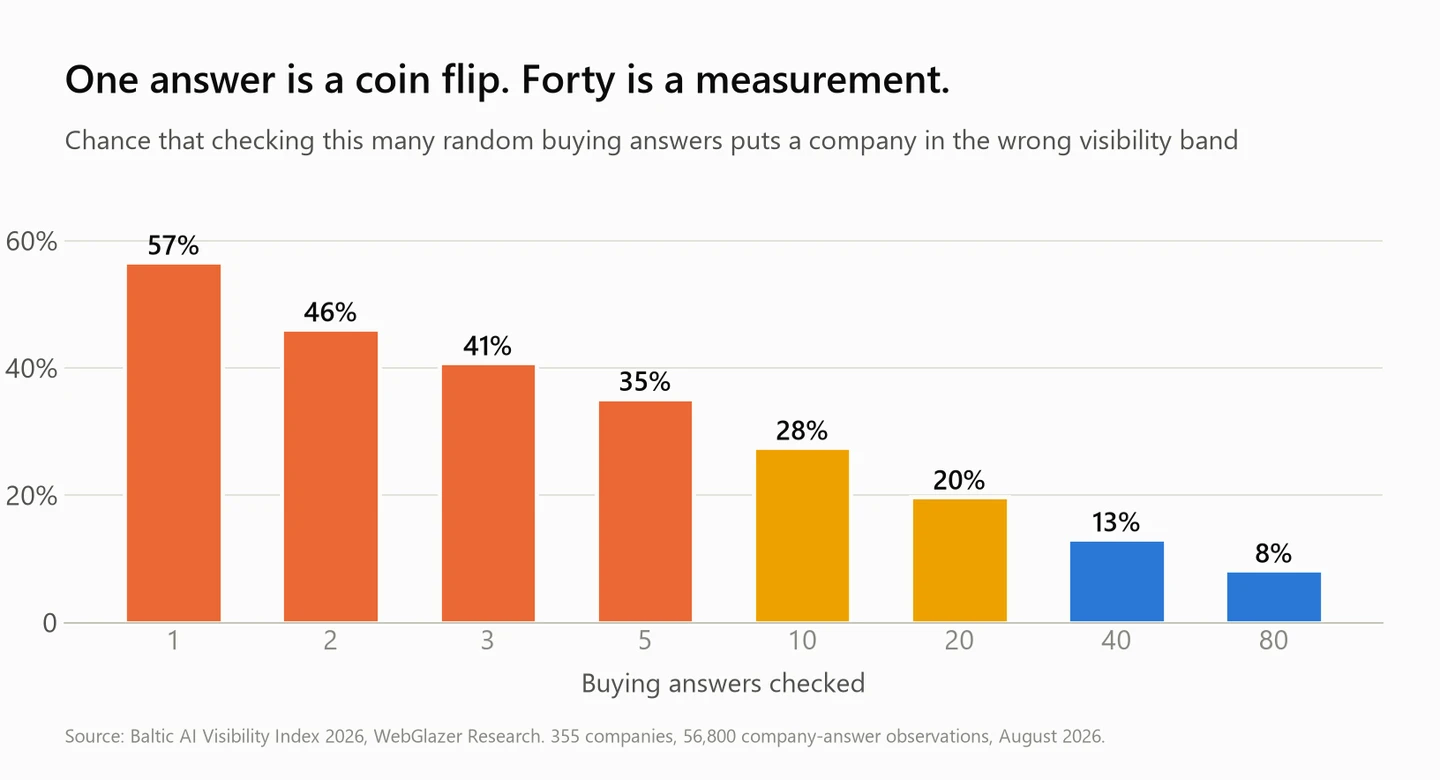
Here is the full curve. Wrong band means the check puts the company in a different visibility band than its 160-answer rate does, using the study's own bands of never named, weak and visible.
| Answers checked | Average error | Chance a visible company reads as zero | Chance of the wrong band |
|---|---|---|---|
| 1 | 24.2 points | 50.0% | 56.6% |
| 3 | 14.1 points | 21.3% | 40.8% |
| 5 | 10.9 points | 11.3% | 35.2% |
| 10 | 7.7 points | 3.2% | 27.5% |
| 20 | 5.4 points | 0.3% | 19.7% |
| 40 | 3.8 points | 0.0% | 13.1% |
| 80 | 2.7 points | 0.0% | 8.2% |
The first row is the one to sit with. A single answer is off by 24 percentage points on average, and for half of the companies that are genuinely visible in their category it returns a zero. Not a low number, a zero, the result that makes a marketing team believe AI has never heard of them.
Three answers, which is roughly what a careful manual check looks like, still gets the band wrong two times in five. Ten answers gets you an average error of 7.7 points, which is finally smaller than the gap between most competitors in a category. Forty gets you to 3.8.
There is no clever shortcut hiding in there. The error falls as the square root of the sample, so halving it costs four times the answers. That is the arithmetic every AI visibility tracking setup is up against, including ours.
If that sounds like a lot of typing, it is, and it is the part of an audit worth handing to a machine. It is why we put a free AI visibility checker on the site. You give it your website, it works out the buyer questions for your category and runs them across the engines, then shows how often you were named and which competitors came up instead. No account, nothing to install.
The rule it saves you from breaking is the one this whole article is about. Do not judge your visibility on one answer. Ten is the floor, forty is where you can report a number with a straight face.
What this looks like for one company
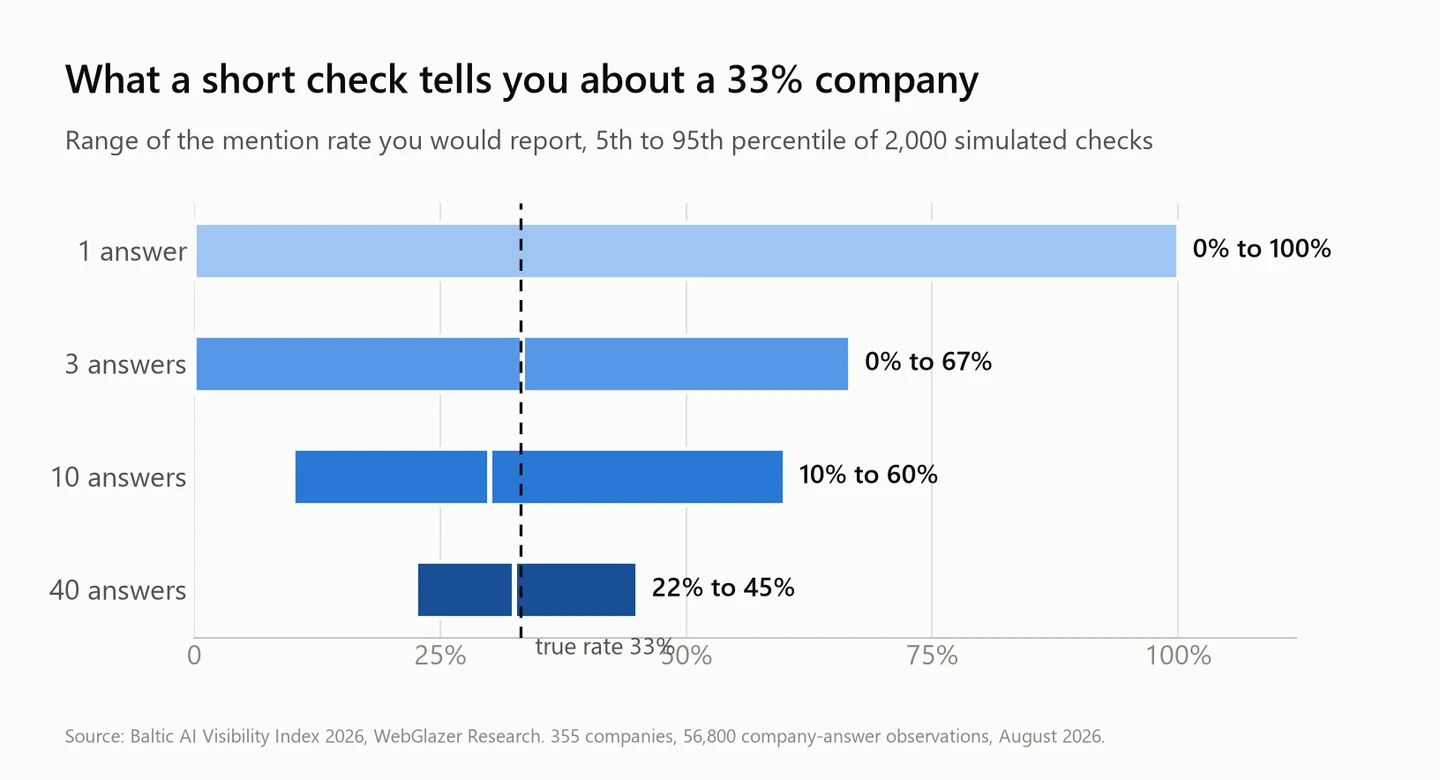
Take a real company from the study, named in 33% of the answers in its category. That is a decent middling position, the kind where a bit more work moves you up the shortlist.
Check one answer and the number you report is either 0% or 100%. Check three and the 90% range runs from 0% to 67%. Check ten and it runs from 10% to 60%, which is wide enough to contain both we have a problem and we are doing fine. Only at 40 answers does the range tighten to 22% to 45%, where you can say something true about the company.
Now imagine running that one-answer check in January and again in March, and reading the difference as a trend.
One engine is not the market
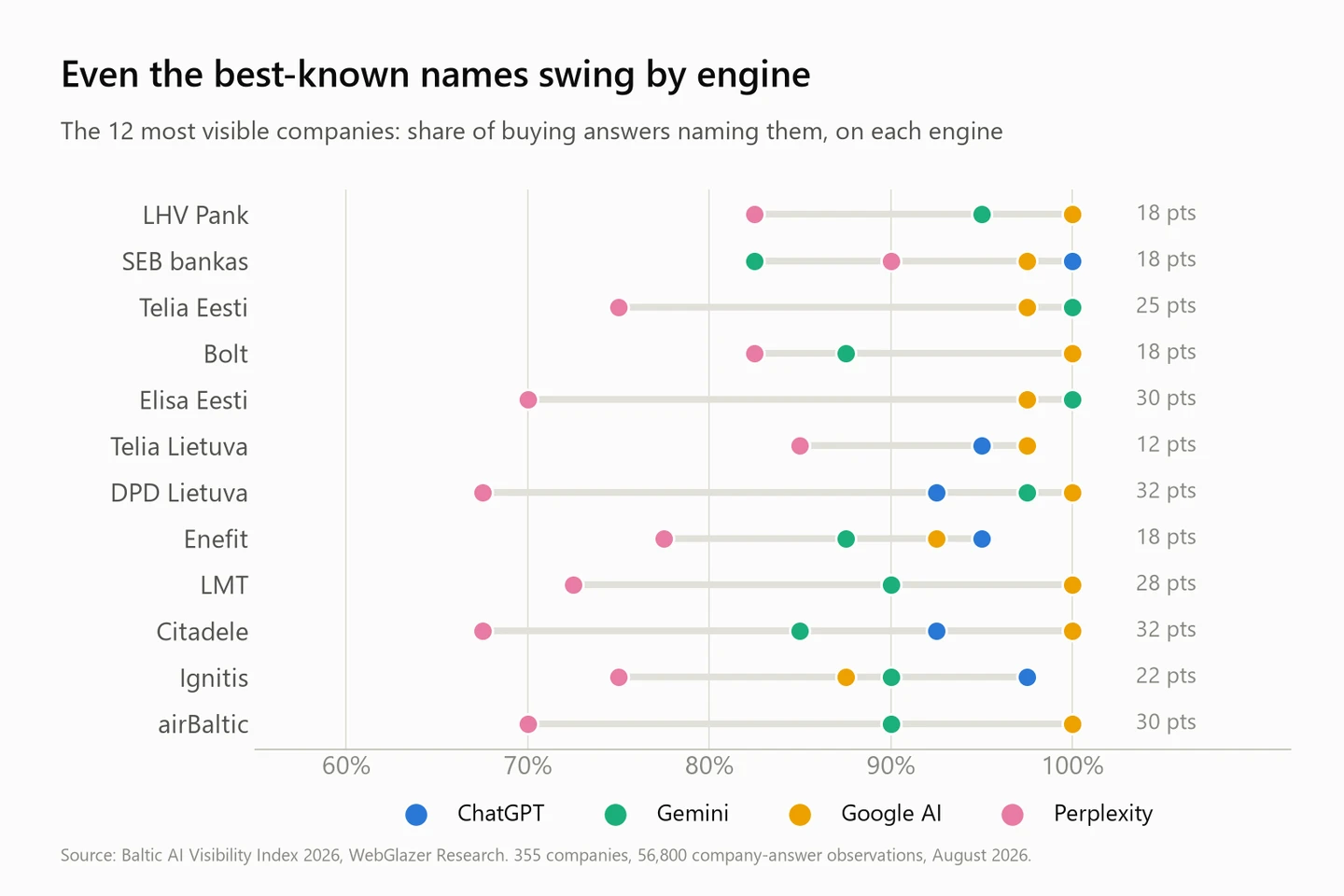
The second way a short audit goes wrong is by checking one place. Across our dataset, the average company's best engine and worst engine are 22 percentage points apart, and the median company is named 2.6 times more often on its best engine than on its worst. Of the 300 companies named at least once, 27.7% are completely absent on at least one engine.
That holds even at the top. Among the 12 most visible companies in the whole study, the smallest spread between engines is 12 points and the largest is 32.
There is a nuance worth keeping, because the simple version of this claim is overstated. Engines broadly agree about who is strong: company-level rates correlate between 0.83 and 0.95 across the four. What they disagree about is any particular answer. On a single question asked the same day, the overlap in the names two engines return runs between 0.14 and 0.23. For Google AI against Perplexity, 60% of questions produced two lists with no name in common.
Other datasets land in the same place from different directions. Agenzy analysed 187,810 answers across 91 European projects and reported a median 5.1-fold gap between a brand's strongest and weakest engine, with 30% of brands visible somewhere absent from at least one engine, which is close to our 27.7%. Ahrefs, looking at cited URLs rather than named brands across 15,000 prompts, found only about 12% of assistant citations also appeared in Google's top ten. PageTraffic's repeated ecommerce runs found an average brand-set overlap of 0.65 between runs of the same prompt.
None of those measure quite the same thing as each other, and they should not be averaged together. They agree on the conclusion that matters for an audit: performance on one engine does not stand in for performance on another, and per-engine reporting is not a nice-to-have.
Language, and the three different numbers people call visibility
Query language moves the result too. In our data, local companies were named 4.4 percentage points more often when the question was asked in English than in Latvian, Lithuanian or Estonian, consistently across all three countries. Part of the reason is visible in the engines' own behaviour: even for a local-language question, 43% of ChatGPT's background searches and 34% of Gemini's were run in English.
Do not take that as a universal law. A 2026 multilingual experiment across 66 brands, 12 languages and 35,640 grounded responses found the opposite direction, with home-language queries lifting local champions. The two studies ask different questions, ours about unbranded category buying and theirs about brand reputation, and both results can be true. The practical consequence is the same either way: if you audit in one language you have measured one language.
The last thing a serious audit has to separate is three numbers that get collapsed into one. Being named in an answer, being cited as a source and being described accurately are different outcomes with different fixes. In the index, only 8.8% of the citations in buying answers pointed at the company's own website, and 5.3% of the descriptions engines gave of a company contained an error that would mislead a buyer. A company can be named often and described wrongly. A score that averages those together tells you nothing about which one to fix.
Even accuracy depends on definition. A strict judge that counts any unconfirmed claim as an error puts the major error rate at 15.3%. One that only counts direct contradictions puts it at 4.4%. Any audit reporting an accuracy number owes you the definition it used.
What a defensible audit does
Eight things, all of them derived from the numbers above rather than from opinion.
Ask unbranded buying questions, not your own name
Asking an engine about your brand tests whether it knows you. Asking what the best supplier is tests whether it recommends you, and those have different answers.
Sample at least 40 answers per company per engine before reporting a rate
Below 20 the chance of the wrong verdict is above one in five. If 40 is unaffordable, report fewer with an interval attached and do not publish a single-point number.
Report every engine separately and never collapse them into one average
A company can be strong on Google AI and absent on Perplexity, and the average hides exactly the engine you needed to see.
Report every language separately, for the same reason
English and local-language questions returned different companies in all three countries we measured.
Attach an interval and a date to every number
Models and retrieval change under you. A visibility figure without a collection window is not reproducible even by the people who produced it.
Compare within a category, not against the whole market
The question an answer competes on is category-shaped, and so is the benchmark.
Keep mention, citation and accuracy as separate metrics
They have different causes and different fixes, and a combined score hides which one is broken.
Expect the bottom of the list to move
Company-level scores correlated at 0.992 between two waves a week apart, so the aggregate is stable. Individual answers are not: a company named in week one was named again 82.6% of the time overall, but only 38.7% of the time in the least visible quarter.
The first two rules are the ones a person cannot keep up by hand for long, which is the honest argument for automating this part. Our free AI visibility checker covers them for a single run and costs nothing, and the WebGlazer platform runs the same set every week if you need the history.
How we got these numbers
The underlying study drew 358 companies from the official business registers of Latvia, Lithuania and Estonia, placed them in 49 plain industry categories, and wrote ten unbranded buying questions per category, translated by native speakers. Every question went to ChatGPT, Google AI answers, Gemini and Perplexity in the consumer apps people actually use, in English and the local language, in two waves a week apart. That is 160 answers per company and 25,932 answers in total. Name matching was checked against hand-labelled samples at 96.0% precision and 95.2% recall.
The resampling here draws k observations at random with replacement from each company's 160, 600 times per company per value of k, and compares the resulting estimate with that company's full-sample rate. Bands are the study's own: never named, weak below 15%, visible at or above 15%.
Two limits. Our 160 answers per company are themselves an estimate rather than ground truth, so the errors above are if anything optimistic. And the resampling treats a company's 160 answers as an interchangeable pool, which spreads the sample across engines and languages more evenly than a real audit usually manages. An audit that checks 40 answers all on one engine will do worse than the table suggests, not better.
The full method, the statistics and every limitation are in the research report. If you want the other half of this work, on whether classic SEO authority predicts any of it, that is in do backlinks still matter in AI search.
How to cite: WebGlazer Research (2026). Baltic AI Visibility Index 2026, measurement supplement.
Do not run one question. Run the whole set.
The free AI visibility checker generates the buyer questions for your category and runs them across AI engines, then shows how often you are named and which competitors appear instead. No account needed.
Run the free checkFrequently asked questions
What is AI visibility?
AI visibility is how often an AI assistant names your company when someone asks a buying question in your category without naming any brand. It is a probability rather than a rank: the same question asked twice can return different shortlists, so the honest form of the number is a rate measured over many answers, on a named engine, in a named language, with a date attached.
How do you measure AI visibility?
Write the unbranded questions your buyers actually ask, run them on each engine and in each language your market uses, repeat them enough times to estimate a rate, and record whether your company was named, whether your site was cited and whether the description was correct. In our data you need about 40 answers per company per engine before the verdict is stable, and the result should be compared with the other companies in your category rather than with a global score.
How many prompts does an AI visibility audit need?
More than most audits use. Checking one answer puts a company in the wrong visibility band 56.6% of the time, three answers 40.8%, ten 27.5%, forty 13.1%. Those are averages across 355 companies with a known reference rate. The number of distinct questions matters as much as the repeats, because one question only covers one way a buyer might ask.
How often should I check AI visibility?
Often enough that a change you see is bigger than the noise. Measured over many answers, company scores were highly stable week to week (correlation 0.992, mean absolute change 2.5 points), so anything smaller than about 3 points between two well-sampled runs is not a real move. Weekly sampling with monthly reporting works. A monthly screenshot does not.
Can I check AI visibility for free?
Two ways. By hand: ask your buying questions without your brand name on ChatGPT, Gemini, Perplexity and Google, in each language, and repeat over several weeks. It is honest and it is slow, and three manual checks still get the band wrong two times in five. Or use our free AI visibility checker at webglazer.com/tools/ai-visibility-checker, which works out the buyer questions for your site and runs them across the engines for you. It is free and needs no account.
What is a good AI visibility score?
There is no universal threshold, and the number only means something next to your category. For context, among the 355 largest Baltic companies only 32 were named in more than 80% of their category's answers, 196 cleared 15%, and 56 were never named once. A typical buying answer names three companies, so the realistic target is a seat on a very short list rather than a percentage.