ResearchNovember 9, 2026
Baltic AI Visibility Index 2026: 1 in 6 of the biggest Baltic companies is invisible to AI
13 minutes read

Every week, buyers in Latvia, Lithuania and Estonia ask ChatGPT and Google which bank, courier or supplier to use. The AI answers with a short list of names. We wanted to know who makes that list, so we ran the first public measurement of it across the whole region.
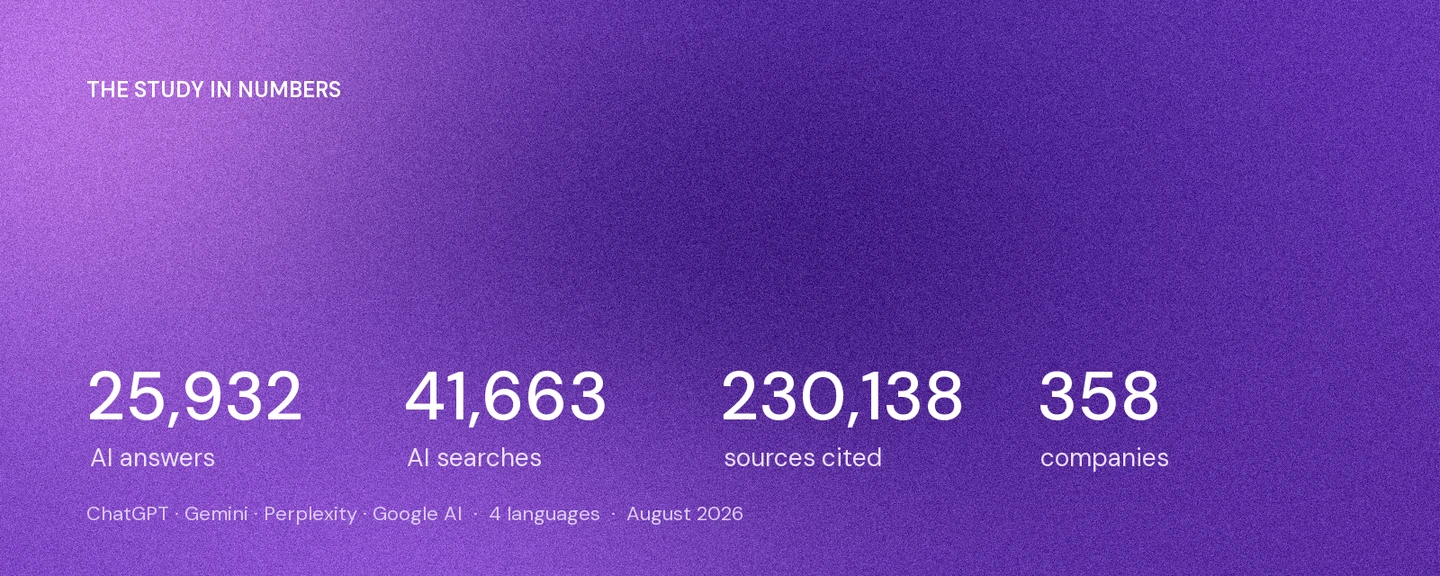
We asked ChatGPT, Gemini, Perplexity and Google AI Mode 2,530 real buying questions about 358 of the largest companies in Latvia, Lithuania and Estonia, in English and each local language, twice, a week apart.
This page covers the main findings in plain terms. The full research report (PDF) has the methods, the statistics and every caveat, and the company lookup file (Excel) lets any company in the study find itself.
This study is also available in Latvian: Baltijas AI redzamības indekss 2026.
Size doesn't buy visibility
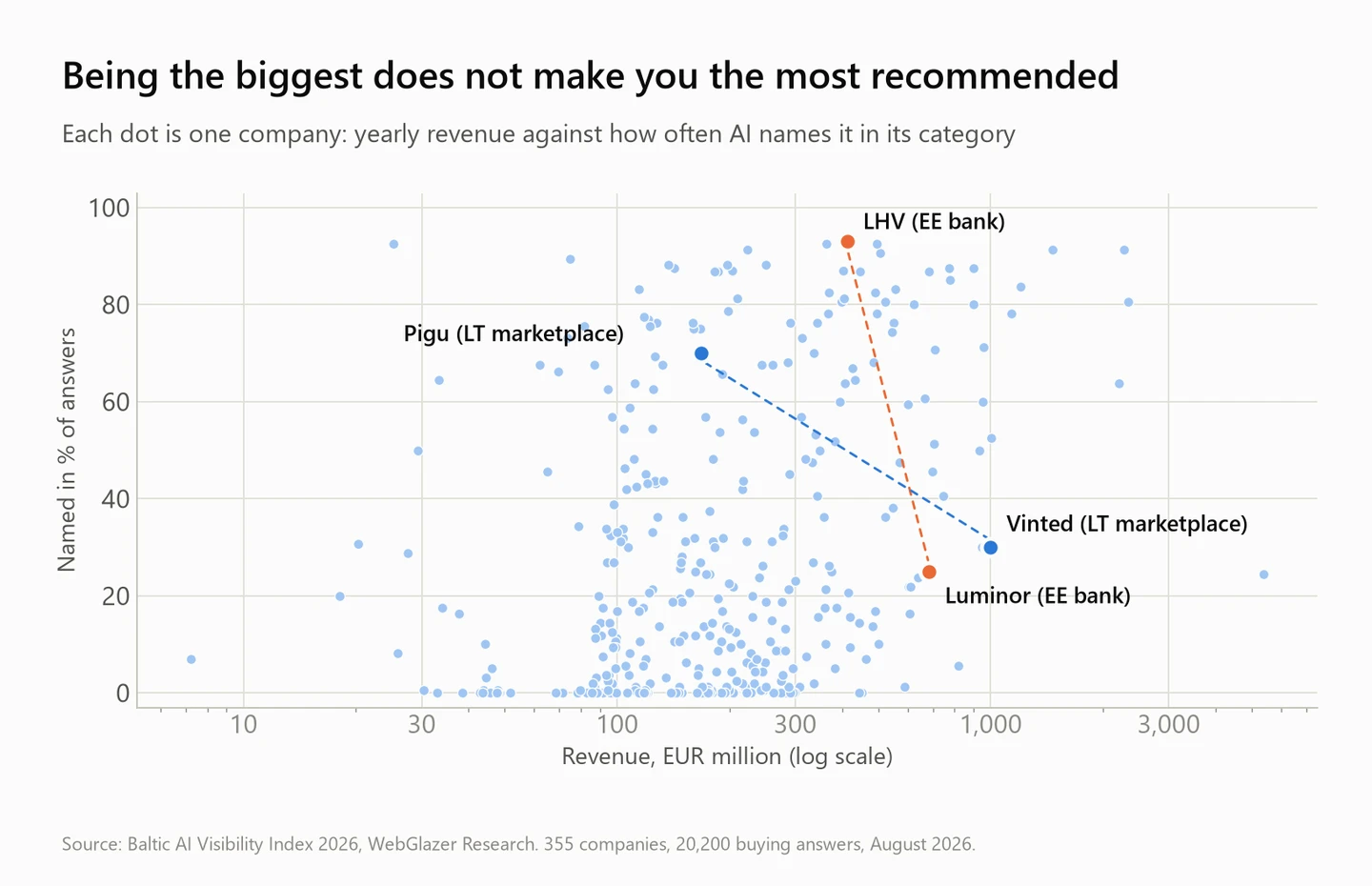
Each dot below is one of the companies we studied. Further right means more revenue; higher means AI names it more often. If size bought visibility, the dots would climb from left to right. They don't.
| Category | Larger company | Named in | Smaller company | Named in |
|---|---|---|---|---|
| Estonian banks | Luminor (EUR 684m) | 25.0% | LHV (EUR 413m) | 93.1% |
| Lithuanian online marketplaces | Vinted (EUR 999m) | 30.0% | Pigu (EUR 168m) | 70.0% |
| Latvian energy | Latvenergo (EUR 950m) | 30.0% | Sadales tīkls (its own subsidiary) | 51.9% |
This doesn't mean the AI is wrong. A smaller specialist is often a good answer to a buyer's question. It means market share and AI share have come apart, and a big company can't assume its size carries over.
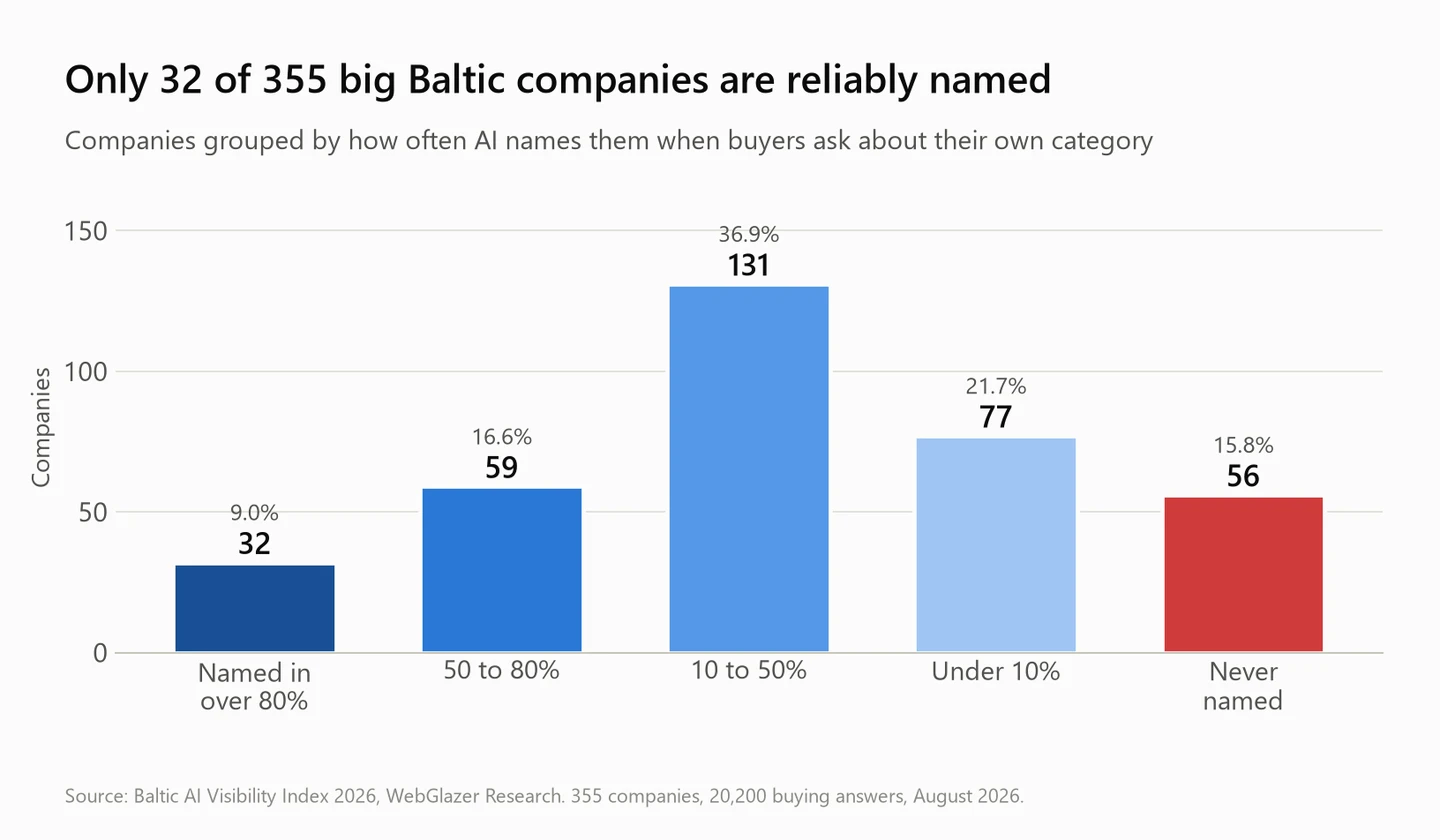
Only 32 of 355 large companies were named in more than 80% of the answers for their category. Another 59 were named in 50 to 80%. The biggest group, 131 companies, sat between 10% and 50%, and 56 were never named once in 160 tries.
Revenue barely predicts who gets named. Inside a category, the link between size and AI visibility is weak (an average rank correlation of 0.19).
| Company | Country | Category | Named in |
|---|---|---|---|
| LHV Pank | Estonia | Banks | 93.1% |
| SEB bankas | Lithuania | Banks | 92.5% |
| Telia Eesti | Estonia | Telecom | 92.5% |
| Bolt | Latvia / Estonia | Mobility platforms | 91 to 93% |
| Elisa Eesti | Estonia | Telecom | 91.2% |
| Telia Lietuva | Lithuania | Telecom | 90.6% |
| DPD Lietuva | Lithuania | Parcel delivery | 89.4% |
| LMT | Latvia | Telecom | 88.1% |
| Enefit | Lithuania | Energy retail | 88.1% |
| Citadele | Latvia | Banks | 87.5% |
| airBaltic | Latvia | Airlines | 87.5% |
| Ignitis | Lithuania | Energy retail | 87.5% |
Most category races are close. The median gap between the first and second most-named company in a category is 6.9 points. A few are one-sided: in Estonian scrap metal, Cronimet Nordic is named in 75% of answers and the next tracked company in 1.3%.
The study at a glance
| What we measured | Result |
|---|---|
| Companies named in a typical AI answer | 3 |
| Big companies reliably named (over 80% of answers) | 32 of 355 |
| Big companies never named in their category | 56 (15.8%) |
| Extra visibility when asked in English | +4.4 points |
| Citations pointing to the company's own site | 8.8% |
| AI descriptions with a major error | 5.3% |
How we chose the companies
We started from the official business registers of all three countries and took the 100 largest companies per country by FY2025 revenue. Banks report income rather than revenue, so we ranked them by income. We then added 58 smaller companies so that every industry had at least five members in at least one country. Eight of the very largest firms had no website at all, so we replaced them with the next company down and recorded that as a finding.
That gave us 358 active companies: 128 in Lithuania, 121 in Estonia and 117 in Latvia. Each was placed in one of 49 plain industry categories, such as banks, grocery retail, parcel delivery or road freight, and a person checked every assignment. A company is only ever compared with others in its own category, so a bank is measured against banks and a courier against couriers.
For each category we wrote ten questions a real buyer would ask, without naming any brand, and native speakers translated them into Latvian, Lithuanian and Estonian. Export industries got English questions from a foreign buyer's point of view, because that is the conversation that wins or loses them business.
| Category | Example question (English) | Same question (Latvian) |
|---|---|---|
| Grocery retail | Which grocery store in Latvia is best for a family doing a big weekly shop? | Kurš pārtikas veikals Latvijā ir vislabākais ģimenei, kas veic lielus iknedēļas iepirkumus? |
| Parcel delivery | Which courier in Latvia is best for a small online shop sending daily parcels? | Kurš kurjers Latvijā ir vislabākais mazam interneta veikalam, kas sūta sūtījumus katru dienu? |
| Banks | Which bank is best for a small company in Latvia? | Kura banka ir vislabākā mazam uzņēmumam Latvijā? |
We collected answers from the real consumer versions of ChatGPT, Google AI Mode and Perplexity, and from Gemini with Google Search switched on. In an earlier test, API answers without live search named about half as many competitors as the apps people actually use, so the consumer apps were the honest choice. We checked our name-matching against hand-labelled samples, and it was right 96% of the time.
AI picks about three names
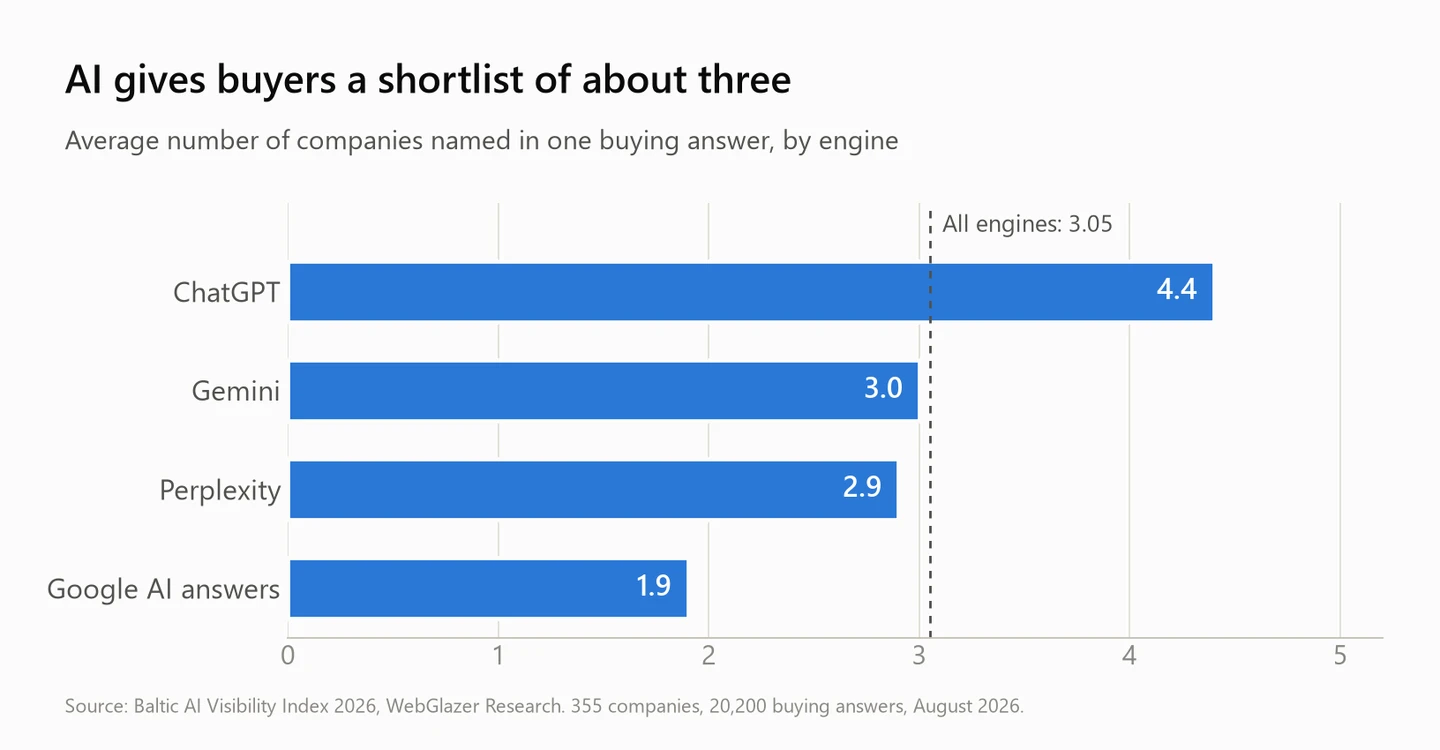
The typical answer to a buying question names three companies. In 15.3% of answers no company is named at all. The engine matters most: ChatGPT names 4.4 on average, while Google AI Mode names 1.9 and usually just one.
Behind those short lists sits a huge pool. Across 20,200 buying answers the engines named 11,136 different companies, and 5,433 of them showed up exactly once. The ten most-named brands (Circle K, Rimi, Neste, Bolt, Swedbank, Maxima, Enefit, Lidl, Tele2 and Alexela) together took only 6.4% of all the name slots. The shelf is short and the queue for it is very long.
English beats local languages
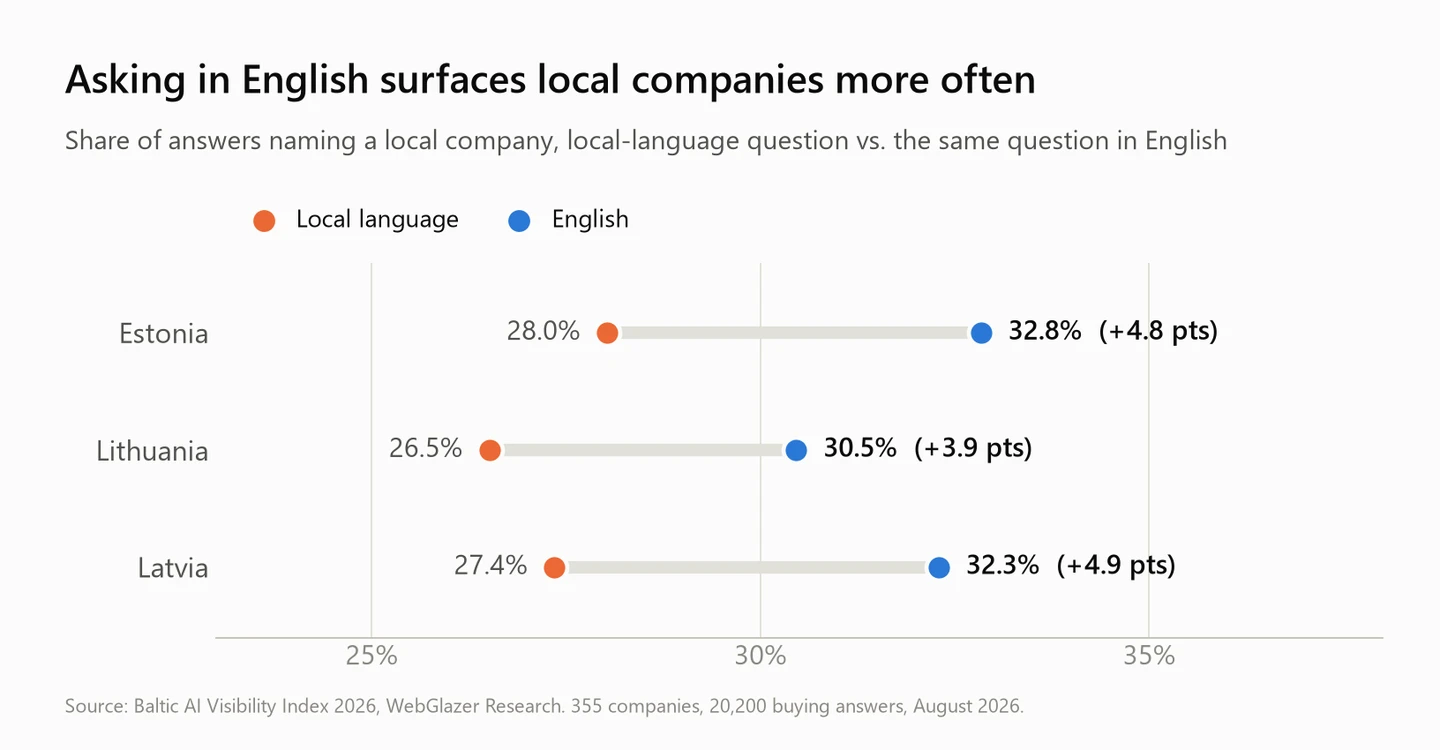
Local companies were named 4.4 points more often when the question was in English than when it was in Latvian, Lithuanian or Estonian. It happened in all three countries, and 58% of companies scored higher in English individually.
The engines' own background searches point to why. Even when the question was in a local language, 43% of ChatGPT's searches and 34% of Gemini's were run in English. Estonian questions triggered the most English searching. So English-language information about your company gets found more often, whatever language the buyer types in.
This is about being found, not about being described correctly. Descriptions written in the local language were slightly more accurate than English ones.
Every engine answers differently
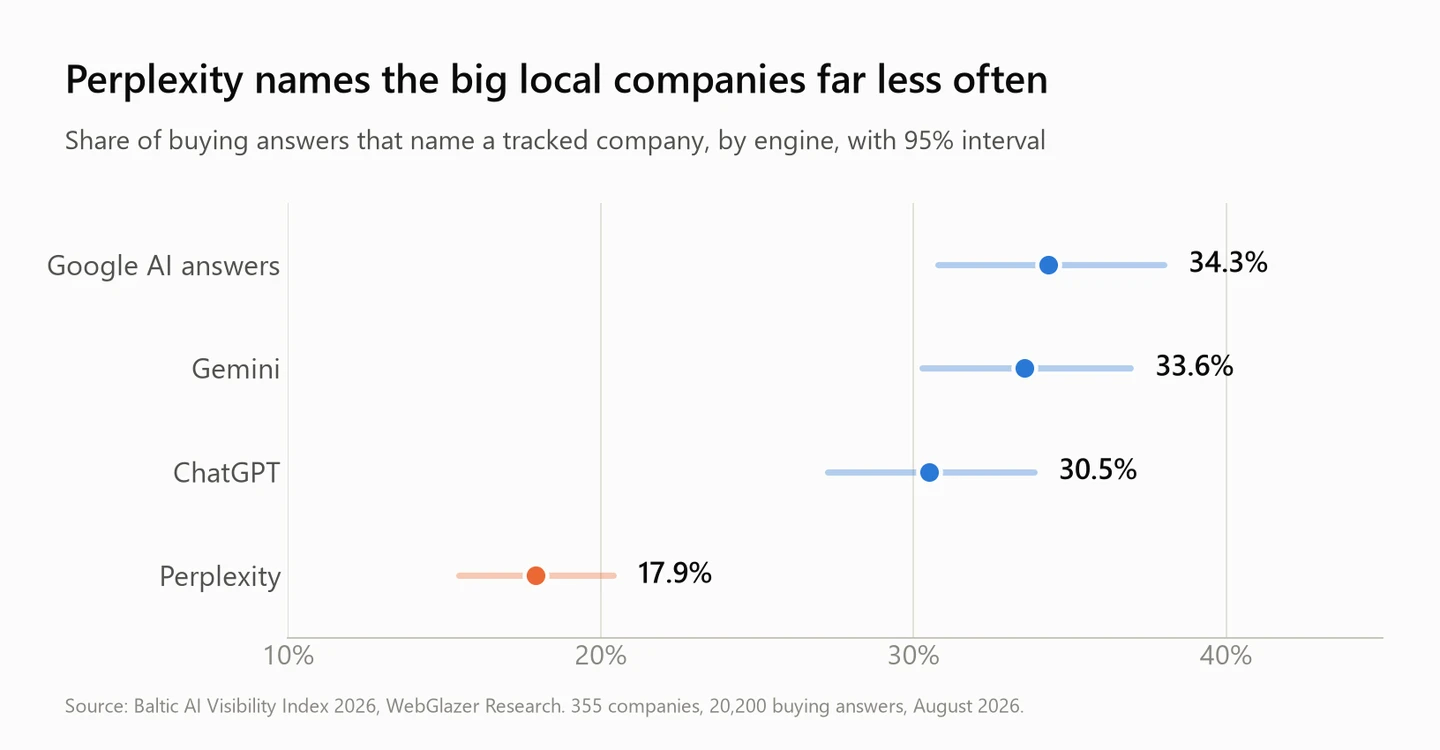
Google AI Mode and Gemini named the large local companies most often, at about 34%. ChatGPT came in at 30.5%. Perplexity named them far less, at 17.9%. That isn't because its answers are shorter. It names different companies, more of them outside our list of the largest firms.
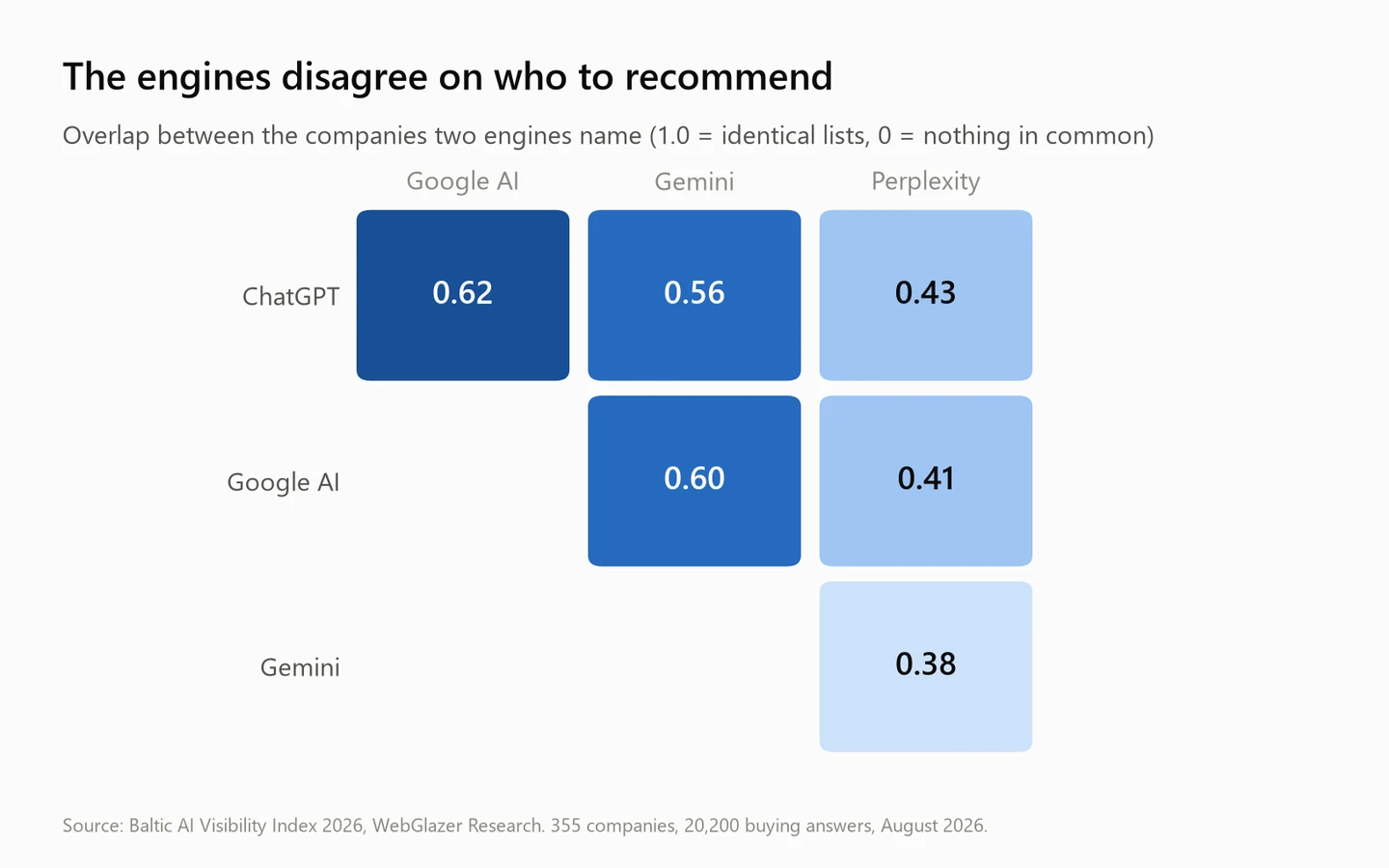
The engines also disagree on who to name. Even the closest pair, ChatGPT and Google AI Mode, shares only 0.62 of its names. On a single question asked on the same day, the overlap drops to between 0.14 and 0.23, and for Google AI Mode against Perplexity, 60% of questions produced lists with no name in common. Where you stand depends on which app your customer opens.
Top names stay, the rest rotate
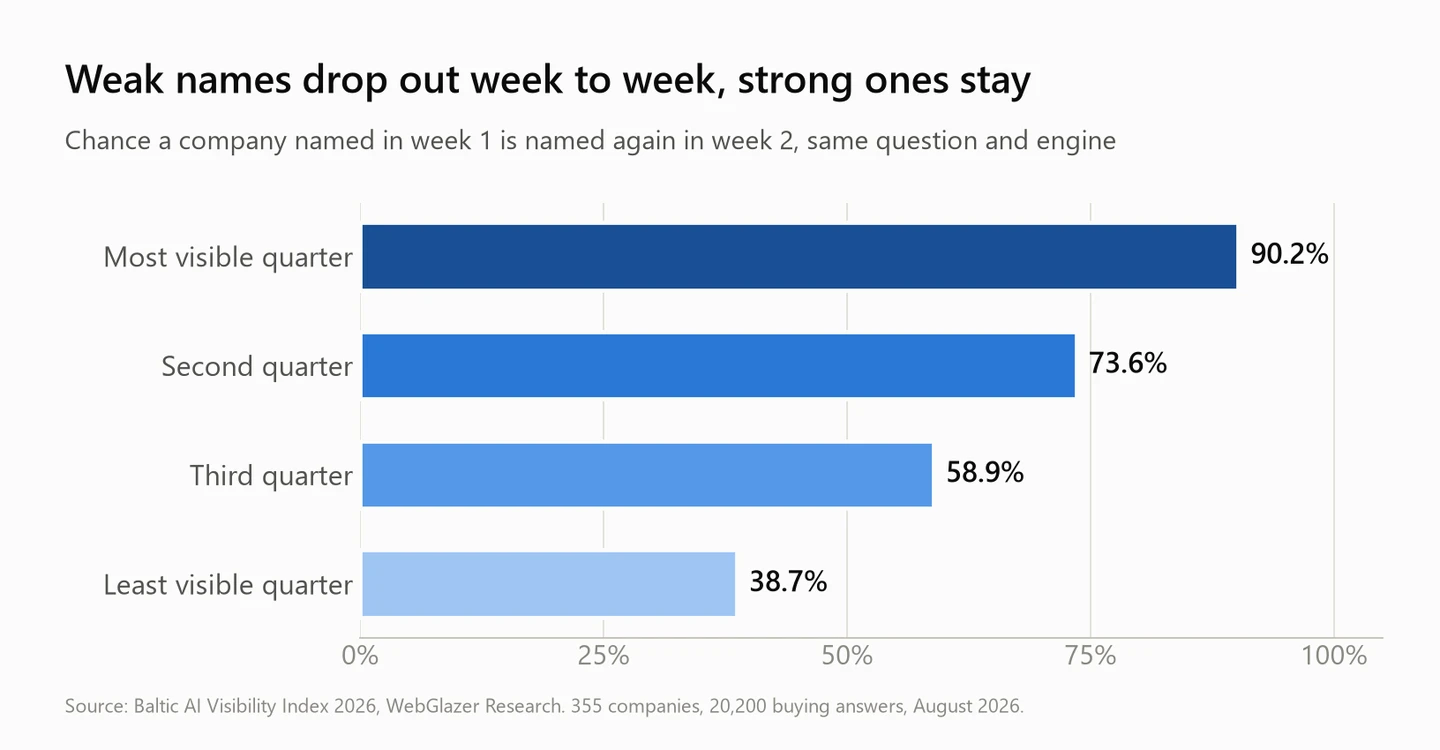
Measured across many answers, a company's score is very stable: the scores from week one and week two correlate at 0.992. Single answers are not. A company named in week one was named again for the same question on the same engine 82.6% of the time.
That number depends on how strong the company is. The most visible quarter kept its place 90.2% of the time. The least visible quarter kept it only 38.7% of the time, worse than a coin flip. The leading names in a category hold steady and the rest of the shortlist gets redrawn. One answer is one roll of the dice, so checking a prompt once tells you very little. We have since measured exactly how little: one check gets the visibility verdict wrong 56% of the time.
Where AI gets its information
The engines cited 176,673 sources in buying answers, spread over 19,615 different websites. Only 8.8% of those citations pointed at the company's own website. The top ten websites made up 13.6% of all citations, and the rest is a very long tail.
After Google's own result pages, Reddit was the most-cited site at 3.3%. Business registries came next (ssb.ee and rekvizitai.vz.lt, about 1% each), then B2B directories such as ensun.io and clutch.co. ChatGPT cited the most sources, 12.6 per answer, and Gemini cited anything at all in only 43.9% of its answers. Your own site matters, but most of the evidence AI uses about you lives on other people's pages.
Why do sources matter more than rankings? Our follow-up research, is SEO dead? A meta-analysis of the search S-curve, shows that AI answers are built on top of classic search, so the pages that rank still shape what the AI quotes. We later joined domain authority, backlink and search traffic data to every company in this study to test whether classic SEO authority predicts being named at all: do backlinks still matter in AI search.
One more thing we found when we looked closer at those pages, added in October 2026. The third-party pages the engines quote are mostly pages nobody links to. We sampled 300 of them and only 29 carried any backlinks a crawler could find, which is 9.7%. Company register records and directory profiles get cited constantly while carrying no authority of their own, so being linked to is not what gets a page into an AI answer.
How accurate AI is
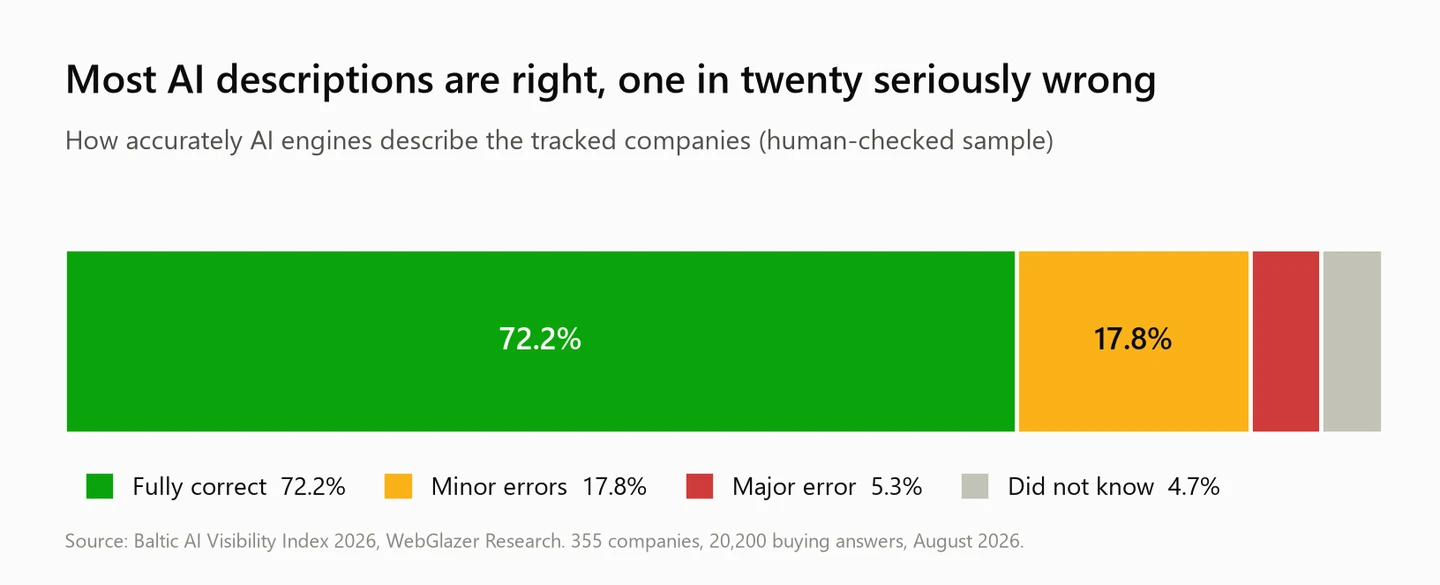
We also asked each engine directly about every company: what it does, whether it can be trusted, and how it compares with its main rival. In a sample checked by a person, 72.2% of descriptions were fully correct, 17.8% had minor errors and 5.3% had a major error that would mislead a buyer. In 4.7% the engine didn't know the company.
The typical serious mistake is mixing up company entities: facts about a group pinned onto its local company. Neste Eesti was credited with its Finnish parent's station network, and one county cooperative was described as the whole of Coop Eesti. Across the study we found at least one major error for 23 companies; the lookup file flags which ones and on which engine.
The error rate also depends on how you count. A strict judge that treats any unconfirmed claim as an error finds 15.3% major errors, while one that only counts contradictions finds 4.4%. Any accuracy figure for AI answers should say which definition it uses.
No country is ahead
Once you compare like with like, category by category, no country has a visibility advantage. Latvia, Lithuania and Estonia all land within the study's noise range (adjusted p = 0.88 for every pair), so we publish no national ranking.
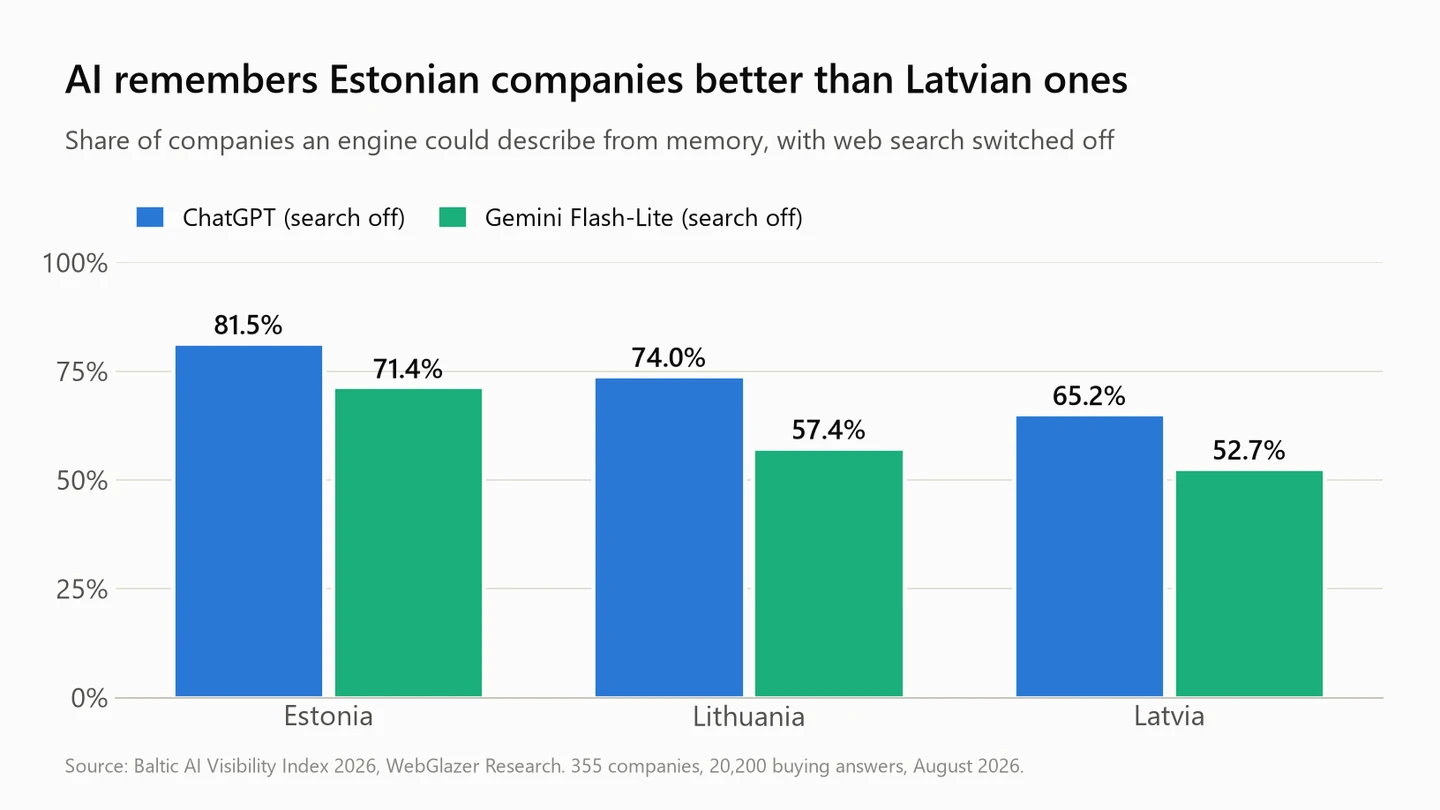
The one real country difference is in what the models remember without searching. With web search off, both engines knew Estonian companies better than Latvian ones: 81.5% against 65.2% for ChatGPT and 71.4% against 52.7% for Gemini. Latvia came last in both. Once the engines search the web, that gap disappears from the recommendations.
With search off, ChatGPT tended to say it wasn't sure. The small Gemini model more often described the wrong company entirely (19.3% of cases), sometimes swapping in a mythological or fictional namesake.
Companies AI never names
56 of the 355 scored companies were never named in any of the 160 answers for their category. Read that list with care. Many of them are registry companies no customer would ask an AI about, like a retailer's sourcing arm, a utility's power generation subsidiary, franchise operators and shipyards. Some are category mismatches where zero is the right answer, for example a hosting provider tested against "best IT services company" questions.
The cases that should worry a marketing team are the 13 companies that are both unknown to the models and never recommended. Of the 56, 43 are known to at least one engine, so for most of them invisibility isn't a knowledge problem. The AI knows who they are; it just doesn't think of them when a buyer asks.
Every company's result is in the company lookup file: its visibility status, rank in its category, per-engine and per-language figures, and whether we found a major error in how AI describes it.
What marketing teams should do
You are competing for three slots
A typical AI answer names about three companies, and Google AI Mode often names one. Being large is not enough to get one of them.
Measure every engine separately
ChatGPT, Gemini, Perplexity and Google AI Mode name different companies. One overall "AI visibility" number hides the engine where you are missing.
Check repeatedly, not once
Below the top quarter, a company's place in a given answer changes from week to week. Sample the same questions many times before drawing conclusions.
Publish clear information in English too
The engines search in English even when the buyer writes in Latvian, Lithuanian or Estonian. Say plainly in English what you do, where you operate and who you serve.
Work on the sites AI actually cites
Your own website is under 9% of citations. Reddit, business registries, directories and industry sites carry most of the weight.
Make your company entity unambiguous
Mix-ups between a group and its local company cause the most serious errors. Keep your homepage, registry entry and directory listings consistent about which company you are.
Check your own company
Start with the company lookup file. If your company was in the study, it shows your visibility status, your rank in your category and whether we found a major error in how AI describes you.
To test it yourself, ask the buying questions your customers would ask, without naming your brand, on ChatGPT, Gemini, Perplexity and Google. Ask in English and in your local language, and repeat the same questions over a few weeks. One answer on one day tells you very little, as the results above show.
The fast version is our free AI visibility checker. Enter your website and it works out the buyer questions for your category and runs them across the AI engines for you, then shows how often you are named and which competitors come up instead. It is free and needs no account. Run it on a set of questions rather than one, because a single answer is close to a coin flip.
To make that manual test easier, we have a free WebGlazer Chrome extension that walks you through it step by step, including the searches the AI runs in the background. It isn't in the Chrome Web Store yet, so email our team and we'll send it to you.
If you'd rather not do it by hand, try the WebGlazer platform. It runs your buyers' questions on every major engine and updates your visibility, your competitors and the sources AI cites every week.
Download the report and data
📄 Full research report (PDF, 24 pages)
Methods, all results, limitations, the category leaders in every country and the full list of companies never named.
📊 Company lookup (Excel) · CSV version
One row per company: visibility status, rank in its category, results per engine, language and week, AI accuracy, and whether a major issue was found. Wrong-claim details are available to the company from support@webglazer.com.
This is a snapshot from August 2026, repeated every year. A low score shows how AI represents a company, not how good the company is.
How to cite: WebGlazer Research (2026). Baltic AI Visibility Index 2026.
Methods and references
🗓️ Data collected 5 to 14 August 2026; analysis closed 3 September 2026. Four engines: ChatGPT, Google AI Mode, Gemini and Perplexity. Claude was planned but couldn't be measured in time.
📐 Proportions carry Wilson 95% intervals and company rates use a bootstrap over companies. Country comparisons are standardised by category and corrected with Benjamini-Hochberg. English vs. local uses a paired Wilcoxon test; engine agreement uses the Jaccard index. Full limitations are in section 5 of the report.
Company data sources
Uzņēmumu reģistrs (Latvia, via data.gov.lv); Registrų centras (Lithuania, via rekvizitai.vz.lt); Äriregister (Estonia).
Statistical references
Wilson, E. B. (1927). Probable inference, the law of succession, and statistical inference. Journal of the American Statistical Association.
Benjamini, Y., & Hochberg, Y. (1995). Controlling the false discovery rate. Journal of the Royal Statistical Society, Series B.
Efron, B., & Tibshirani, R. J. (1993). An Introduction to the Bootstrap. Chapman & Hall.
Jaccard, P. (1912). The distribution of the flora in the alpine zone. New Phytologist.
Kruskal, W. H., & Wallis, W. A. (1952). Use of ranks in one-criterion variance analysis. JASA.
Mann, H. B., & Whitney, D. R. (1947). On a test of whether one of two random variables is stochastically larger. Annals of Mathematical Statistics.
Wilcoxon, F. (1945). Individual comparisons by ranking methods. Biometrics Bulletin.
Funding and disclosure
The study was funded by WebGlazer, which sells AI visibility software. The data files are published so anyone can check the results. Wrong claims an engine made about a specific company are only shared anonymously or with permission.
Where does your company land in AI answers?
WebGlazer tracks your brand across ChatGPT, Gemini, Perplexity and Google AI Mode on the questions your buyers actually ask, per engine and over time, so you know where you stand and what to fix next.
Start freeFrequently asked questions
What is the Baltic AI Visibility Index 2026?
It is a WebGlazer Research study of how ChatGPT, Google AI Mode, Gemini and Perplexity recommend companies in Latvia, Lithuania and Estonia. It covers 358 of the largest companies, 2,530 buying questions in four languages and 25,932 AI answers collected in August 2026.
How many companies does an AI assistant recommend?
The typical buying answer names three companies. ChatGPT names 4.4 on average, Gemini 3.0, Perplexity 2.9 and Google AI Mode 1.9, often just one. In 15.3% of answers no company is named.
Do bigger companies get recommended more by AI?
Only weakly. Within a category, revenue and AI mention rate had an average rank correlation of 0.19. LHV is named in 93.1% of Estonian banking answers while the larger Luminor is named in 25.0%.
Does the language of the question matter?
Yes. Local companies were named 4.4 percentage points more often when the question was asked in English rather than Latvian, Lithuanian or Estonian, partly because the engines run many of their background searches in English.
Which Baltic country is most visible in AI answers?
None. After comparing companies category by category, there is no significant difference between the three countries. The only country difference is in model memory without search, where Estonian companies are better known than Latvian ones.
How were the companies in the study chosen?
We took the 100 largest companies by FY2025 revenue in each country from the official business registers of Latvia, Lithuania and Estonia (banks ranked by income), then added 58 smaller companies so every industry category had at least five members in at least one country. Companies with no website were replaced by the next largest. That gave 358 companies in 49 industry categories, and each company is only compared with others in its own category.
How can I check how AI recommends my company?
Ask the buying questions your customers would ask, without your brand name, on ChatGPT, Gemini, Perplexity and Google, in English and your local language, and repeat them over several weeks. Our team can send you a free WebGlazer Chrome extension that guides you through this manual test (email support@webglazer.com). For weekly tracking across every engine, try the WebGlazer platform.
Can I see the results for a specific company?
Yes. The company lookup file linked in this article has one row per company with its AI visibility status, rank in its category, results per engine and language, and whether a major error was found in how AI describes it.