ResearchNovember 9, 2026
Is SEO dead? What innovation theory says about where search as technology
18 minutes read

You hear two stories about search today. The first story says SEO is dead because AI replaced it. The second story says nothing important has changed. Both stories are simple. The data says neither is true.
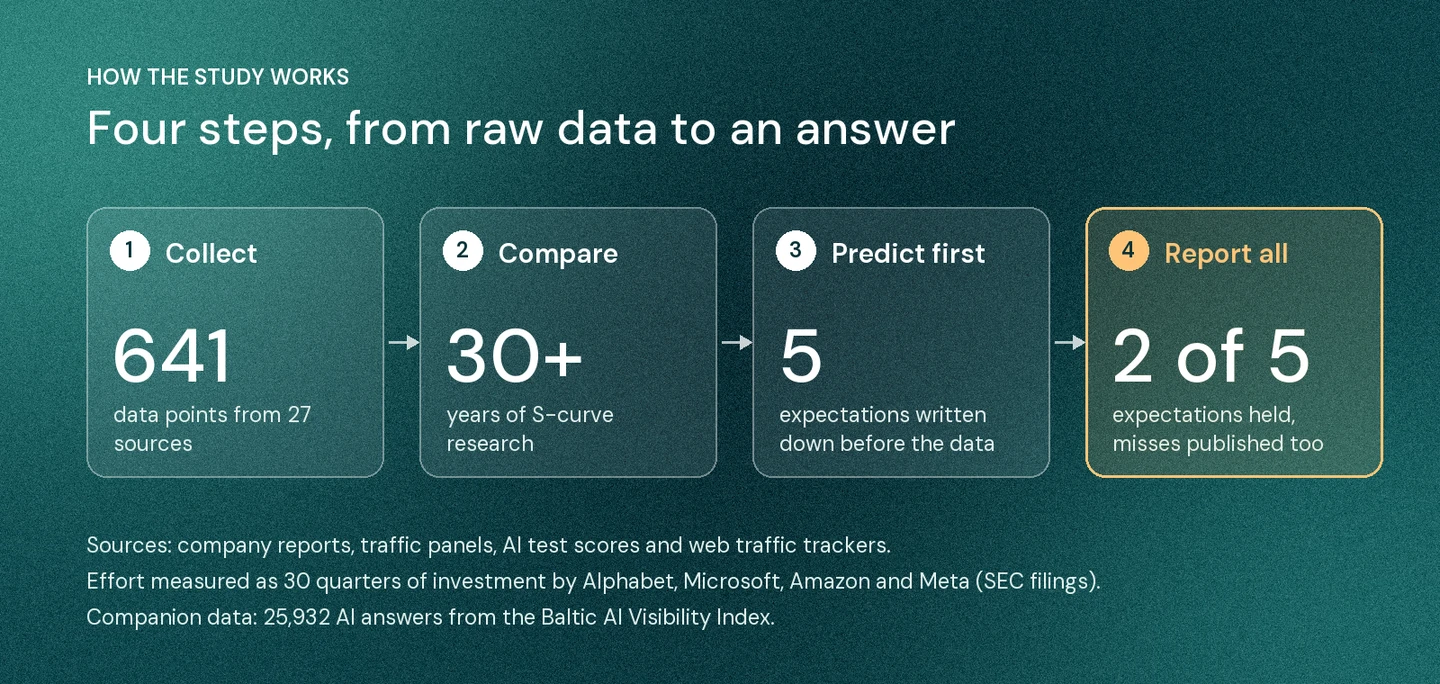
We collected 641 data points from 27 sources: company reports, traffic panels, AI test scores and web traffic trackers. Then we compared them with the technology S-curve, a model that researchers have tested on real industries for more than 30 years. Before we looked at the data, we wrote down what we expected to find. Some of our expectations were wrong, and we report those too.
This study follows our Baltic AI Visibility Index 2026. We wrote it for people who work in SEO. The short answer: search is not dying, AI answers are not a short trend, and the useful work is in the middle.
Why an S-curve
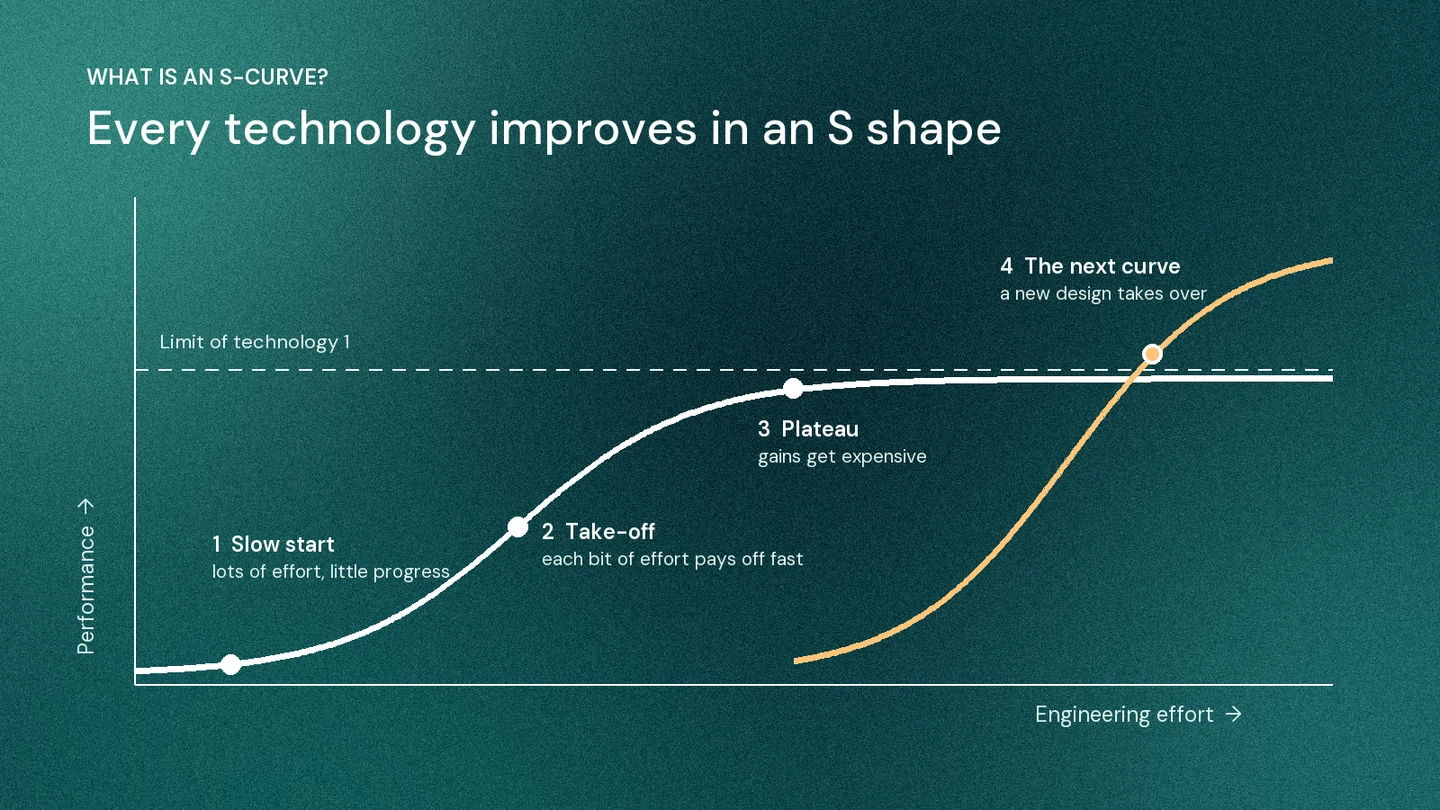
An S-curve shows how a technology improves when people invest effort into it. At first, progress is slow. Then it becomes fast. Later it slows down again, because the technology gets close to its limit. At that point a new technology often starts its own curve.
The best-known study of this is Clayton Christensen's research from 1992. He looked at every disk drive sold in the world between 1979 and 1990.
In 1977, engineers at the company Control Data decided that one part of the disk drive, the ferrite head, had reached its limit. They moved their best people to a new technology called thin film. But thin film took longer than planned. The engineers who stayed with the old ferrite heads kept improving them, and they made them three times better.
Other companies show the same pattern. IBM stopped using ferrite heads at a density of 3.5 megabits per square inch. Fujitsu kept using them and reached 30. The companies that switched early lost market share: together they went from 60% to 37%. The companies that switched late grew from 10% to 33%.
Christensen's main lesson is important for search. The old technology did not stop because of physics. It stopped because companies believed it was finished and moved their engineers away. The belief made the prediction come true.
His study also explains why many "SEO is dead" charts are misleading. We used three of his rules:
Measure against effort, not time. If you plot progress against years, you often see a straight line. If you plot it against how much money and work went into it, you see the real curve. We use the investment of the big tech companies as our measure of effort.
Choose the right level. We study internet search as one system. Inside it, two methods compete. In classic link search, the user clicks links and finds the answer. In AI answers, the search engine reads the pages and writes the answer. GEO tools are not a separate curve. They are a tool that works inside this system.
Measure quality, not sales. A chart of how many people bought something is about sales, not about how good the technology is. Our own earlier S-curve notes made this mistake. This study replaces them.
Under the hood: links vs AI
Before we measure anything, we need to understand what really changed inside search. Many people think AI search is a completely new technology. It is not. Most of the machine is the same.
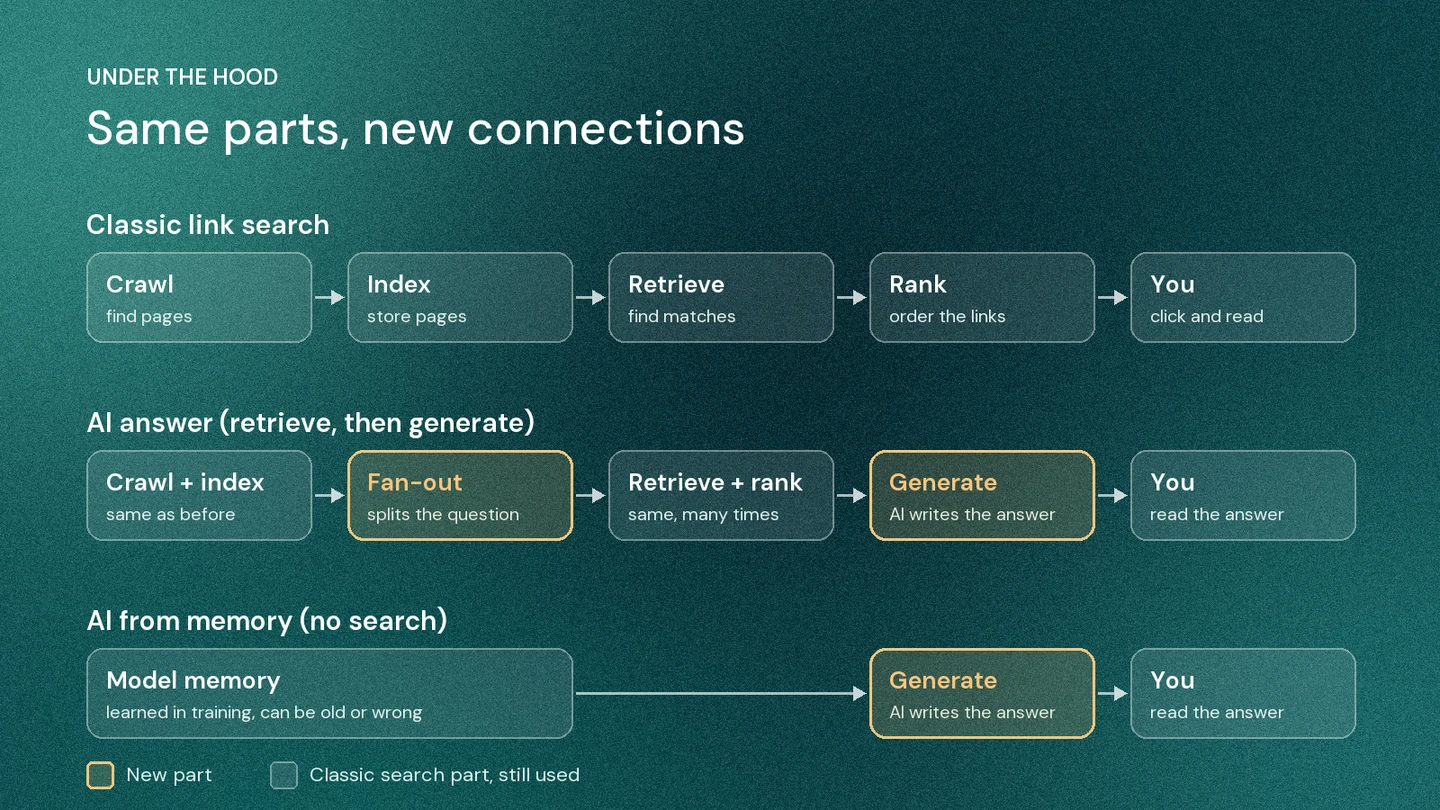
Classic search has five steps. It crawls the web, stores pages in an index, finds pages that match the question, ranks them, and shows you a list of links to click.
An AI answer uses almost the same steps. Engineers call it RAG, short for retrieval-augmented generation: first the engine retrieves pages, then an AI model writes an answer from them. Only two steps are new:
Query fan-out. The AI splits one question into several smaller searches and runs them at the same time. Google confirms that AI Mode and some AI Overviews work this way.
Generation. The model reads the pages it found and writes one answer, instead of showing a list of links.
There is also a third way to answer: from memory only. Here the model uses what it learned during training and does not search at all. This is cheaper, but riskier. In our Baltic study, with search switched off, ChatGPT knew 73.7% of the 358 companies, and a small Gemini model described the wrong company 19.3% of the time. So "model plus search" and "model alone" are two different products, and they need to be measured separately.
What kind of change is this? Innovation researchers Rebecca Henderson and Kim Clark sort technology changes into four types. They ask two questions: do the parts change, and does the way the parts connect change?
| Type of change | The parts | How the parts connect | Is AI search this type? |
|---|---|---|---|
| Incremental | improved | same | No |
| Modular | replaced | same | No |
| Architectural | improved | changed | Yes |
| Radical | replaced | changed | No |
AI search is an architectural change. Crawling, indexing, retrieval and ranking all survive, and they become even more important. What changes is how they connect, and who gets the value at the end: the website that got the click, or the engine that wrote the answer.
This is important for SEO. The classic search steps still decide which pages the AI even sees. If a page is not found and ranked, the AI cannot use it.
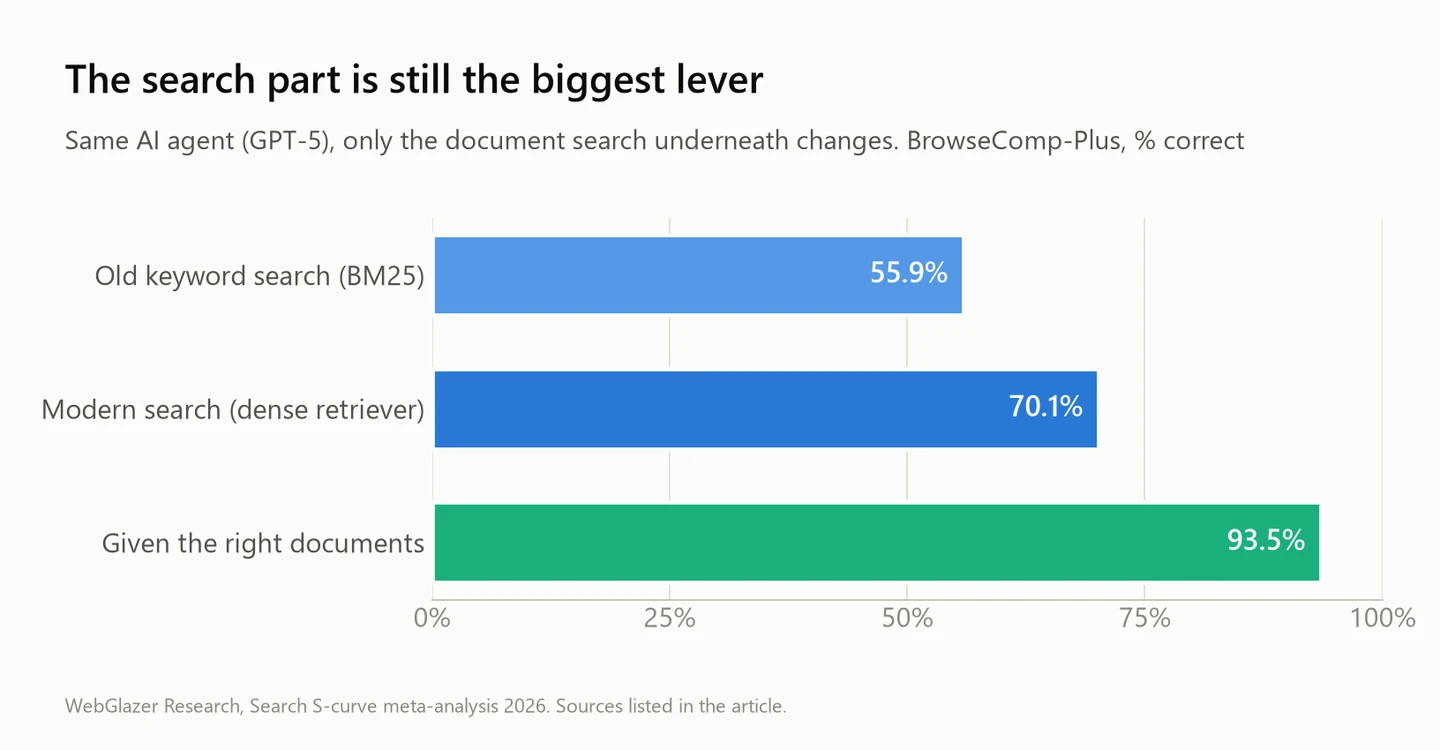
A 2025 experiment shows how much the search step still matters. Researchers gave the same AI agent, GPT-5, the same set of hard research questions and changed only the search system underneath. With an old keyword search (BM25) it answered 55.9% correctly. With a modern search system it answered 70.1%. When it got the right documents directly, it answered 93.5%. The better the search part, the better the answer.
Industry data points the same way. The share of AI Overview sources that also rank in Google's organic top 10 grew from 32.3% to 54.5% between May 2024 and September 2025, according to BrightEdge. A study of 120,000 queries by Botify and DemandSphere found that 75% of AI Overview links come from the top 12 organic results. Every engine also stands on a classic search index. Google AI Overviews and Gemini use Google's index. Copilot uses Bing, and ChatGPT is widely observed to use Bing as well. Perplexity runs its own index.
So where is the real innovation? It sits in a new control layer on top of the old parts. The AI decides whether to search, what to search for, how many searches to run, and how to combine the results. Research such as Search-R1 trains models to make exactly these decisions. Information retrieval researchers describe it the same way: AI agents move search and ranking to a new place in the system, they do not remove them.
Old parts, new connections. That is why both stories about search are wrong. SEO is not dead, because AI answers are built on top of it. And it is not business as usual, because a new layer now decides which sources reach the user.
Innovation research has a name for this moment: the fluid phase. No design has won yet. ChatGPT, Google AI Mode, Perplexity and AI browsers all compete and change often. The rule for this phase is simple: don't bet on one interface. Bet on what all of them share. Be easy to find, be described correctly, and be cited by sources the engines trust.
This is the base for the rest of the study. If AI answers are built on classic search, the old curve should keep improving while the new one grows. The data below tests that.
How we built the study
Search has many qualities, so we chose what to measure before we collected any data. For each quality we defined the limit and the main source.
| What we measured | How we measured it | The limit | Main sources |
|---|---|---|---|
| User effort | share of searches with no click, click-through with and without an AI answer | no effort at all | SparkToro with Similarweb and Datos, Seer Interactive |
| Accuracy | share of test questions answered correctly | 100% | SimpleQA Verified, BrowseComp, Humanity's Last Exam, our Baltic study |
| Content supply | how often AI crawlers visit compared to how often they send visitors, publisher traffic | whether people keep paying to create content | Cloudflare Radar, SparkToro, Similarweb |
| Reliability | how often engines disagree, how often they describe a company wrongly | no fixed limit | Baltic AI Visibility Index |
The content supply is the real limit for AI answers. If people don't need to click anymore, websites lose the visits that pay for their content. Then there is less good content for the AI to learn from. This is an economic limit, not a technical one, and we can measure it.
Before we collected data, we wrote down five expectations and four rules for reading the results:
| Rule | What it means |
|---|---|
| Past the fast phase | A number grows more slowly three periods in a row. |
| Overtaken | The new method beats the old one on what the client cares about, for example revenue from AI visitors compared to revenue from organic visitors. Traffic volume alone does not decide this. |
| Limit reached | AI crawlers take more and send back fewer visitors, while AI accuracy stops improving. |
| Method getting old | A type of optimisation work brings smaller results across two groups of clients. |
We followed one more rule everywhere: we never joined data from different measuring tools into one line. Many alarming charts online do exactly this.
Zero-click predates AI
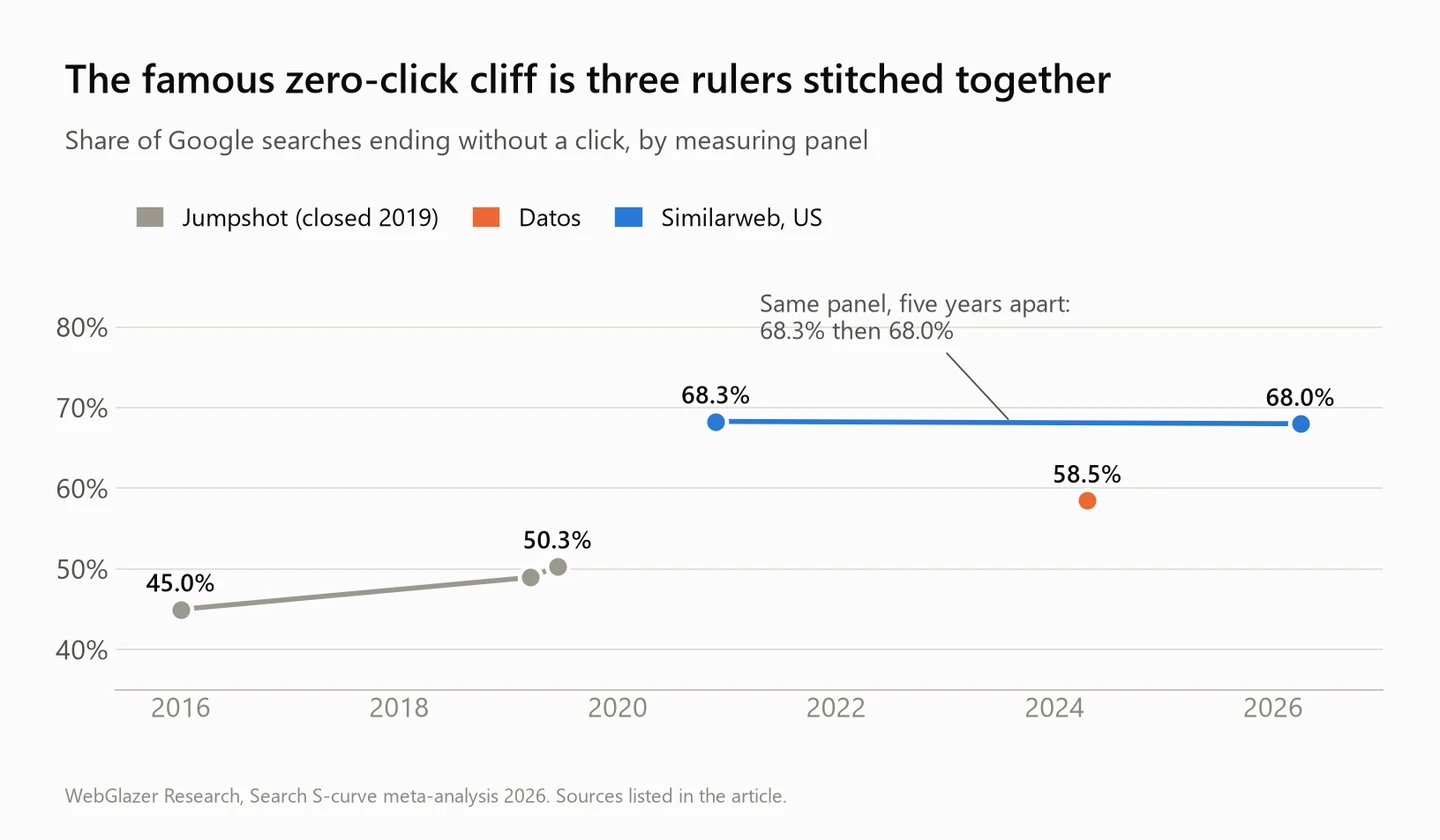
People often say that about two out of three Google searches end without a click. That is true today. It was also true in 2020.
The chart that shows a big rise usually combines three different measuring tools: Jumpshot, which closed in 2019; Datos, which Semrush now owns; and Similarweb. If you use only one tool, Similarweb for the US, the numbers are 68.3% at the end of 2020 and 68.0% in April 2026. The 58.5% figure from 2024 comes from a different tool, so it is not comparable.
What really happened is that Google slowly added answers to the results page over ten years: the weather, currency conversion, sports scores, definitions and short answer boxes. Each of these removed a click, long before AI chatbots appeared.
One thing did change. Fewer Google clicks now go to independent websites. In 2024, 360 of every 1,000 US searches sent a visitor to the open web. In early 2026 it was 232. These two numbers come from different tools, so read them as a direction, not an exact measurement.
AI answers cut some clicks
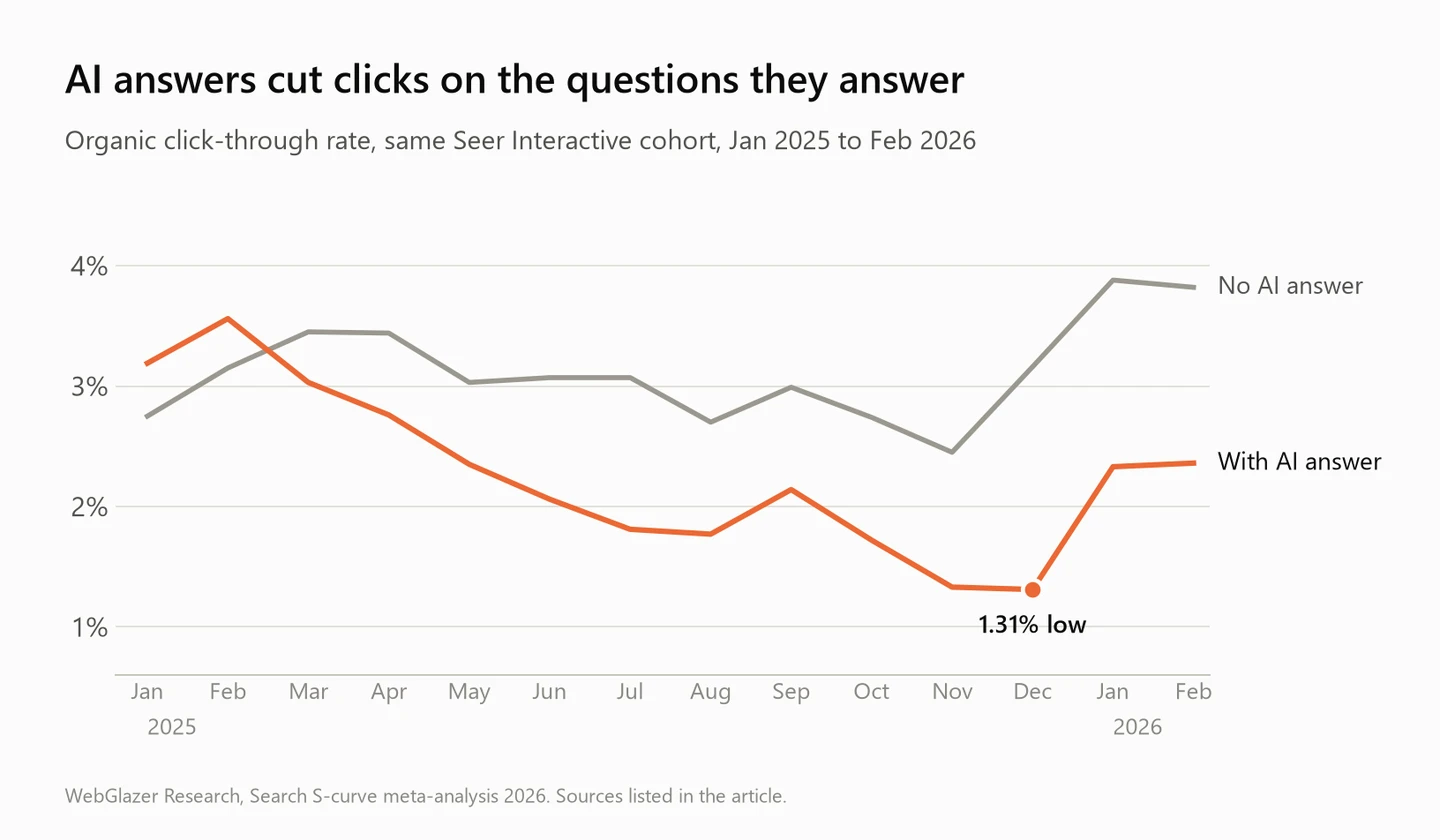
The most reliable data in our study comes from Seer Interactive. Seer measured the same group of accounts every month, with the same method.
| Month | Click-through with an AI answer | Without an AI answer |
|---|---|---|
| January 2025 | 3.19% | 2.75% |
| December 2025 | 1.31% | 3.16% |
| February 2026 | 2.36% | 3.82% |
Searches without an AI answer stayed stable and even improved a little. Searches with an AI answer lost more than half of their clicks during 2025. In early 2026 they recovered part of them.
So AI did not stop Google from sending people to websites. It reduced clicks on questions that a machine can answer directly. Most of these are simple fact questions, not buying questions. Whether this hurts a client depends on what kind of searches bring them customers. The recovery also shows that Google changes these systems all the time, in both directions.
Google's second wind
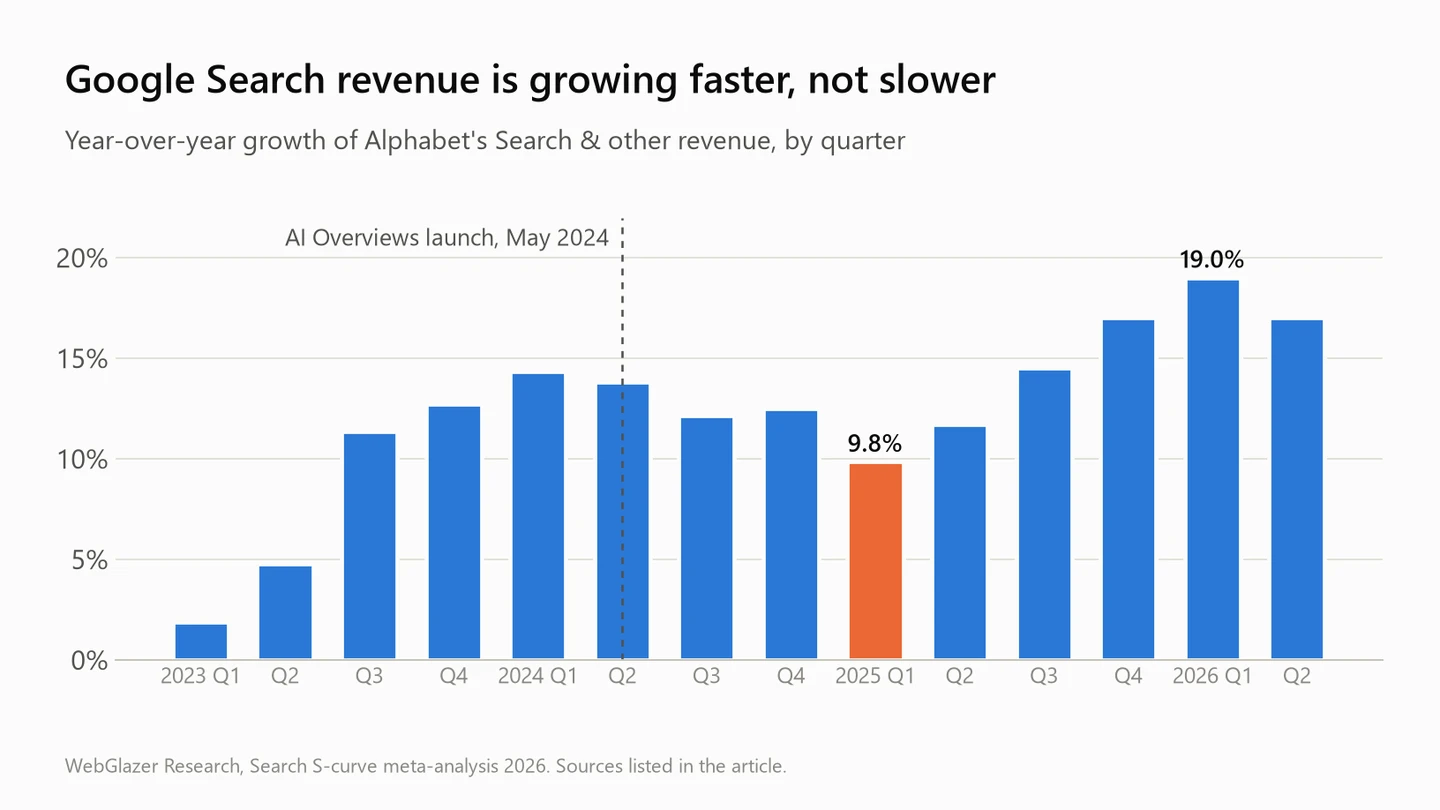
Google's search revenue growth was lowest in the first quarter of 2025, at 9.8%. That was nine months after AI Overviews started. Since then, growth has gone up every quarter, to 17 to 19%. This is the same pattern as the ferrite heads: the old technology is still being improved, not abandoned.
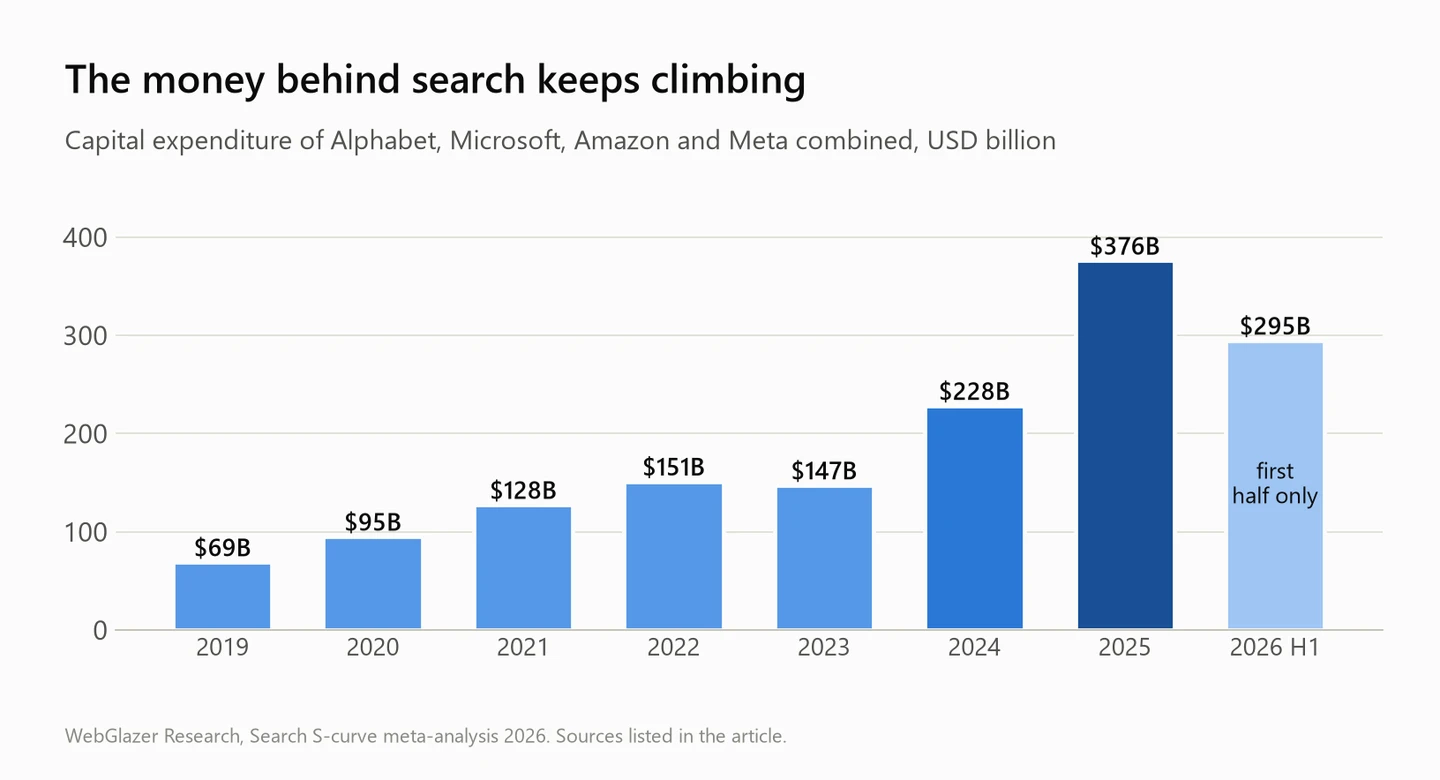
Investment shows the same thing. Alphabet, Microsoft, Amazon and Meta spent $147 billion on infrastructure in 2023, $228 billion in 2024, $376 billion in 2025, and $295 billion in only the first half of 2026. Companies do not invest like this in a product they think is dying. If a client cuts their SEO budget because they expect Google to collapse next year, they repeat Control Data's mistake.
Benchmarks are filling up
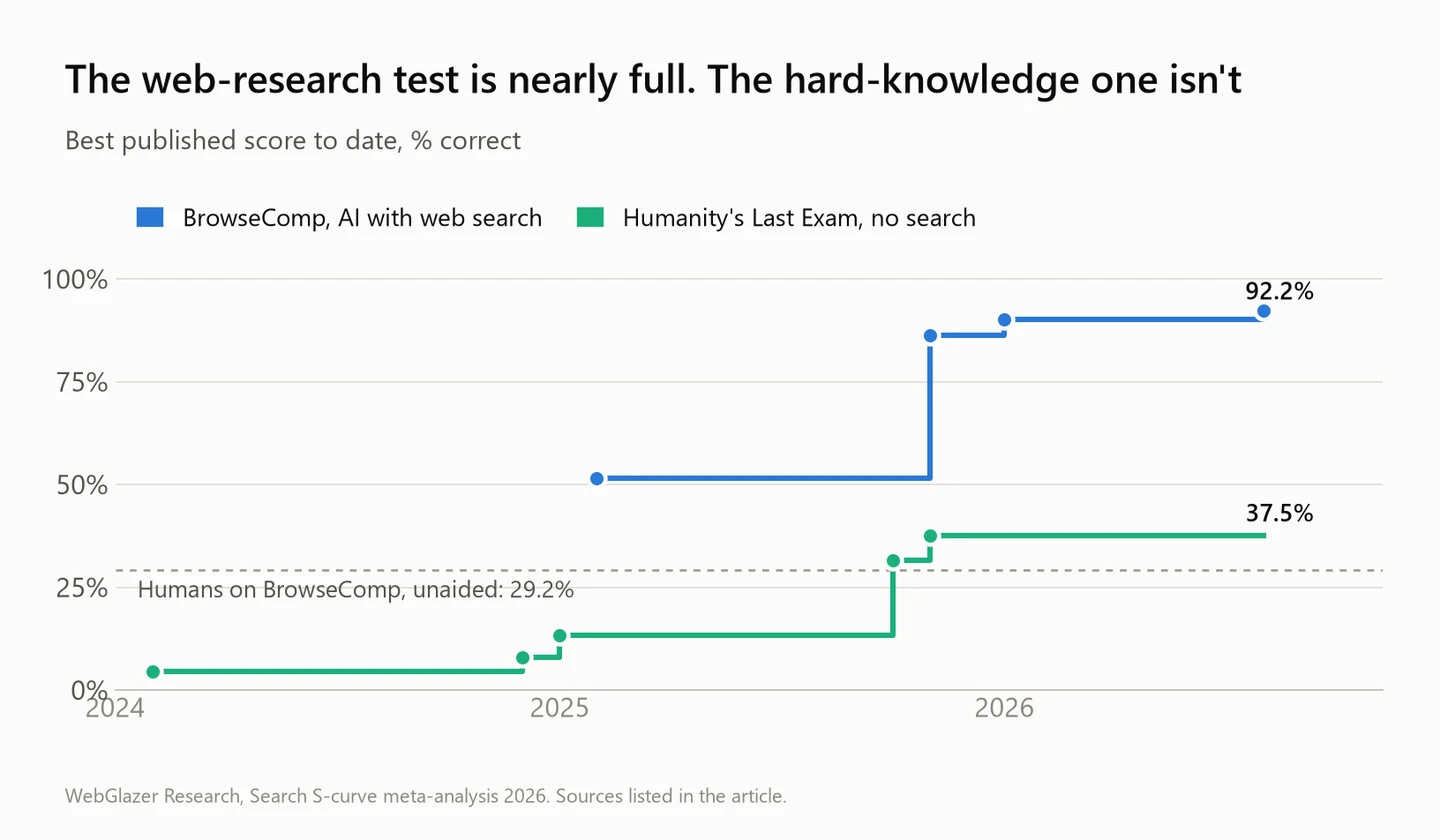
BrowseComp is a test with very hard web research questions. People without AI help answered 29.2% correctly. In February 2025 the best AI system scored 51.5%. By August 2026 the best score was 92.2%.
The cost of each extra point is the interesting part. From 51% to 86%, every $100 billion of investment bought about 13 points. The newest improvements bring less than half a point for the same money. This does not mean AI has reached its limit. It means the test is almost full. Most AI tests reach this point within about 18 months.
AI knowledge without web search is still improving. On the test Humanity's Last Exam, the best score went from 4.6% in early 2024 to 37.5% at the end of 2025. So the open question is no longer whether AI can find and read an answer. The open question is which sources it chooses.
Our Baltic AI visibility study helps here. We asked AI engines about 358 large companies. The descriptions were completely correct 72% of the time, and 5.3% had a serious error. The four engines also named different companies for the same question. There is still a lot of room for improvement, and it depends on how clearly a company's facts appear across the web.
The supply limit is open
If AI answers take content without sending visitors back, websites will earn less and publish less. Then AI accuracy would stop improving. The publisher data points in this direction: search traffic to the top 1,000 websites fell 6.7% in the year to June 2025, and news sites lost 26% of their organic traffic in the year after AI Overviews started.
The crawler data does not confirm it yet. Cloudflare's own data exists for only two dates per AI company, and between July and August 2025 it moved the other way. OpenAI went from 1,700 page visits per referred visitor to 887. So we call this question open, and we don't force an answer.
AI traffic: small, but valuable
In every reliable measurement we found, AI platforms bring about 1% or less of all web traffic. Growth is also slowing: ChatGPT gained 100 million weekly users in two months in early 2025, but the next 100 million took five months.
However, in most studies we collected, visitors from AI buy more often than average visitors. So AI's share of revenue is bigger than its share of traffic. It is a small channel with very good customers. That is a reason to measure it carefully, not a reason to change a whole strategy.
Show your clients where they stand in AI answers
AI visitors are few, but they buy more often. WebGlazer shows each client which AI engines name them, which competitors appear instead, and which sources the answers use.
Try it on one client for freeHypotheses scorecard
| What we expected, before the data | What we found |
|---|---|
| 1. Clicks were stable under link search, then dropped when AI Overviews started | Not true. Zero-click stayed flat in the same tool. AI changed the clicks per question, not the zero-click share. |
| 2. AI knowledge without search is slowing down, AI with search is not | Half wrong. Knowledge without search is still growing fast. The test for AI with search is the one that is almost full. |
| 3. The content supply limit has been reached | Open. Publisher traffic is falling, but there is too little crawler data. |
| 4. Link search gets a second wind | True. Revenue growth was lowest in early 2025 and has grown since. |
| 5. Optimisation methods get old in a fixed order: entity fixes, then structured content, then earned media | No data yet. We need client project data. |
Two expectations were true, one was half wrong, one is still open, and one was not tested yet. We publish the wrong ones too. A study that confirms everything its authors wanted is usually not worth much.
Where search sits now
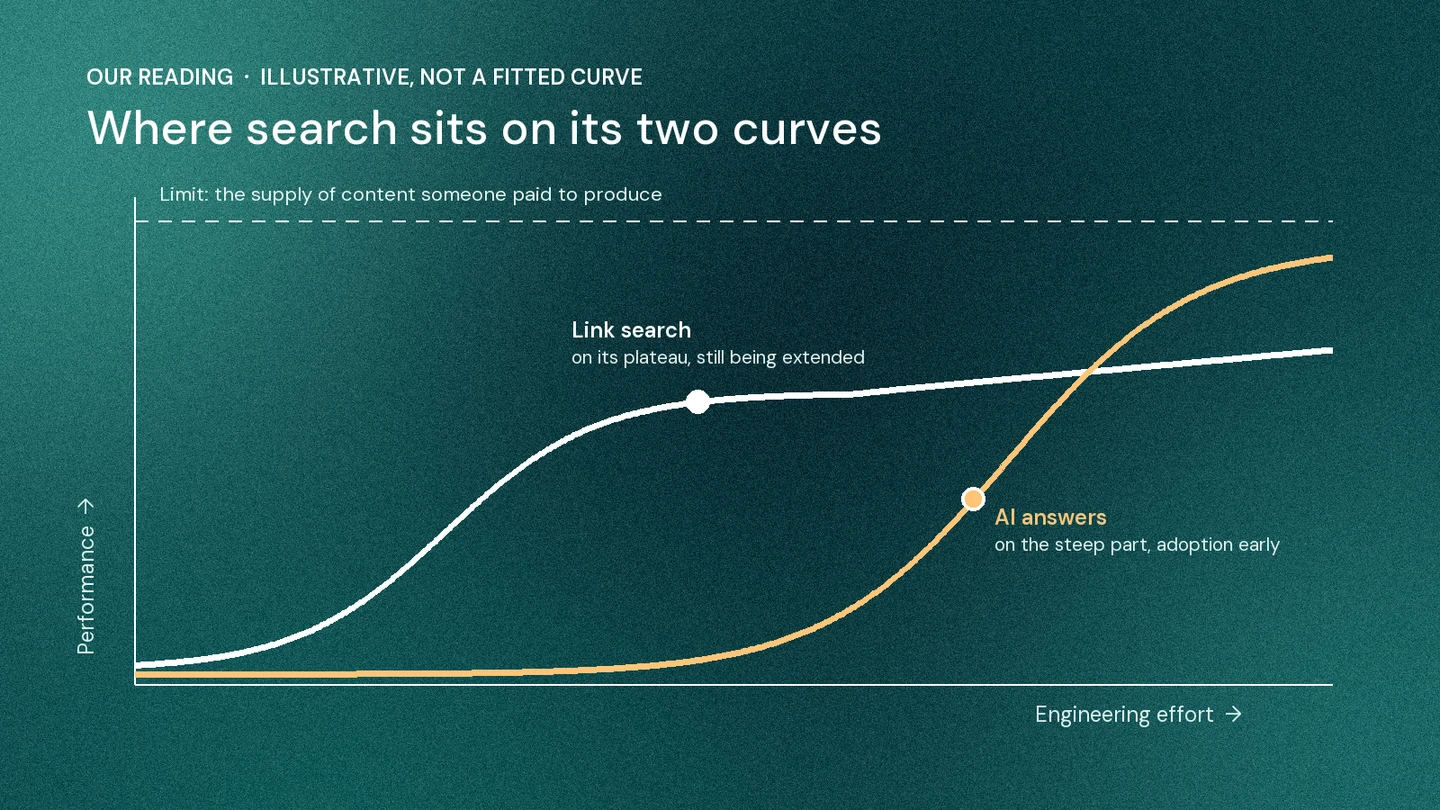
This is our reading, with the evidence for each part.
Link search has reached its plateau, but it is still being improved. User effort was already close to its minimum around 2020, long before AI answers. But Google's revenue growth is rising and investment keeps growing. The disk drives behaved the same way: the old technology kept improving for ten more years after people called it finished.
AI answers are on the fast part of their own curve. Accuracy is still improving quickly, the engines disagree with each other, and use is still low, at about 1% of web traffic. This is a technology in its growth phase, not close to its limit.
The real limit is economic. The limit for AI answers is not computing power. It is whether people keep paying to create the content that AI needs. This is the number to watch in the next quarters.
So "SEO is dead, GEO is king" does not match the data. Both methods run at the same time, in the same system, for the same users, and one still feeds the other. The job is to do both well and to measure them separately.
What agencies should do
Don't predict the end of Google
The channel that still brings most traffic is growing, and its owners are investing hundreds of billions in it. Clients who cut SEO because they expect a collapse repeat Control Data's mistake. * WebGlazer tracks Google AI Mode next to ChatGPT, Gemini and Perplexity, so you can show clients both sides of search.
Split reports by query type
Report searches with an AI answer separately from searches without one. This explains most of the traffic loss clients worry about, and often shows the loss is in fact questions that rarely bring customers. * WebGlazer builds prompts from real search demand, so AI tracking matches the keywords you already report on.
Track sources, not one score
An "AI visibility" score that goes from 34 to 37 does not tell you what to do. A list of which pages AI quoted for a client's buying questions, and which pages it quoted for competitors, is a task list. * WebGlazer reads answers from the real consumer apps, not the API. In our tests, API answers named about half as many competitors, so app data shows more sources and more precise results.
Fix the company facts first
The most serious AI errors in our Baltic data mixed up companies: facts about a parent group were given to its local company. Make the facts consistent on the website, in business registers and in directories. It is cheap to fix. * WebGlazer's gap analysis turns missing or wrong facts into a list of fixes, in order of importance.
Use one measuring tool per line
When you show a client a trend, use one data source for each line and name it. Most alarming charts online break this rule. * WebGlazer asks each engine the same prompts every time and reports each engine separately, so trends stay comparable.
Measure before you change things
Start measuring before you change anything. Otherwise you will never know which work moved the numbers. This step costs the least and is the one most people skip. * WebGlazer starts tracking on the day you add a client and tracks every day, with client-ready reports on agency plans.
Limitations
The industry data comes from different companies with different methods. We can show their numbers side by side, but we cannot combine them. We only have accuracy data for AI answers, not for link search. Google does not publish its own quality data, so everything here is an indirect measure.
Some 2026 AI test scores come from collected leaderboards, not from original research papers. Tools that measure AI Overviews disagree by up to 30 points for the same month. The chart with both S-curves shows our interpretation, not a mathematical model. We need at least eight data points for each series before we can fit real curves.
We also sell AI visibility software, so we have an interest in AI search being important. That is why we wrote our expectations down before we saw the data, and why we publish the ones that were wrong.
Add AI visibility to your SEO retainers
Your clients are already asking about AI search. With WebGlazer agency plans you track their buying questions in ChatGPT, Gemini, Perplexity and Google AI Mode every day, see which pages each answer used, and send client-ready reports. A new service you can add to the retainers you already have.
Book an agency demoSources
Framework
Christensen, C. M. (1992). Exploring the limits of the technology S-curve, Part I: Component technologies. Production and Operations Management, 1(4), 334 to 357.
Henderson, R. M., & Clark, K. B. (1990). Architectural innovation: the reconfiguration of existing product technologies and the failure of established firms. Administrative Science Quarterly, 35(1), 9 to 30.
Abernathy, W. J., & Utterback, J. M. (1978). Patterns of industrial innovation. Technology Review, 80(7), 40 to 47.
How AI search works
arXiv:2602.17518 (2026). On how agentic search changes retrieval and ranking, preprint.
Google (2025). Expanding AI Overviews and introducing AI Mode.
Search Engine Journal (2025). Query fan-out technique in AI Mode: new details from Google.
Search Engine Land. Why your content doesn't appear in AI Overviews (BrightEdge data).
Microsoft Bing (2025). Introducing Copilot Search in Bing.
User effort and clicks
_SparkToro and Similarweb (2021). In 2020, two-thirds of Google searches ended without a click._
_SparkToro and Datos (2024). Zero-click search study, US and EU._
_SparkToro and Jumpshot (2019). Less than half of Google searches now result in a click._
_Seer Interactive (2026). AI Overview impact on Google CTR, 2026 update._
Revenue and investment
_Alphabet Inc. quarterly earnings releases, Search & other revenue, via SEC EDGAR._
Alphabet, Microsoft, Amazon and Meta 10-Q and 10-K filings, purchases of property and equipment, 2019 to 2026, via SEC EDGAR.
Accuracy benchmarks
_Phan, L. et al. (2025). Humanity's Last Exam. arXiv:2501.14249._
_Google DeepMind (2025). SimpleQA Verified. arXiv:2509.07968._
_Scale AI. Humanity's Last Exam leaderboard._
Supply and diffusion
_Cloudflare (2025). The crawl-to-refer ratio on Cloudflare Radar._
_Cloudflare (2025). Radar 2025 year in review._
_Similarweb (2026). Generative AI landscape report._
OpenAI public disclosures of ChatGPT weekly active users, 2023 to 2026.
Companion study
_WebGlazer Research (2026). Baltic AI Visibility Index 2026._
Every data point in our dataset has its source and link. We read the data again every quarter and will publish updates, including results that go against us. You can ask for the dataset at support@webglazer.com.
Frequently asked questions
How to measure the impact of AI Overviews on organic traffic?
Split your queries into those that trigger an AI Overview and those that don't, then compare click-through for the two groups over time from one consistent source such as Search Console. In Seer Interactive's cohort, click-through on queries with an AI Overview fell from 3.19% to 1.31% during 2025 while queries without one held near 3%.
How does Google AI Overviews choose which sources to cite?
AI Overviews use Google's normal search index and ranking. Google splits the question into several smaller searches (query fan-out) and the model writes an answer from the pages it finds. A study of 120,000 queries by Botify and DemandSphere found 75% of AI Overview links come from the top 12 organic results, so classic SEO still decides most of what gets cited.
What is RAG in SEO?
RAG means retrieval-augmented generation. The AI engine first retrieves pages with a classic search system, then a language model writes an answer from them. For SEO this means crawling, indexing and ranking still decide which pages the AI can use. Only query fan-out and answer generation are new.
How much traffic do AI Overviews take from organic search?
On the queries where they appear, click-through roughly halved during 2025 in Seer Interactive's tracking, then recovered to 2.36% by February 2026. Queries without an AI Overview were not affected, so the real impact depends on how much of a site's traffic comes from queries that trigger one.
How to explain a traffic drop from AI Overviews to a client?
Show the drop split by query type. Losses usually sit in informational queries that now get an AI answer and rarely convert, while commercial queries hold up. Back it with Google's own numbers: Search revenue growth rose from 9.8% in Q1 2025 to 17 to 19%, so the channel itself is not shrinking.
Is zero-click search increasing in 2026?
Barely. On the same Similarweb US panel, zero-click searches were 68.3% in Q4 2020 and 68.0% in April 2026. Charts showing a sharp rise usually splice data from different measurement panels.
Is SEO dead in 2026?
No. Link search is on its plateau but is being actively extended: Alphabet's Search revenue is growing 17 to 19% a year and the four largest hyperscalers spent $376 billion on capex in 2025. AI answers are growing alongside it, not replacing it.
How to track which sources ChatGPT and Perplexity cite for a brand?
Run the buying questions a client's customers ask, without the brand name, on each engine repeatedly, and record which pages every answer cites and which competitors it names. Use the consumer apps rather than the API where you can: in our tests API answers without live search named about half as many competitors.
How to fix wrong information about a company in AI answers?
Start with entity consistency. The most serious errors we found were mixed-up entities, where a parent group's facts were pinned on its local company. Make the company name, legal entity, location and offering consistent across the website, business registries and directories the engines cite.