AI Visibility ToolsNovember 19, 2026
8 Best AI Overview Tracking Tools in 2026 (Compared)
12 minutes read

Key takeaways
- Pick by where you already work: Semrush and SE Ranking users can track AI Overviews inside their rank tracker.
- For exact cited URLs on a schedule, AIclicks and keyword.com list them; keyword.com starts at $4 a month.
- For a one-off look, the free WebGlazer AI Overview checker shows whether a keyword has an AI Overview and which pages it cites.
Google now shows an AI Overview above the normal results on 61% of US searches in DataForSEO's keyword panel (August 2026). So a page can rank well and still not be one of the sources Google quotes. An AI Overview tracking tool checks your keywords on Google, records whether an AI Overview appears and shows which pages it cites.
Below are 8 tools that do this, compared on what they check, whether they show the cited URLs, which other AI engines they cover and what they cost. Want a quick one-off check first? Our free AI Overview checker shows whether a keyword triggers an AI Overview and which pages it cites.
Your buyers are asking AI. Are you in the answer?
WebGlazer tracks your brand across every major AI engine on the prompts your customers actually search, so you know where you stand and what to fix next.
Start freeWhat are Google AI Overviews?
Google AI Overviews are AI-generated summaries that appear at the top of Google search results pages (SERPs) for certain queries. Their primary function is to provide direct, concise answers to user questions, often synthesizing information from multiple sources found across the web. Instead of simply listing links, AI Overviews aim to deliver immediate value by answering the query directly within the search interface.
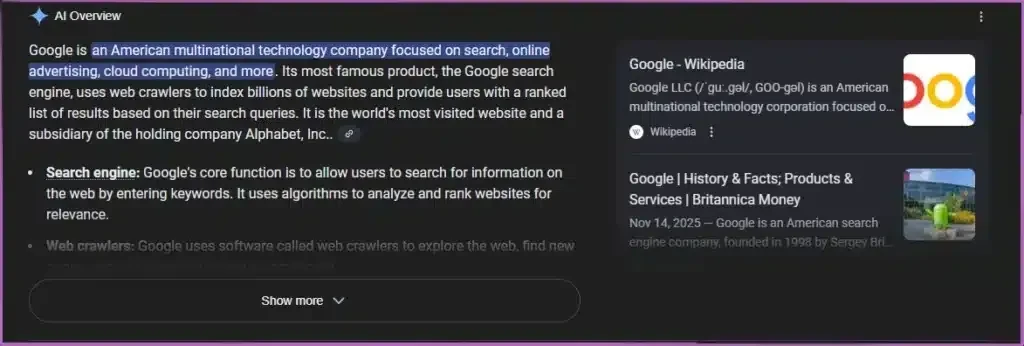
These AI-powered summaries can significantly impact traditional search results. By offering direct answers, they can reduce the need for users to click through to individual websites, potentially affecting organic traffic to publishers. For businesses, this means that being cited as a source within an AI Overview becomes incredibly important. It represents a new form of visibility and authority, signaling to users (and potentially to Google's algorithms) that your content is trustworthy and relevant. Understanding how AI Overviews work, which queries trigger them, and whether your content is being cited is crucial for any modern digital strategy.
The 8 AI Overview tracking tools at a glance
Prices are the cheapest plan each vendor listed on 19 November 2026. Where a vendor showed euros, we give euros.
| Tool | Best for | AI Overview tracking | Cited URLs | Other AI engines | Starts at | Free option |
|---|---|---|---|---|---|---|
| WebGlazer | Marketing teams and agencies | Free AI Overview checker for one-off checks | Yes, in the checker | ChatGPT, Perplexity, Gemini, Google AI Mode, Bing AI Mode | $69/mo billed annually ($79 monthly) | 7-day free trial |
| Omnia | Next steps from your data | Not stated; tracks prompts every 24 hours | Citations; URL list not stated | ChatGPT, Perplexity, AI Mode; Claude, Gemini, Bing AI Mode on request | €79/mo | 14-day trial |
| Thruuu | Content teams and SEOs | Your keywords, checked on Google | Yes | ChatGPT, AI Mode, Gemini, Perplexity (Pro) | $33/mo (Pro) | 10 free credits |
| ZipTie | AI Overviews next to organic rankings | Prompts, daily, weekly or monthly | Your own cited pages | ChatGPT, Perplexity, AI Mode, Copilot, Gemini | $25.65/mo | 7-day trial, no card |
| SE Ranking | Existing SE Ranking users | Your tracked keywords | Yes, domains and URLs | AI Mode, Gemini, ChatGPT, Copilot (add-on) | €87.20/mo (Core) | 14-day trial |
| keyword.com | Low-cost keyword tracking | Your keywords, weekly or daily | Yes, with HTML snapshot | Separate AI Search Visibility plan | $4/mo (50 keywords, annual) | 14-day trial, no card |
| AIclicks | Daily checks with exact sources | Your keywords, every 24 hours | Yes, exact URLs | AI Mode, ChatGPT, Perplexity, Gemini, Copilot, Claude, Grok | $59/mo | 3-day trial, card needed |
| Semrush | Existing Semrush users | AI Overviews filter in Position Tracking | Your own domain only | ChatGPT, Gemini, Perplexity (AI Visibility) | €134/mo (SEO plan) | 7-day trial |
1. WebGlazer: best for marketing teams and agencies
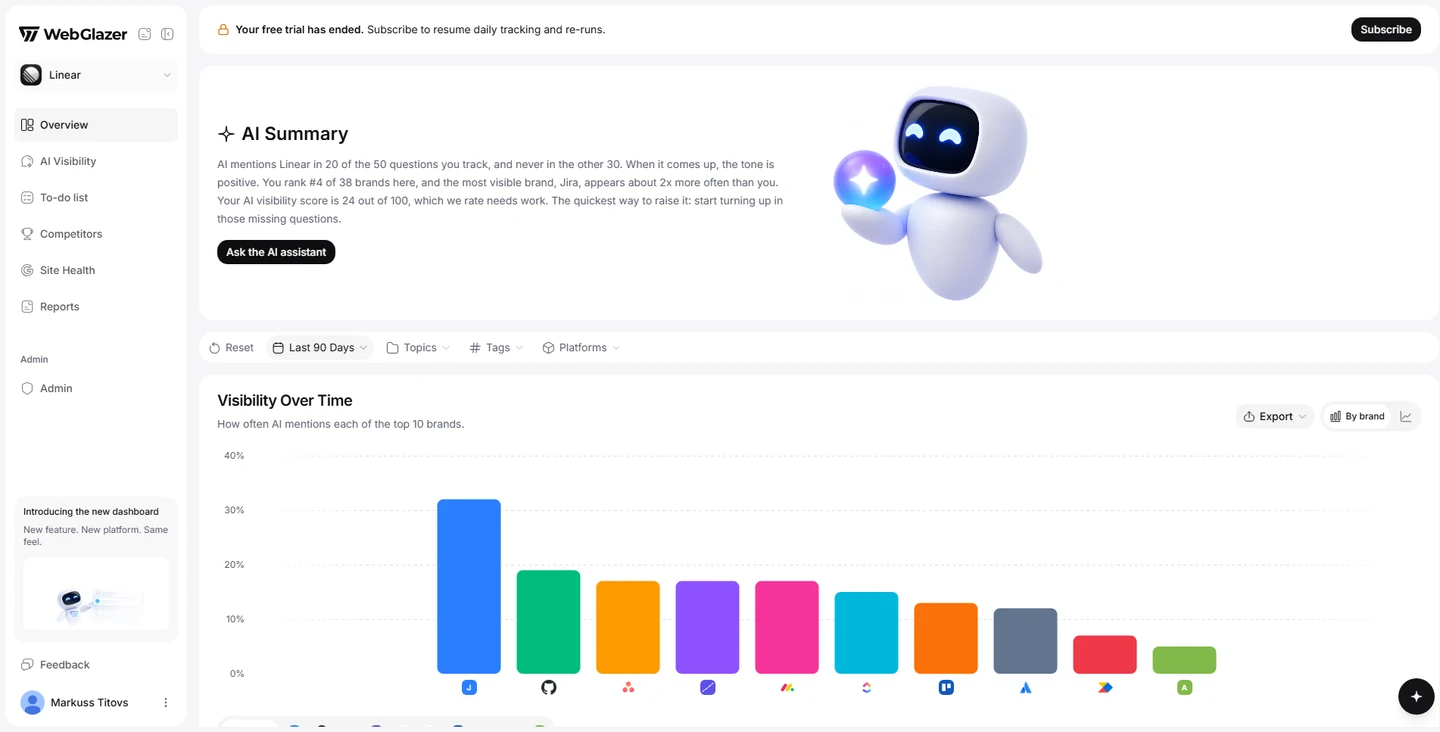
WebGlazer stands out as a powerful solution for strategic marketing teams and agencies seeking comprehensive AI visibility. It offers a unique approach to monitoring your brand's presence across the evolving AI ecosystem, moving beyond simple keyword tracking to provide deep, actionable insights.
WebGlazer's core strength lies in its ability to monitor whether major AI models like ChatGPT, Perplexity, Gemini, Google AI Mode, and Bing AI Mode name your brand or your competitors. It meticulously checks every AI response for validity and allows you to drill down to the exact AI output for verification. This level of detail ensures you understand precisely how your brand is being represented.
A key differentiator is WebGlazer's focus on competitor share-of-voice and average position on the same buyer prompts. This means you can see exactly which AI recommends your competitors instead of you, providing crucial competitive intelligence. Furthermore, WebGlazer builds its prompts from real keyword clusters and search volume, then shapes each prompt to reflect the keyword's buying intent. This ensures you're tracking demand-backed questions that people actually search, rather than generic prompts invented out of thin air. For instance, a high-intent keyword might be transformed into a buying-stage prompt asking which tool to purchase to improve AI visibility.
The tool also tracks which sources and domains the AI cites within your category, revealing who the AI trusts for specific topics. WebGlazer then pinpoints the exact gaps between your brand and your competitors, identifying prompts and topics where they are named or cited, and you are not. It transforms these gaps into a prioritized fix list, which can be pushed to a built-in to-do workflow. This systematic approach allows you to first achieve parity with competitors and then strategically get ahead.
To further streamline optimization, WebGlazer includes an AI agent that drafts and performs improvement work, such as generating content or fixes to boost your AI visibility, ready for your review and approval. For advanced users, it ships with an MCP server, providing your own AI agent endpoint, allowing you to connect tools like Claude or Cursor and query your visibility data directly. Agencies will appreciate its robust support for white-labeling and multi-client workspaces, making it an ideal choice for managing diverse client portfolios.
Key Features:
• Multi-engine AI visibility tracking (ChatGPT, Perplexity, Gemini, Google AI Mode, Bing AI Mode)
• Validation of AI responses and drill-down to exact output
• Competitor share-of-voice and average position on buyer prompts
• Demand-backed prompt generation from real keyword clusters and buying intent
• Source and domain citation tracking
• Gap analysis and prioritized fix list with built-in workflow
• AI agent for content drafting and improvement work
• MCP server for direct AI agent querying (e.g., Claude, Cursor)
• Agency white-label and multi-client workspaces
Pros:
• Highly strategic insights based on real user intent
• Actionable recommendations and automated content drafting for optimization
• Comprehensive competitive analysis
• Advanced technical capabilities for direct AI integration
• Scalable for agencies with white-label support
Cons:
• May have a steeper learning curve due to advanced features
Pricing: From $69/mo billed annually ($79 month to month). 7-day free trial.
2. Omnia: best for next steps from your data
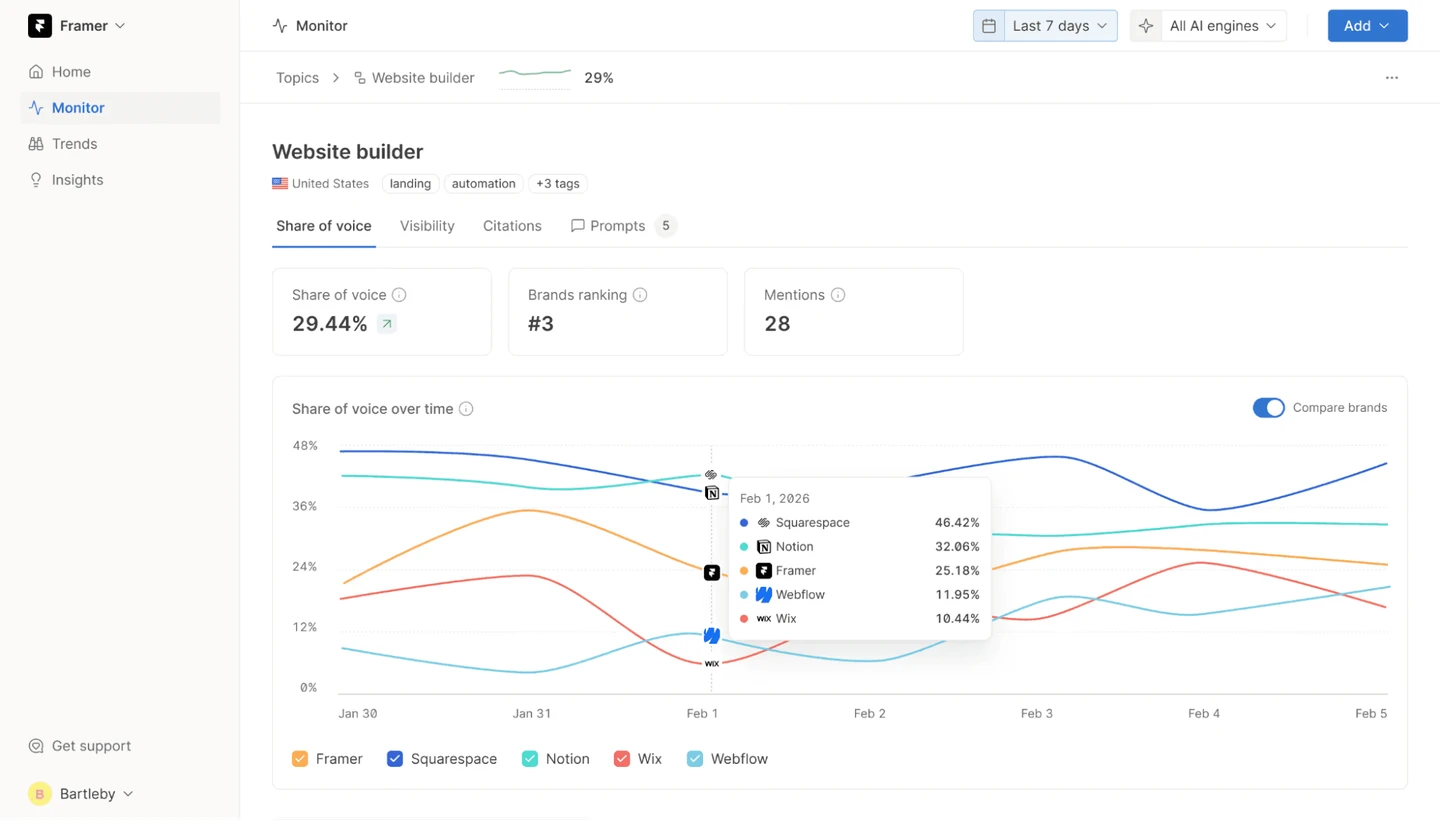
Omnia tracks a set of prompts every 24 hours in ChatGPT, Perplexity and Google AI Mode, and adds Claude, Gemini and Bing AI Mode on request. Its pitch is turning the data into actions, with a citation-level gap analysis that shows where competitors are cited and you are not. Its pages do not say that it tracks the AI Overviews in normal Google results.
- Strength: it shows you how to act on the data, not only the numbers.
- Limitation: the cheapest plan covers 25 prompts, and Claude and Gemini are only on request.
- Pricing: Growth €79/month, or €63/month billed yearly. 14-day free trial, no card.
3. Thruuu: best for content teams and SEOs
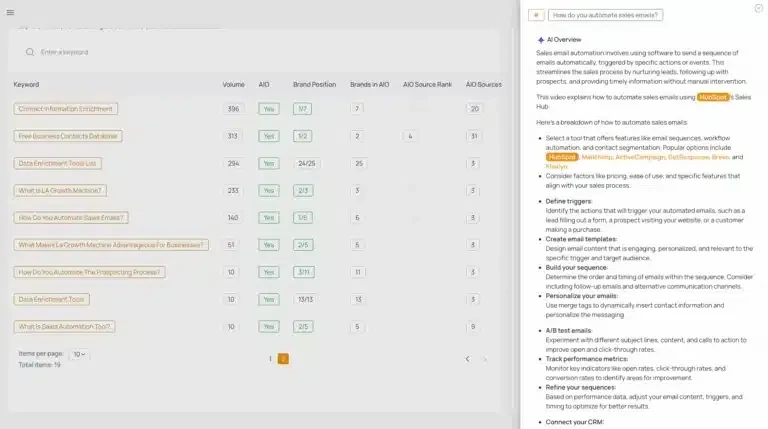
Thruuu works from a keyword list. You upload keywords, it searches Google for each one and records whether an AI Overview shows and whether your domain is among its source URLs. The Pro plan adds ChatGPT, Google AI Mode, Gemini and Perplexity.
- Strength: it flags keywords where your site is used as a source but your brand is not named in the answer.
- Limitation: checks cost 50 credits per 1,000 keywords, and comparing one run with the next is only on the Agency plan.
- Pricing: Pro from $33/month. A free plan gives 10 one-time credits.
4. ZipTie: best for AI Overviews next to organic rankings
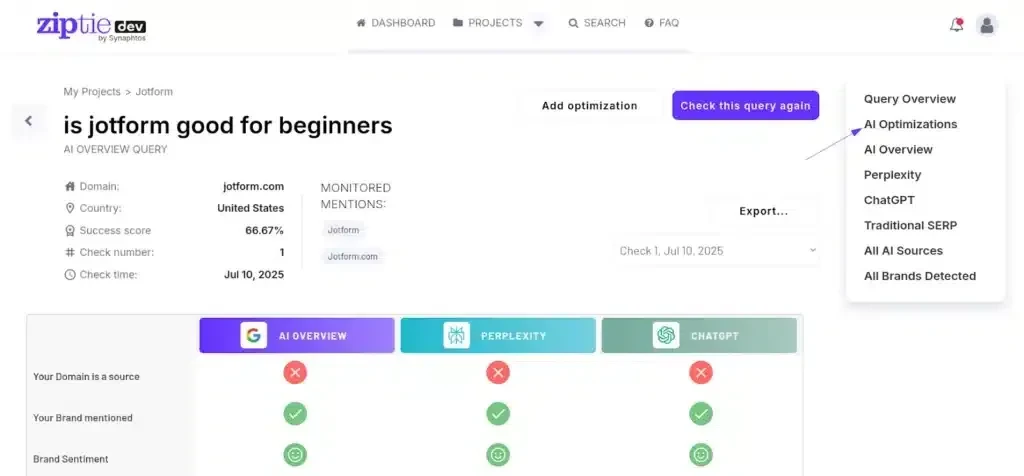
ZipTie (now at ziptie.ai) checks a set of prompts daily, weekly or monthly across Google AI Overviews, AI Mode, ChatGPT, Perplexity, Copilot and Gemini. For AI Overviews it puts the answer next to your top 10 organic results at no extra cost, so you see both in one view.
- Strength: AI Overview answers and organic rankings side by side.
- Limitation: nothing can be backfilled, so your history starts on the day of your first check.
- Pricing: Starter from $25.65/month. 7-day trial with 25 daily prompts, no card.
5. SE Ranking: best for existing SE Ranking users
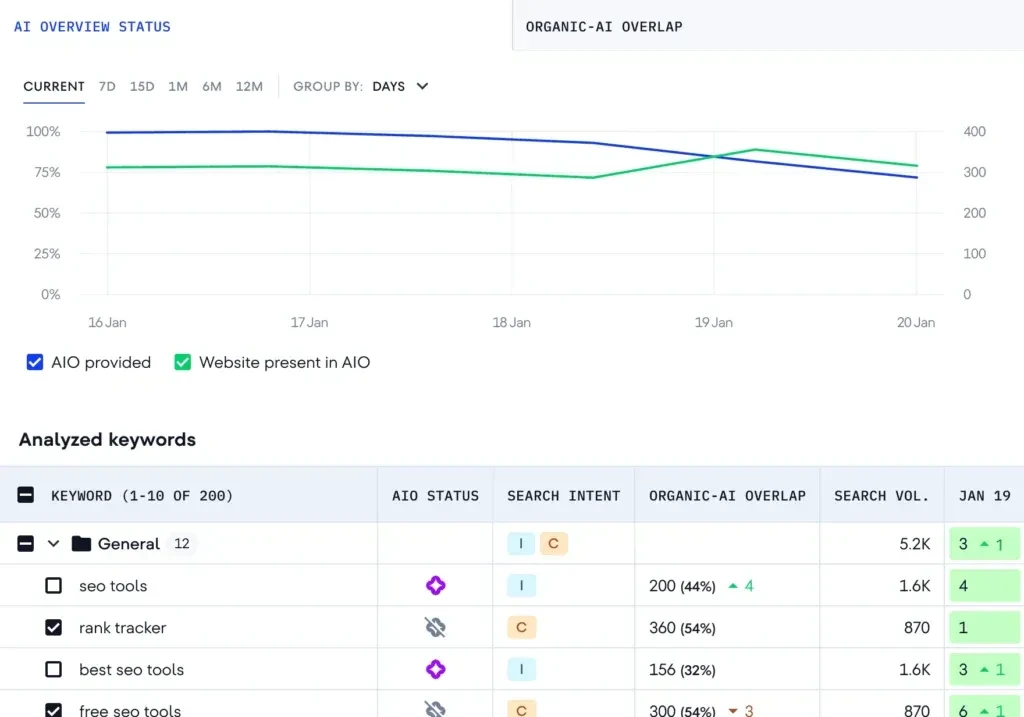
SE Ranking's AI Overviews tracker sits inside its rank tracker and works on the keywords you already track. It shows the domains and the individual URLs used as sources. Its AI visibility add-on also covers AI Mode, Gemini, ChatGPT and Copilot.
- Strength: URL-level source data inside a rank tracker many SEO teams already use.
- Limitation: SE Ranking itself says the range of keywords that trigger AI answers is currently limited.
- Pricing: Core €87.20/month (pricing page; it does not say which plan includes the tracker). 14-day trial, no card.
6. keyword.com: best low-cost keyword tracker
keyword.com tracks Google AI Overviews for your keywords with weekly or daily updates. It records the exact URLs and snippets used in each answer and keeps an HTML snapshot of the result. ChatGPT, Perplexity, Gemini and other engines are in a separate AI Search Visibility plan.
- Strength: the HTML snapshot, which works as proof of what Google showed on a given day.
- Limitation: other AI engines need the separate plan.
- Pricing: Search Visibility from $4/month for 50 keywords, billed annually. 14-day trial, no card.
7. AIclicks: best for daily checks with exact sources
AIclicks runs every keyword you track against Google every 24 hours and lists the exact URLs Google pulls into each AI Overview. It also tracks AI Mode, ChatGPT, Perplexity, Gemini, Copilot, Claude and Grok.
- Strength: CSV export and charts of each site's share of citations.
- Limitation: the Starter plan covers 1 website, 1 country and 3 AI engines.
- Pricing: Starter $59/month. 3-day trial, card required.
8. Semrush: best for existing Semrush users
If you already pay for Semrush, its Position Tracking tool has an AI Overviews filter that shows the keywords where your domain is a source. The separate AI Visibility toolkit tracks ChatGPT, Gemini, Perplexity and Google AI.
- Strength: AI Overview tracking inside a rank tracker you may already use.
- Limitation: it only shows your own domain's citations, and it counts a citation as a #1 ranking even when the page ranks lower organically.
- Pricing: SEO plan €134/month (€112.52 billed yearly). AI Visibility €94.94/month per domain, billed yearly. 7-day trial.
How we picked
We read each vendor's own pricing and product pages on 19 November 2026 and kept tools that check Google AI Overviews, or Google's other AI answers, for your keywords or prompts. Where a vendor's page does not state something, we say so instead of guessing.
How to track AI Overviews
- Pick the keywords that matter: the ones you already rank for on page one, and the ones with buying intent.
- Check each keyword for the country, language and device your customers use. AI Overviews differ between them.
- Record whether an AI Overview shows, which pages it cites and where your page sits in that list.
- Compare that with your organic rank. Keywords where you rank on page one but are not cited are the first to fix.
- Repeat on a schedule. AI Overviews change, and most tools cannot fill in history you did not record.
For a one-off look at a single keyword, use our free AI Overview checker. For daily tracking, pick one of the tools above.
How to pick the right tool
Choosing the right AI Overviews monitoring tool requires a clear understanding of your team's specific goals, workflows, and budget. It's not just about finding the tool with the most features, but the one that best aligns with your strategic objectives.
First, consider your primary business goals. Are you primarily focused on defending existing organic traffic that might be cannibalized by AI Overviews, or are you looking to proactively build brand awareness and establish authority within this new search paradigm? Tools vary in their emphasis; some excel at identifying threats to current rankings, while others are designed to help you seize new opportunities for AI visibility.
Next, evaluate your team's workflow. Content creators might prioritize tools with integrated content brief generation or deep content analysis capabilities, like Thruuu, to directly inform their writing process. Data analysts, on the other hand, might need tools with extensive export options, APIs, and granular filtering for in-depth reporting and trend analysis. Strategic marketing teams might lean towards tools that offer comprehensive competitive intelligence and actionable fix lists, enabling them to make data-driven decisions quickly.
A crucial point often overlooked is the quality of the data being tracked. Most tools track generic AI responses, which can be misleading. The real value, and a key differentiator in this evolving space, is monitoring AI Overviews for demand-backed questions derived from real keyword clusters and buying intent. If a tool simply generates prompts out of thin air, the insights it provides might not translate into tangible business impact. Ensure the tool you choose can connect AI responses back to actual user search behavior and commercial intent.
Finally, consider the true cost beyond just the subscription fee. Factor in the time your team will spend learning and using the tool, the resources required to act on its insights, and whether it integrates well with your existing tech stack. A cheaper tool that provides irrelevant data or requires significant manual effort might end up being more expensive in the long run. Prioritize tools that offer a clear path from insight to action, ensuring your investment yields measurable results.
Is tracking AI Overviews enough?
While monitoring Google AI Overviews is undoubtedly critical, relying solely on this singular aspect of AI visibility might not be sufficient for a comprehensive digital strategy in the long term. The AI landscape is rapidly expanding beyond just Google's search results, encompassing a broader ecosystem of generative AI models and platforms.
The concept of Generative Engine Optimization (GEO) is emerging as a more holistic approach. GEO recognizes that brand visibility now extends to large language models (LLMs) like ChatGPT, Perplexity, Gemini, and others, which users increasingly turn to for information, recommendations, and direct answers. These platforms operate differently from traditional search engines, and being cited or recommended by them requires a distinct optimization strategy.
Solely tracking AI Overviews might give you a narrow view of your brand's overall AI presence. For instance, a user might ask ChatGPT for product recommendations, or use Perplexity for research, where your brand's visibility could be entirely different from its standing in Google AI Overviews. A broader strategy for AI visibility involves understanding how your content performs across this entire AI ecosystem, identifying which LLMs cite your sources, and analyzing the sentiment and context of those mentions.
Therefore, while an AI Overview monitoring tool is an essential component, consider it part of a larger GEO strategy. This broader approach ensures your brand remains relevant and discoverable wherever users are engaging with generative AI, safeguarding your brand's future visibility and authority in an increasingly AI-driven digital world.
Your buyers are asking AI. Are you in the answer?
WebGlazer tracks your brand across every major AI engine on the prompts your customers actually search, so you know where you stand and what to fix next.
Start freeFrequently asked questions
How do you track AI Overviews?
Choose your keywords, check each one on Google for your country, language and device, and record whether an AI Overview shows and which pages it cites. A tracking tool repeats this on a schedule so you see changes over time.
Which AI Overview tracker is the best?
It depends on where you already work. Semrush and SE Ranking users can track AI Overviews inside their rank tracker. keyword.com is the cheapest start at $4 a month, AIclicks checks daily with exact cited URLs, and WebGlazer covers ChatGPT, Perplexity, Gemini, AI Mode and Bing AI Mode.
Is there a free AI Overview tracker?
For one-off checks, yes: the free WebGlazer AI Overview checker shows whether a keyword has an AI Overview and which pages it cites, with no signup. For ongoing tracking, Thruuu has a free plan with 10 credits and most other tools offer a trial.
Do normal rank trackers show AI Overviews?
Some do. Semrush Position Tracking has an AI Overviews filter, SE Ranking tracks AI Overview sources for your tracked keywords, and Ahrefs Rank Tracker lists AI Overviews among the SERP features it records, with weekly updates.
How often should you check AI Overviews?
Daily for the keywords that matter most. AI Overviews change, and tools such as ZipTie say history cannot be backfilled, so data starts on the day you begin tracking.