ResearchNovember 9, 2026
AI Search Statistics 2026: AI Overviews, Clicks, Citations and What Still Works
18 minutes read

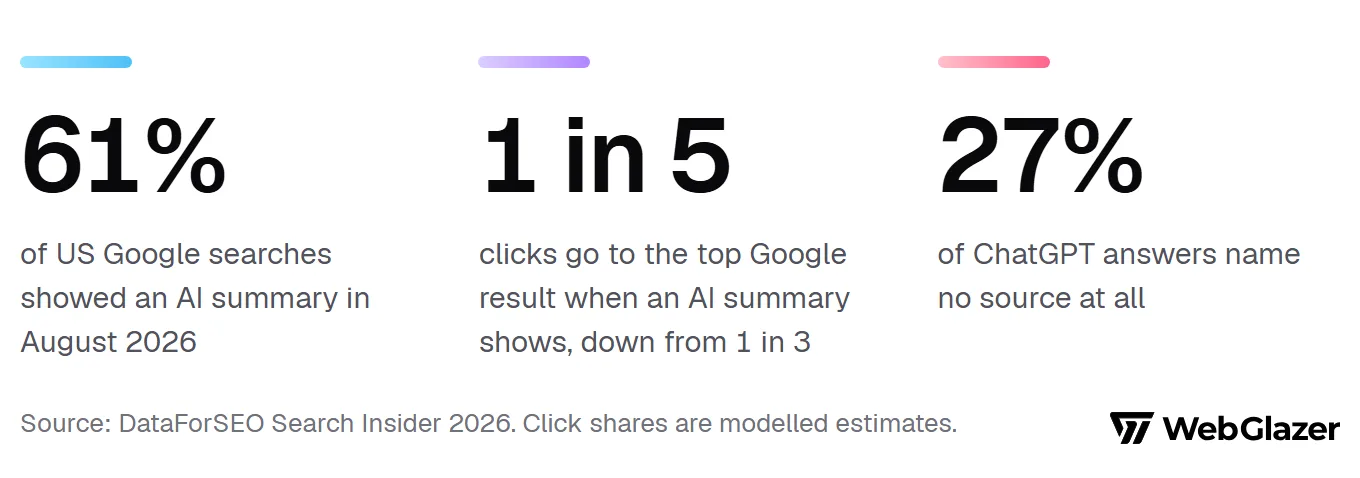
Two years ago, Google showed an AI summary on about 1 in 17 searches. By August 2026 it showed one on more than half. Clicks on the top result fell, and many marketing teams now ask whether SEO still matters.
We collected the biggest AI search studies published this year. Most numbers come from DataForSEO's Search Insider 2026 report on 190 million US keywords. Where studies disagree, we say so. The full source list is at the end.
Key takeaways
- Google shows an AI summary on 61% of US searches, up from 6% two years ago.
- Easy, low-volume keywords get AI summaries too, at least 4 times in 10.
- With an AI summary on the page, the top result gets about 1 in 5 clicks, down from 1 in 3.
- ChatGPT, Claude and Google quote different websites. Check each one.
- SEO still matters. ChatGPT needs extra work on top of it.
- This is US data in English. Test your own market.
What is an AI Overview, and how often does Google show one?
An AI Overview is the AI-written summary Google shows above the normal search results, with links to the pages it drew from. In DataForSEO's monthly panel of 20 million US keywords, AI Overviews appeared on 5.93% of results in September 2024 and on 61.43% in August 2026, a tenfold rise in two years.
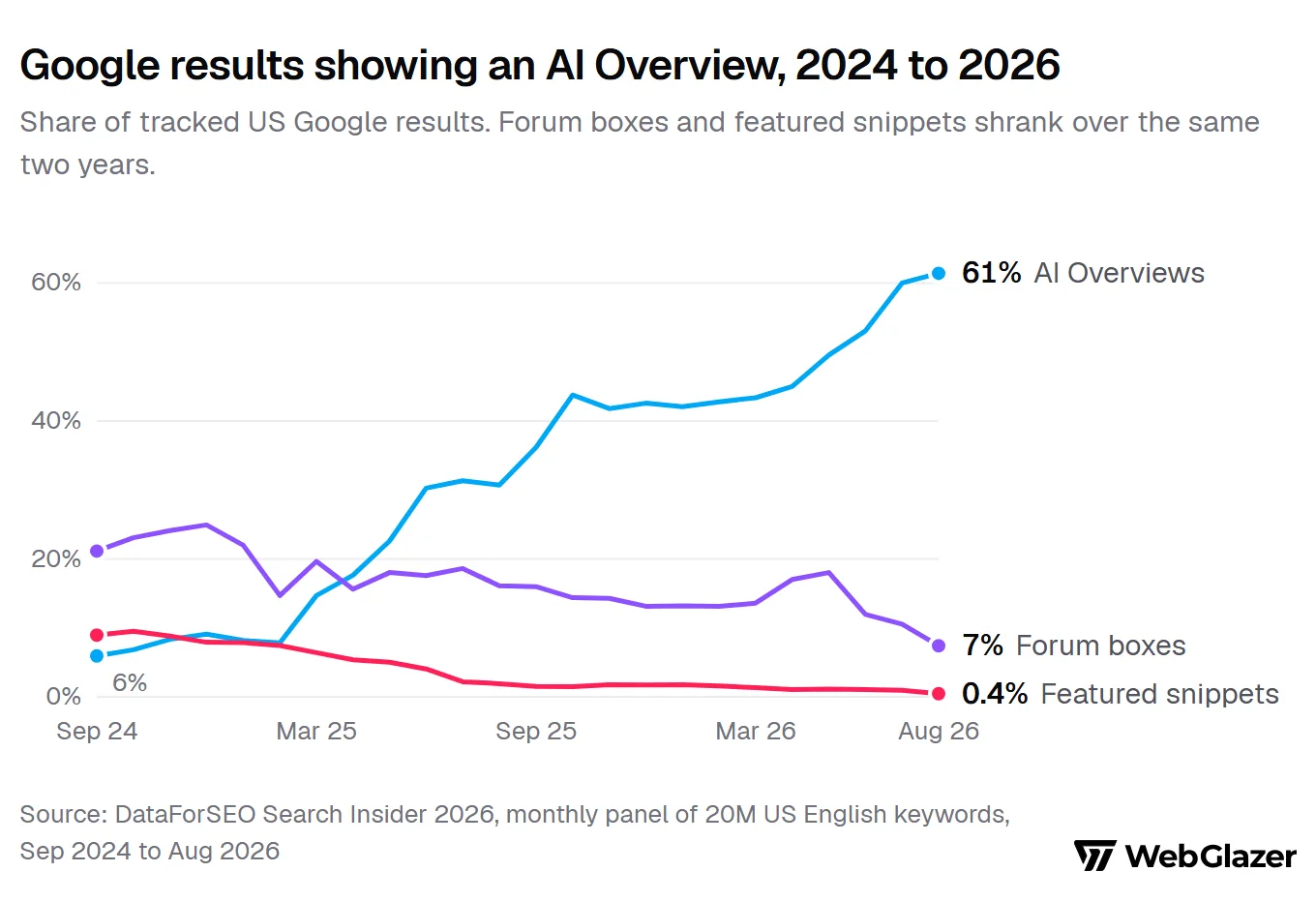
The growth didn't come in a straight line. AI Overviews sat below 10% until early 2025, passed 30% by June 2025, stayed between about 42% and 45% from October 2025 to April 2026, then climbed again to 61% by August 2026. Over the same two years, two older result types nearly disappeared:
- Featured snippets (the quoted answer box at the top) fell from 8.96% of results to 0.44%.
- "Discussions and forums" boxes fell from 21.13% to 7.42%. Reddit's ordinary blue links held steady, which we come back to below.
- Video results doubled, from 9.67% to 19.98%, and local packs grew from 19.98% to 25.99%.
People see these summaries at a huge scale. Google said at I/O in May 2026 that AI Overviews have over 2.5 billion monthly users, and that AI Mode, its full chat-style search, has passed 1 billion.
The query side is changing more slowly. Three- and four-word searches are still the most common. On desktop, searches of five words or more rose from 29.3% to 34.8% of unique queries between September 2025 and August 2026; on mobile, from 29.6% to 31.9% (DataForSEO). People are writing slightly longer, more specific searches, but nobody has stopped using short keywords.
Which searches trigger AI Overviews?
Informational searches trigger AI Overviews most often, but commercial searches grew fastest. In DataForSEO's quarterly panel of 74.9 million results, the rate for commercial searches (people comparing products or services before they buy) went from 26.30% in Q4 2025 to 51.35% in Q3 2026.
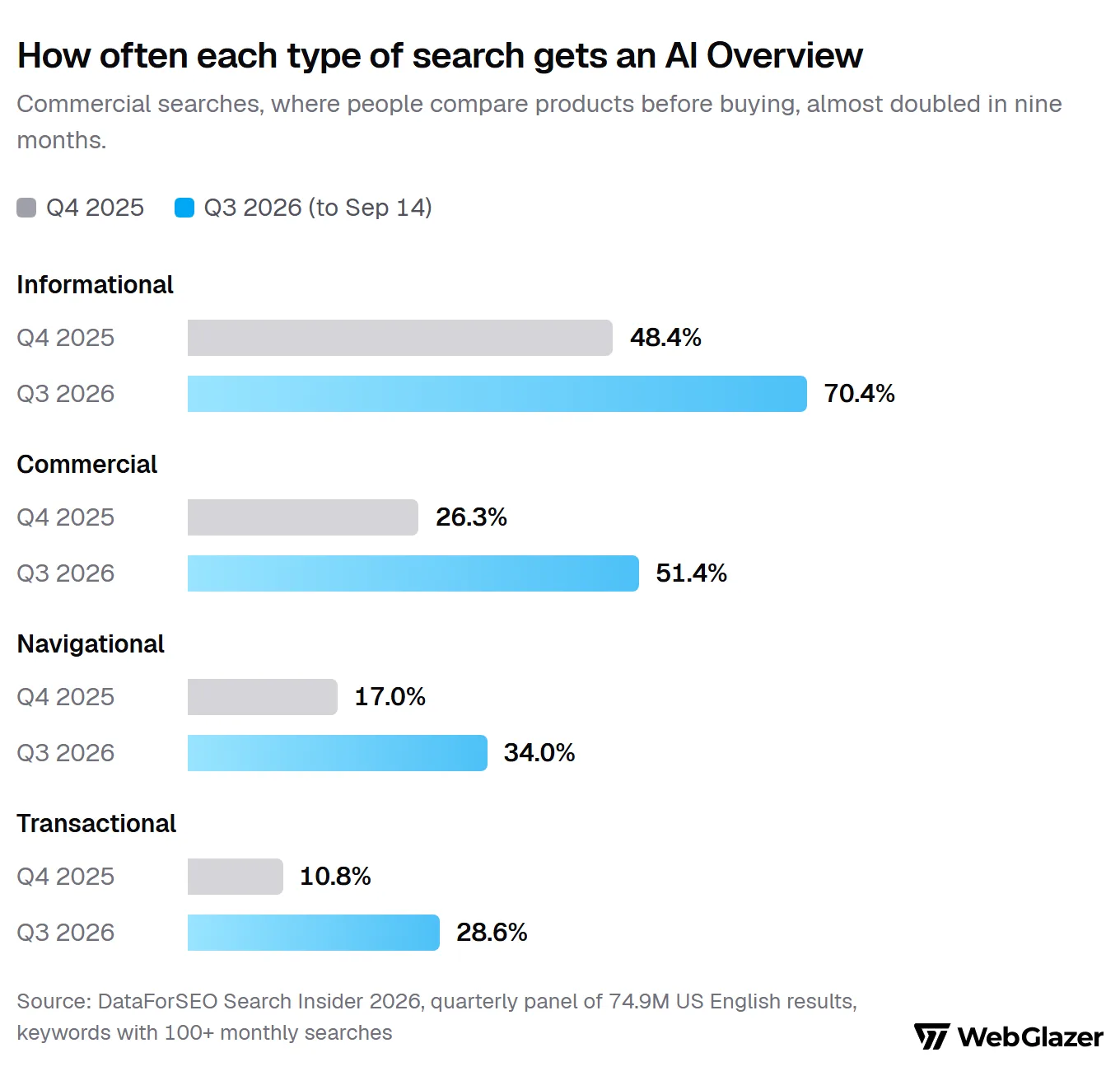
That commercial jump is the change that matters most for revenue. A year ago, a brand comparing "best X for Y" pages could assume most of those searches showed plain blue links. Now about half of them open with an AI answer that names brands before the reader sees a single ranking.
Do easy or low-volume keywords avoid AI Overviews?
No. Picking keywords that are easy to rank for, searched less often or expensive to advertise on doesn't keep you clear of AI Overviews. In DataForSEO's data, every group triggers them at least 42% of the time.
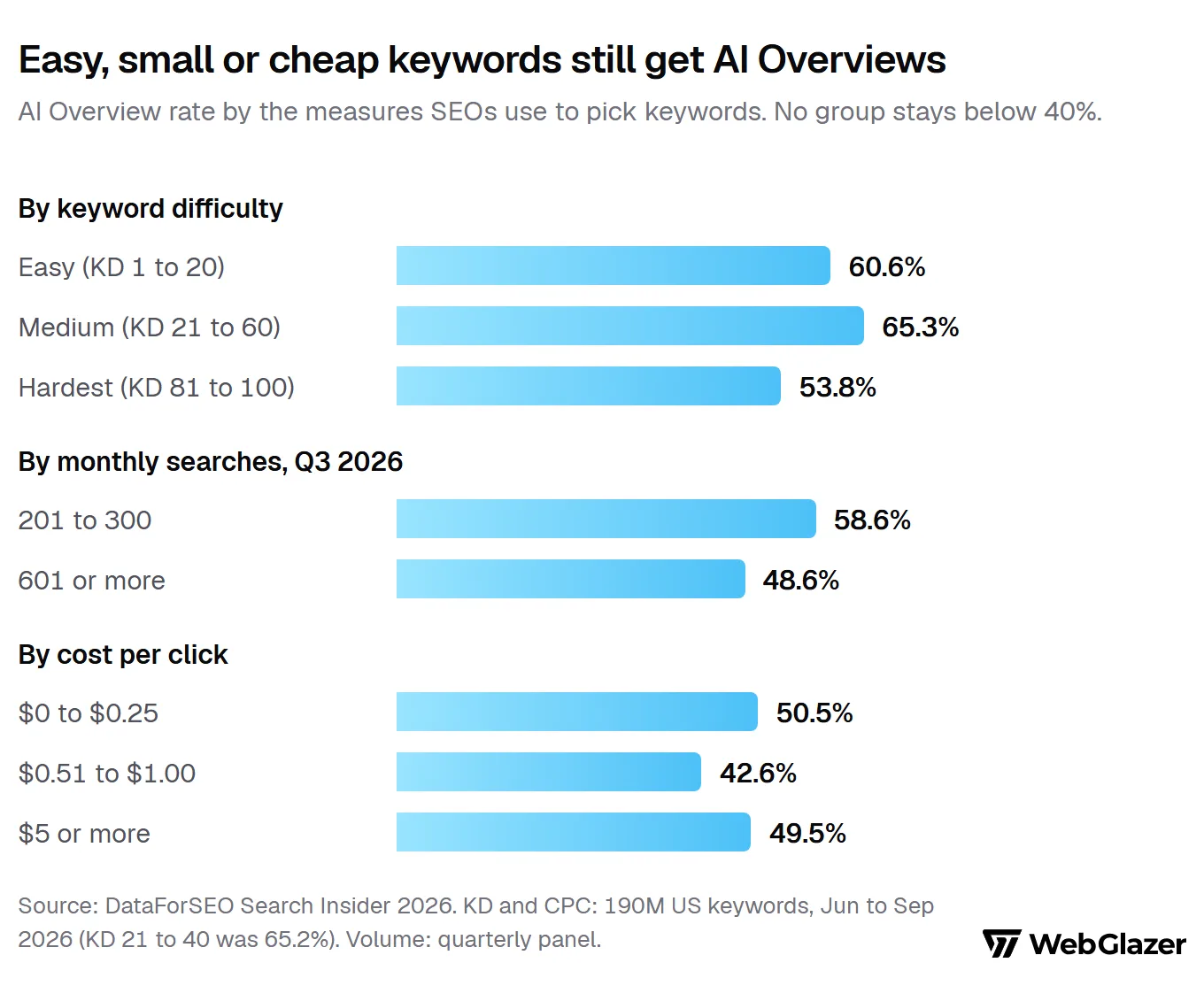
- Keyword difficulty: easy keywords (KD 1 to 20) triggered AI Overviews 60.6% of the time, medium ones (KD 21 to 60) about 65%, and the hardest (KD 81 to 100) 53.8%.
- Search volume: in Q3 2026, keywords with 201 to 300 monthly searches triggered them 58.6% of the time, against 48.6% for keywords with 601 or more.
- Cost per click: the cheapest keywords ($0 to $0.25) reached 50.5%, and keywords costing $5 or more per click 49.5%.
If your keyword plan relies on "low competition" long-tail terms to get clicks, check those terms on Google before you write. A low-difficulty keyword that opens with an AI answer may send far fewer visitors than its volume suggests.
Which industries get the most AI Overviews?
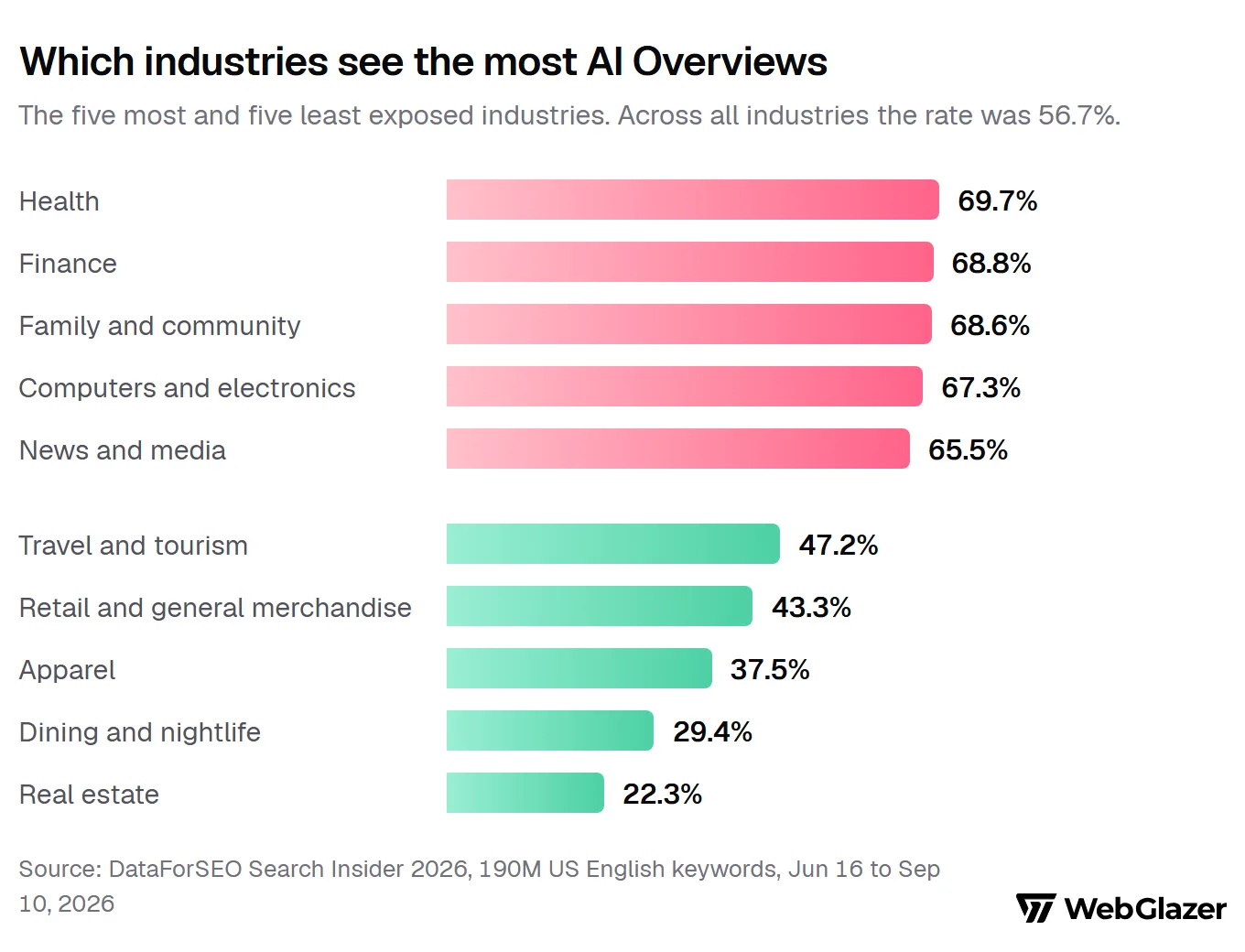
Health and finance searches get AI Overviews most often, and real estate the least. Across 190 million US keywords checked between June and September 2026, the rate was 69.7% for health and 22.3% for real estate, against 56.7% for all industries together.
| Industry group | AI Overview rate | What it means for you |
|---|---|---|
| Health, finance, family and community | 68.6% to 69.7% | Expect an AI answer on most searches. The accuracy of what AI says about you matters as much as whether you appear. |
| Computers and electronics, news, internet and telecom | 63.7% to 67.3% | Product and comparison searches mostly open with AI. Product facts on your own pages carry weight. |
| Most other industries | 47% to 63% | Roughly every other search. Check your own top keywords one by one. |
| Retail, apparel, dining, real estate | 22.3% to 43.3% | Classic results, local packs and shopping results still dominate. Organic rankings still drive most clicks. |
Health and finance are also where wrong AI answers do the most damage. At Profound's Zero Click conference in Singapore, Standard Chartered said it tested more than 5,000 prompts and found that its rates and product facts were often wrong in AI answers. Most of the errors came from the bank's own website, such as old documents and terms and conditions, not from the AI models or third parties. If you work in a high-exposure industry, auditing what AI says about you belongs next to tracking whether it mentions you.
Do AI Overviews reduce clicks?
Yes, for the organic results below them. DataForSEO modelled where clicks go on Google results pages from clickstream data: when an AI Overview appears, the links inside it take an estimated 42 to 45% of clicks, and the #1 organic result's share falls from 33 to 38% to 21 to 24%. Searches that end with no click at all are left out of these shares.
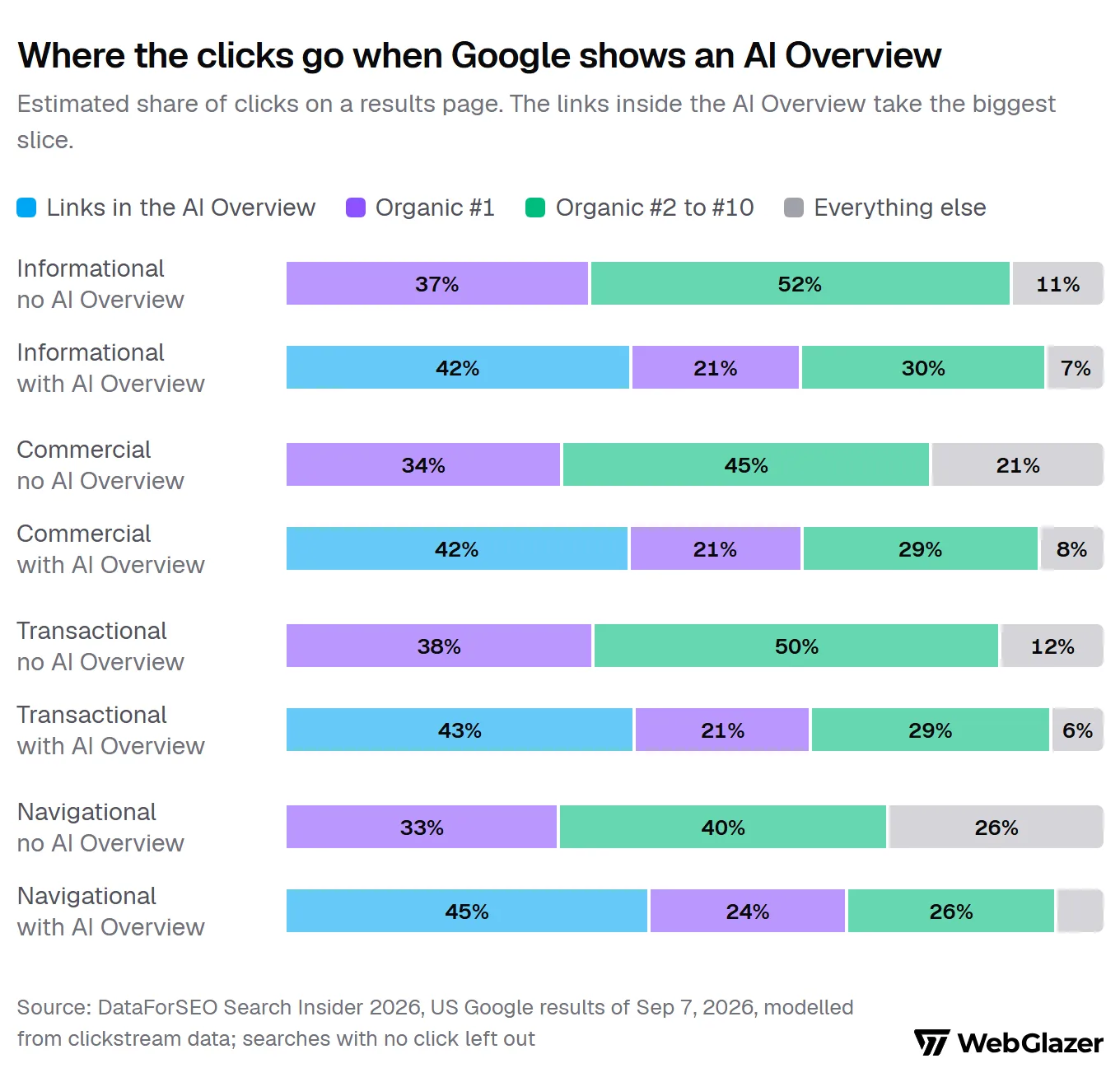
Read the chart this way: the click is still there, but it goes somewhere else. On an informational search without an AI Overview, the #1 result gets about 37% of the clicks. Add an AI Overview and #1 gets about 21%, while 42% go to the pages the AI Overview links to. Being one of those cited pages is now worth more than ranking #2 or #3 underneath.
How much has organic click-through rate dropped?
On desktop, a lot. In DataForSEO's data from more than 2,000 US websites, the click-through rate of the #1 result on desktop fell from 17.83% in September 2025 to 7.43% in August 2026. On mobile it fell from 25.17% to 20.80%, after a dip to about 13% in February and March 2026.
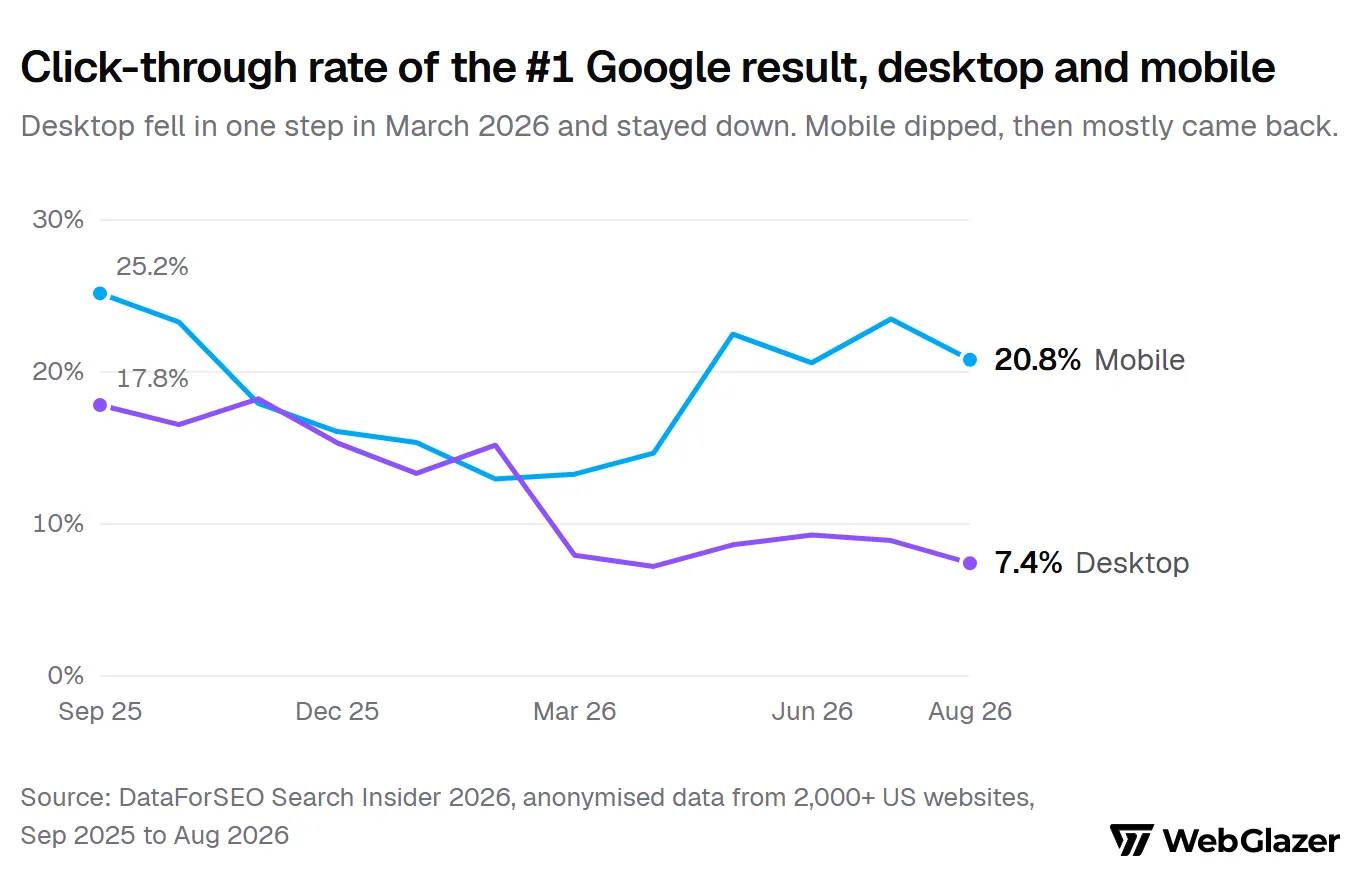
Three caveats before you quote these numbers:
- DataForSEO says its data doesn't show what caused the decline: AI answers, layout changes or changes in how people search.
- The report's headline also says desktop position #2 fell 12.2 points, from 15.27% to 3.07%. The September 2025 starting point is an outlier. In every other month position 2 sat between 1% and 7%, so we'd not repeat that number.
- These are averages across a sample of sites. Your own Search Console data is the only reliable read on your pages.
A second, independent dataset points the same way with a smaller effect. Seer Interactive's 2026 update, covering 53 brands and 5.47 million queries, found organic click-through on queries with an AI Overview fell from 3.19% in January 2025 to 1.31% in December 2025, then recovered to 2.36% by February 2026. Queries without an AI Overview were at 3.82% in February 2026. Both datasets show a real loss, and both show some recovery after the low point.
Are zero-click searches increasing?
Not as much as the headlines suggest. A zero-click search is one that ends without the searcher clicking any result. SparkToro's 2026 study found 68.01% of US Google searches ended without a click in January to April 2026, based on Similarweb's panel. That number is widely quoted as proof that AI is killing clicks.
On the same kind of panel, though, the share was already high before AI Overviews existed. SparkToro's earlier study reported that in Q4 2020, 68.3% of US Google searches ended without a click. The 2024 figure of 60.45% that makes 2026 look like a big jump came from a different panel (Datos), and SparkToro itself calls that comparison "a bit of apples and oranges".
| Period | Share of US Google searches with no click | Panel |
|---|---|---|
| Q4 2020 | 68.3% | Similarweb |
| 2024 | 60.45% | Datos |
| Jan to Apr 2026 | 68.01% | Similarweb |
When we pulled 641 data points together for our search S-curve meta-analysis, this was the clearest example of a trend that only appears when two panels are mixed. What AI Overviews changed is how many clicks each query sends to websites (the Seer and DataForSEO numbers above), not the overall share of searches that end on Google. So "68% of searches are zero-click" is true, but it isn't new, and it isn't a measure of AI's effect.
Google isn't losing searchers either. Alphabet's "Google Search & other" revenue grew 9.8% year on year in Q1 2025, 17% in Q2 2026 and 12% in Q3 2026. People still search; the clicks are just spread differently.
Where does ChatGPT get its information?
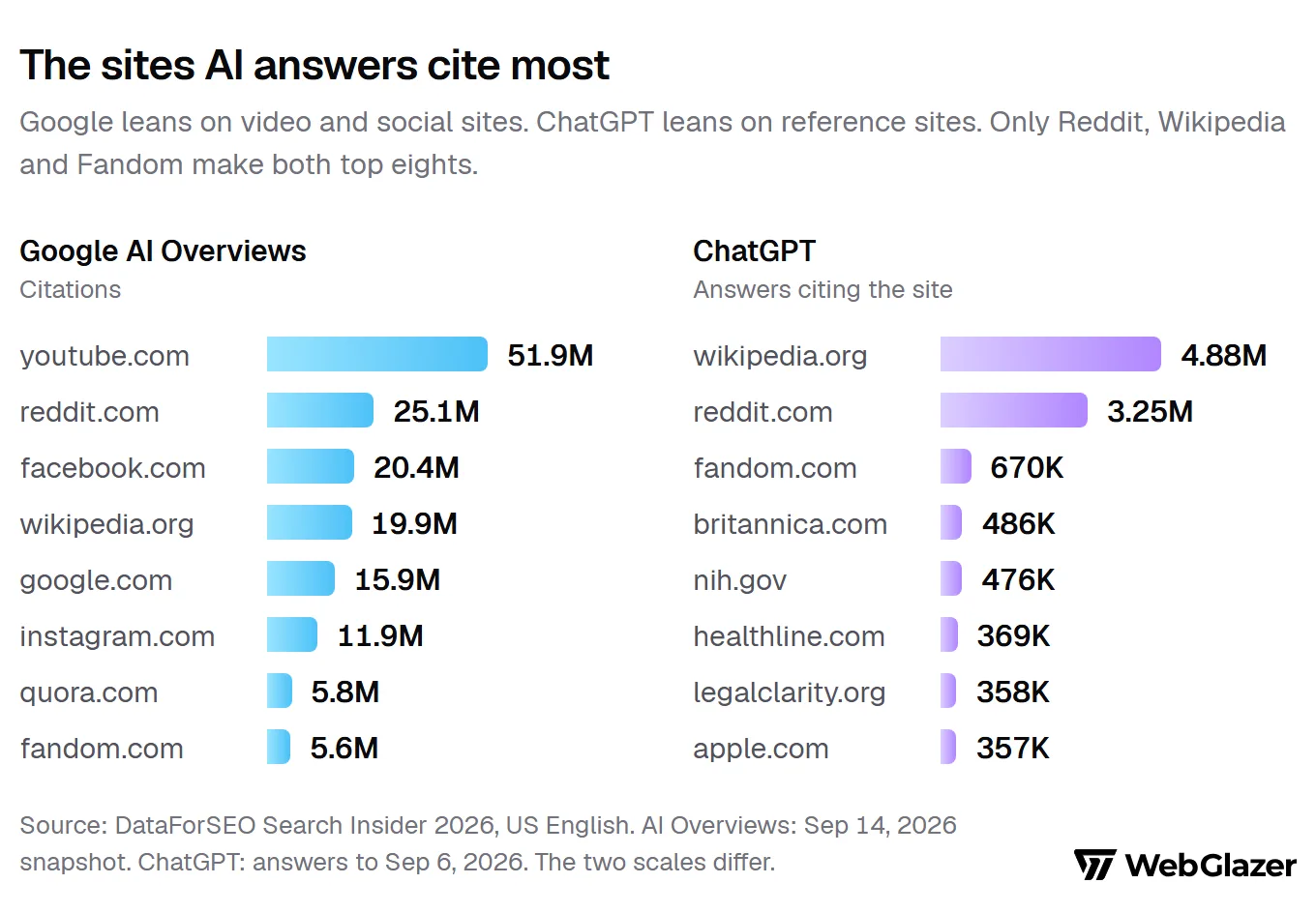
ChatGPT answers from its training data and, when it searches the web, from pages it finds and cites. Its citations lean towards reference sites and publishers. In DataForSEO's corpus of 27.5 million ChatGPT answers (July 2025 to September 2026), Wikipedia was cited in 4.88 million answers and Reddit in 3.25 million, far ahead of Fandom (670K), Britannica (486K) and the US National Institutes of Health (476K).
Google's AI Overviews look very different. In a corpus of 137.9 million AI Overview answers, YouTube led with 51.9 million citations, more than twice Reddit's 25.1 million, followed by Facebook (20.4M) and Wikipedia (19.9M). Six of the top ten are video, social or community sites.
A few more differences worth knowing:
- Uncited answers. 27.3% of ChatGPT answers cited no source, against 0.7% of AI Overviews. A brand can be named in ChatGPT with no link at all.
- News publishers. Reuters (242K answers), The Guardian (226K), AP News (156K) and The Washington Post (139K) are in ChatGPT's top 30 but not in Google's.
- Social platforms. Facebook, Instagram and TikTok are in the AI Overviews top 10 but not in ChatGPT's top 30.
How different are ChatGPT, Claude and Google?
Very different. In research Profound presented at Zero Click New York in June 2026, ChatGPT and Claude shared only 8% of cited domains. In the same talk, 79.2% of Claude's citations came from Brave Search's top 10 results, because Claude uses Brave for web search. Profound also compared each engine with Google's top 50 results for the same question: 64% of the domains Claude cited were in them, against 37% for ChatGPT.
| Engine | What it cites most | What that means |
|---|---|---|
| Google AI Overviews | YouTube, Reddit, Facebook, Wikipedia | Video and community presence count. Rankings in Google decide who is eligible. |
| ChatGPT | Wikipedia, Reddit, reference sites, publishers, and since August 2026 more brand pages | Be described correctly on reference sites, and give ChatGPT clear facts on your own pages. |
| Claude | Brave's top 10, often list-style articles | Rank in Brave, not only in Google. |
So a single "AI visibility" number hides most of what matters. A brand can lead in Claude and barely exist in ChatGPT. We cover how to read this per engine in our guide to the AI visibility score.
Did ChatGPT change what it cites in August 2026?
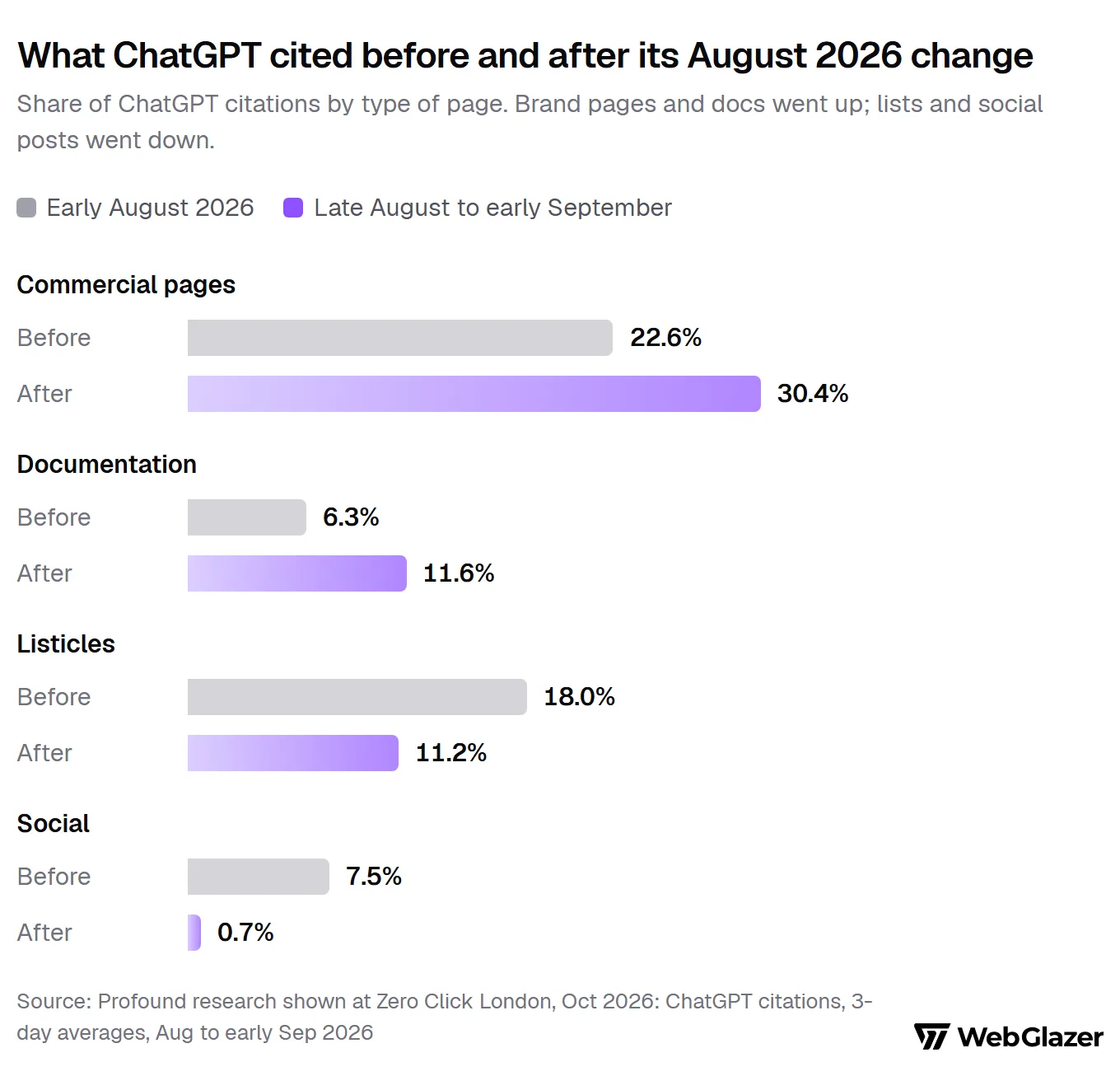
Yes. In early August 2026, ChatGPT started citing more brand pages and documentation and far fewer list articles and social posts. In a sample of 3.26 million ChatGPT citations that Profound presented at Zero Click London in October 2026, commercial pages rose from 22.6% to 30.4% of citations and documentation from 6.3% to 11.6%. Listicles fell from 18.0% to 11.2% and social posts from 7.5% to 0.7%.
Profound's recap of the London event puts it this way: ChatGPT doubled its query fan-out (the extra searches it runs behind one question) while the number of citations per answer stayed flat. Reddit was hit hardest. Promptwatch measured Reddit's share of ChatGPT Search citations at 3.83% from July 18 to August 7, 2026, and 0.52% from August 14 to 17, a drop of 86%.
What this means in practice: the pages ChatGPT now prefers are ones you control. A product page that states the facts plainly, a documentation page for each feature, a page on compatibility or pricing. Comparison lists on other people's sites still matter, but less than they did in July.
Is Reddit still important for SEO and AI search?
For Google, yes. Reddit appeared in Google's top 10 organic results for 32.15% of searches in Q3 2026, nearly eight times Quora's 4.11%, and its share moved by less than three points across four quarters (DataForSEO). For ChatGPT, it's uncertain since August 2026.
| Evidence | Reddit's position | Source |
|---|---|---|
| Google top 10, Q4 2025 to Q3 2026 | 30.3% to 33.2% of searches every quarter; average best position improved from 5.41 to 5.06 | DataForSEO |
| Google AI Overviews citations | #2 domain, 25.1M citations | DataForSEO, September 2026 snapshot |
| ChatGPT citations, July 2025 to September 2026 | #2 domain, 3.25M answers | DataForSEO, mostly before August 2026 |
| ChatGPT Search after August 8, 2026 | 3.83% to 0.52% of citations | Promptwatch |
| Google "discussions and forums" box | 21.13% to 7.42% of results, September 2024 to August 2026 | DataForSEO |
These numbers don't contradict each other. DataForSEO's ChatGPT total covers fourteen months, most of them before August, so it can't show a change at the end. Promptwatch flags its own result as provisional. Our reading: Reddit threads that rank for your keywords on Google are still worth joining with something useful, because they appear in Google's results and in AI Overviews. Don't build a ChatGPT plan on Reddit until newer data shows whether the August drop held.
Do backlinks still matter for AI search?
They're associated with it, but nobody has shown they cause it. Across 486,003 domains, DataForSEO found a moderate positive correlation between a site's number of referring domains (other websites linking to it) and its AI Overview citations, ρ = 0.406. For ChatGPT, across 255,413 domains, ρ = 0.377. Both are statistically significant, and the report says plainly that neither shows cause.
| Measure | Google AI Overviews | ChatGPT |
|---|---|---|
| Domains analysed | 486,003 | 255,413 |
| Referring domains vs citations (Spearman ρ) | 0.406 | 0.377 |
| Links from Reddit and other user-content sites vs citations (ρ) | 0.342 | 0.314 |
ρ (Spearman's rho) runs from -1 to 1. Around 0.4 means sites with more links tend to get more citations, with plenty of exceptions.
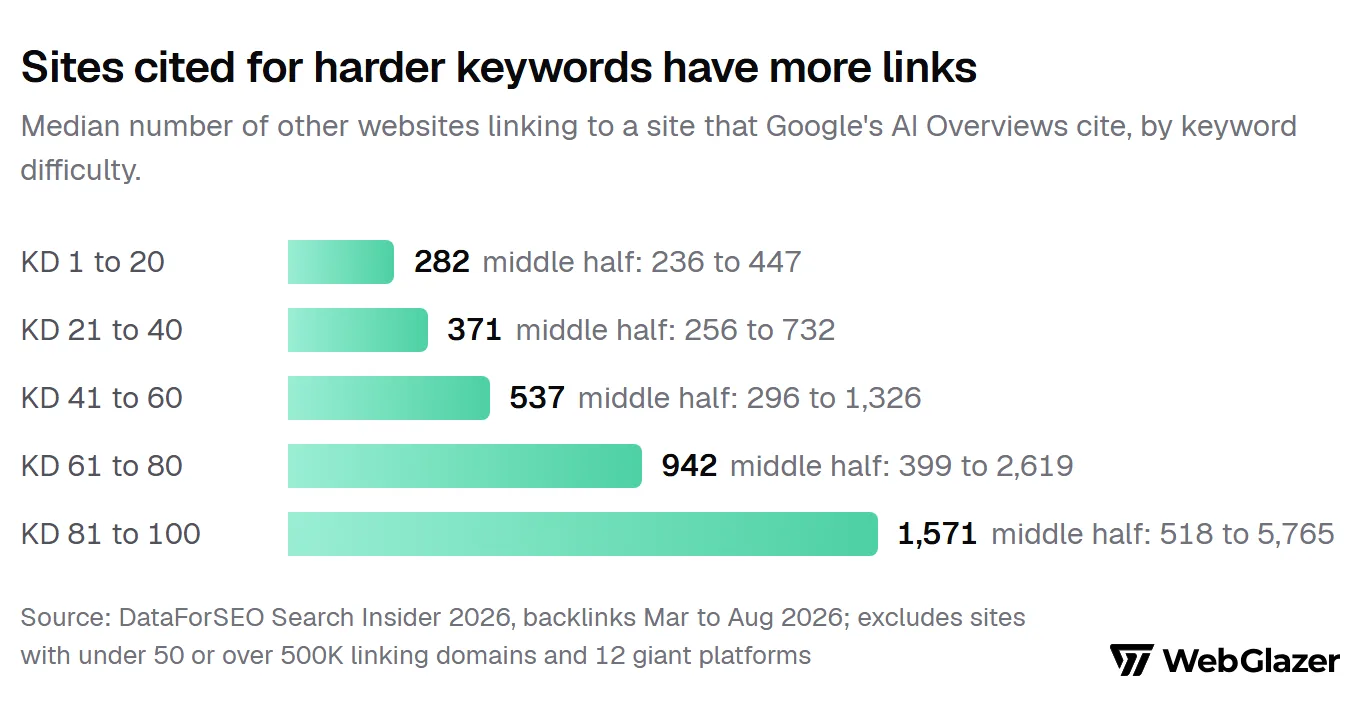
The link counts grow with keyword difficulty. Sites that AI Overviews cite for the easiest keywords had a median of 282 referring domains; for the hardest, 1,571, or 5.6 times as many.
In ordinary rankings, sites ranking #1 had a median of 111 referring domains against 85 for positions 4 to 10, a 31% difference. That's real but small, and the ranges overlap heavily.
Our own test found the limit of this. When we compared 355 companies, referring domains didn't separate the companies AI names from the ones it ignores. Both findings fit together: across hundreds of thousands of sites, links and citations rise together, but within one market, links alone won't tell you who gets recommended. A strong link profile is the foundation, and the rest of this post covers what goes on top of it.
GEO vs SEO: is SEO dead in 2026?
No. GEO (generative engine optimization) is the work of getting your brand named and cited in AI answers, and most of it rests on SEO. Google states that "there are no additional requirements to appear in AI Overviews or AI Mode, nor other special optimizations necessary", and that a page must be indexed and eligible to show with a snippet (Google Search Central).
| Question | SEO | GEO |
|---|---|---|
| Where you compete | Google's ranked results | AI answers in Google, ChatGPT, Claude, Gemini, Perplexity and others |
| What you win | A position and a click | A mention, a citation or a recommendation, often with no click |
| What still counts from SEO | Crawlable, indexed pages, links, matching search intent | The same: Google's AI features use pages from its normal index, and 64% of the domains Claude cites rank in Google's top 50 |
| What's new | Each engine has its own sources, third-party sites carry more weight, answers change week to week, and accuracy has to be checked | |
| How you measure it | Rankings, clicks, Search Console | Mentions and citations per engine, plus whether the AI's description of you is correct |
The overlap is clearest for Google's own AI features, which Google says need nothing beyond normal SEO, and for Claude. It's smaller for ChatGPT, where only 37% of cited domains appeared in Google's top 50 in Profound's research. That's where GEO work beyond SEO pays off most: reference sites, publishers your buyers read, and clear fact pages on your own site.
SEO isn't dead; it just covers less of the visibility you need. DataForSEO's report ends on a similar point: the shift is from measuring where a website ranks to understanding where a brand appears across search results, AI citations and the wider web.
How do you measure AI visibility?
Measure it on each AI engine separately, with your buyers' real questions, and don't rely on referral traffic. Clicks from AI answers catch only a small part of their effect. In Profound's shopper panel, shown at Zero Click London, under 2% of AI conversations that recommended a brand led to a tagged AI referral in the same journey, while 17% led to a visit to a named or cited brand's site by another route. In a separate study, Profound found that about 2.5% of visits influenced by AI carried a trackable referral tag.
The tools you already have show part of the picture:
- Google Search Console added a generative AI performance report in June 2026, open to all sites since August 31. It counts how often your URLs appeared in AI Overviews, AI Mode and Discover. It shows impressions only: no clicks, no position, no queries, and nothing on brand mentions without a link.
- Analytics referrals catch the few visitors who click a cited link. Most AI influence shows up as direct visits or branded searches instead.
- Manual checks in each engine are a useful start, but a single answer is often misleading, because answers change between runs.
Results also move fast. Profound found that the median page's citation share fell to half of its peak in 11 days, a figure Rippling's team cited at the Sydney conference. A monthly snapshot misses most of that.
Track every engine with WebGlazer
WebGlazer asks the AI engines your buyers use the questions they actually ask, then shows where your brand appears, where competitors appear instead, and which websites each engine cites in your category. Here's how you can use it with the data in this post:
- Compare your visibility engine by engine, since a strong Google AI Overview presence says little about ChatGPT.
- See which sites AI engines cite for your topics, which gives you a list of publishers, review sites and communities worth working with.
- Compare your brand with competitors on the same questions and turn the gaps into a prioritised to-do list.
For a quick first read, try the free AI visibility checker. To track it every week, start your 7-day free trial.
Track your AI visibility every week
See where your brand appears in each AI engine, where competitors appear instead, and which sites each engine cites in your category.
Start your 7-day trialHow to show up in AI Overviews and ChatGPT in 2026
The data points to seven practical steps. Most of them are where DataForSEO's recommendations and the brand case studies presented at Profound's conferences agree.
- Keep your SEO foundations. Indexable pages, a healthy link profile and content that matches search intent are the entry ticket for AI Overviews and Claude.
- Check your keywords for AI Overviews before you write. Commercial and low-difficulty keywords are no longer safe from AI answers. Plan traffic expectations accordingly.
- Publish clear fact pages. One page per product, important feature, compatibility question and pricing question, written in plain words. Since August 2026 this is what ChatGPT cites more often.
- Add video where it fits. YouTube is the most-cited domain in AI Overviews, and video results doubled to about 20% of Google results.
- Work beyond your own site. Find the Reddit threads, YouTube videos, review sites, reference pages and publishers that appear for your topics, and check whether your brand is in them.
- Track each engine separately. Google, ChatGPT and Claude cite different sites, so one blended score hides the gaps.
- Check what AI says, not just whether it mentions you. Wrong prices, old features and outdated claims often come from your own old pages. Fix those first.
Where these numbers come from
Our own data is the WebGlazer Baltic AI Visibility Index 2026. We asked ChatGPT, Gemini, Perplexity and Google's AI answers 2,530 buying questions about 358 of the largest companies in Latvia, Lithuania and Estonia. The other datasets cover US searches and answers in English, except the backlink data, which is global. If you sell outside the US, use them for direction and measure your own baseline.
| Source | What it covers | Period | Size |
|---|---|---|---|
| WebGlazer Baltic AI Visibility Index 2026 | Which companies AI names in buying answers, and whether backlinks separate the named from the ignored | August 2026, each question asked twice a week apart | 25,932 AI answers, 2,530 questions in English, Latvian, Lithuanian and Estonian, 358 companies in 48 industries, 230,138 cited sources |
| DataForSEO Search Insider 2026 | AI Overview growth, triggers, industries, clicks, citations, Reddit, backlinks | Sep 2024 to Sep 2026, varies by dataset | 190M keywords, 137.9M AI Overview answers, 27.5M ChatGPT answers, about 1.14B backlinked URLs, 2,000+ websites for click-through rates |
| Profound research, presented at Zero Click New York (June 2026) and London (October 2026) | Claude vs ChatGPT citations, the August 2026 ChatGPT change, AI shopping journeys | 2026 | 3.26M ChatGPT citations for the August analysis |
| Seer Interactive | Click-through rate with and without AI Overviews | Jan 2025 to Feb 2026 | 53 brands, 5.47M queries |
| SparkToro (2026, 2020) | Zero-click share of Google searches | 2020, 2024, 2026 | Similarweb and Datos panels |
| Promptwatch | Reddit's share of ChatGPT Search citations | Jul to Aug 2026 | Provisional |
| Google and Alphabet | AI features guidance, AI Overview users, Search revenue | 2025 to 2026 | Official figures |
DataForSEO, Profound and Promptwatch all sell search or AI visibility data, and WebGlazer uses DataForSEO's APIs. The correlations in this post show what tends to go together, not what causes what.
Related reading
- Search S-curve meta-analysis 2026
- Do backlinks still matter for AI search?
- The 5 best tools for monitoring AI Overviews
- Baltic AI Visibility Index 2026
Frequently asked questions
What is an AI Overview?
An AI Overview is the AI-written summary Google shows above the normal search results, with links to the pages it drew from. In DataForSEO's monthly panel of 20 million US keywords, AI Overviews appeared on 61% of Google results in August 2026, up from 6% in September 2024.
Do AI Overviews reduce clicks to websites?
Yes, for the organic results below them. DataForSEO estimates that when an AI Overview appears, the share of clicks going to the #1 organic result falls from 33 to 38% to 21 to 24%, while the links inside the AI Overview take 42 to 45%. These are modelled estimates for US Google results in September 2026, with searches that end without a click left out.
Are zero-click searches increasing?
Not clearly. SparkToro found that 68.01% of US Google searches ended without a click in January to April 2026. Its earlier study, on the same kind of panel, found 68.3% in Q4 2020, before AI Overviews existed. The change AI Overviews made is in which results get the clicks.
Where does ChatGPT get its information?
ChatGPT answers from its training data and, when it searches the web, from pages it finds and cites. In DataForSEO's data on 27.5 million ChatGPT answers from July 2025 to September 2026, Wikipedia was cited in 4.88 million answers and Reddit in 3.25 million, far ahead of any other site. 27.3% of the answers cited no source at all.
Is SEO dead in 2026?
No. Google says there are no additional requirements to appear in AI Overviews or AI Mode, and that a page must be indexed and eligible to show with a snippet, so normal SEO is still the way in. ChatGPT needs work beyond SEO: in research Profound presented in June 2026, only 37% of the domains ChatGPT cited were in Google's top 50 results for the same question.
What is the difference between GEO and SEO?
SEO is the work of ranking in Google's search results and winning the click. GEO, generative engine optimization, is the work of getting your brand named and cited in AI answers from Google, ChatGPT, Claude, Gemini, Perplexity and others. Most GEO rests on SEO, but each AI engine cites different sources, so GEO also covers third-party sites and checking what each engine says about you.
Do backlinks still matter for AI search?
Backlinks go together with AI citations, but nobody has shown that they cause them. DataForSEO found a moderate positive correlation between a site's referring domains and its citations: 0.406 for Google AI Overviews across 486,003 domains and 0.377 for ChatGPT across 255,413. In WebGlazer's Baltic AI Visibility Index, referring domains did not separate the companies AI names from the ones it ignores.
How do you measure AI visibility?
Ask each AI engine the questions your buyers ask, repeat the checks over time, and record where your brand is mentioned and which sites are cited. Referral traffic shows only a small part: Profound found that about 2.5% of visits influenced by AI carried a trackable referral tag. Google Search Console's generative AI report shows impressions in AI Overviews and AI Mode, but no clicks or queries.