From the WebGlazer blog ·  Martins Mozga · November 2, 2026 · 10 min read
What does an AI visibility score really tell you?
Google is making search data harder to collect, SEO tools are patching the gaps, and AI assistants now recommend brands by name. For growth marketers, the useful question isn't what changed technically. It's which numbers you can still trust, and where your next hour of work pays off.
This autumn, Ahrefs told its customers that between 5% and 20% of the Google results it collects were affected by a new problem: Google was showing data companies different results from the ones real searchers see. Other SEO data companies reported the same.
At the same time, more buyers are asking ChatGPT, Gemini and Google's own AI answers which product to choose. A new kind of score has appeared to measure that.
Both changes land on the same desk. The growth marketer who has to explain a red dashboard on Monday is the same one being asked whether the company "shows up in AI".
The useful question isn't what Google changed under the hood. It's which numbers you can trust, and which ones deserve your next hour.
Three things worth knowing
A red SEO dashboard isn't proof you lost traffic
Since late September, some SEO tools have recorded rankings that real searchers never saw. Check Google's own numbers, your visits and your sales before you change anything.
An AI visibility score is a sample, not an audience
A score of 35% means your brand came up in 35% of the AI answers the tool collected. It doesn't mean 35% of buyers saw you.
Visibility only counts when demand follows
Leads, sales and searches for your brand name tell you whether visibility is working. Mentions without business impact aren't a win yet.
Did your search traffic really drop?
Probably not, if the drop only shows up in an SEO tool. Two Google changes in 2026 made SEO tools less reliable without changing how your website ranks.
The first, in August, changed how Google writes the links on its results page. Each link now passes through a Google address before it reaches the website. People who click still land on the right page, but tools that read the links had to be rebuilt to see where they lead. Most fixed it within days: DataForSEO, a company that sells Google results data, said it could read 99.99% of normal result links the day after Google confirmed the change.
The second is the one that matters for your reports. Since late September, Google has sometimes answered automated tools with a results page that looks normal but lists different websites. A tool can store that page as fact and tell you your site dropped out of the top 10 while real searchers still see it. Nozzle, a ranking-tool company, found this on 22.6% of the results pages it checked from September 13 onwards, against 0.28% before. That is one company's sample, but Ahrefs and Semrush both say they are affected and have added extra checks.
This also isn't the first time. In September 2025 Google stopped letting tools fetch 100 results in one request, which made ranking data beyond page one slower and more expensive to collect. If your tool reports how many keywords you have in the top 100, that number became less reliable a year ago.
The practical rule: don't change your strategy because one third-party dashboard turns red. Check the numbers Google and your own systems record first. Our /goto explainer has the full timeline and where each SEO tool stands.
| What you see | What it most likely means | What to do |
|---|---|---|
| SEO tool drops, Google Search Console steady, visits and leads steady | A data problem in the tool | Note the date, ask the tool's support, change nothing |
| SEO tool drops, Search Console clicks drop, visits drop | A real change in Google | Find which pages and searches lost clicks, then look for the cause |
| Search Console steady, visits steady, leads drop | Not a search problem | Look at the site, the offer or the sales process |
Google Search Console is Google's free tool that shows how often your site appeared in Google and how many clicks it got. It measures inside Google's own systems, so neither of the 2026 changes touches it.
What does an AI visibility score actually measure?
An AI visibility score is the share of collected AI answers that mention your brand, for a set of questions the tool asks on your behalf. It measures a sample of answers. It doesn't measure how many buyers saw you.
That difference matters because AI answers move. The same question can get a different answer depending on how it's worded, which assistant answers it, where the person is, when they ask and what they asked before. Each answer is one draw from a range of possible answers.
We measured how much that matters. Across 56,800 AI answers about Baltic companies, collected in August 2026:
- Checking one answer put a company in the wrong group (never named, weakly visible or visible) 56.6% of the time. Half of the companies that were genuinely visible came out as zero.
- Checking 40 answers per company brought that down to 13.1%.
- 27.7% of the companies named by at least one assistant were missing entirely from another.
- The leaders stayed put and the rest got reshuffled. A company named for a question in week one was named again a week later 82.6% of the time overall, but only 38.7% of the time among the least visible quarter of companies.
So a screenshot of one ChatGPT answer tells you very little, and a score from one assistant doesn't stand in for the others. The method is in our AI visibility audit study.
Three different outcomes also hide inside "visibility". Being named in an answer, being linked as a source and being described correctly need different fixes. In the same data, only 8.8% of the sources linked in buying answers were the company's own website, and 5.3% of the company descriptions contained an error that would mislead a buyer.
What can Google's own data tell you about AI search?
Some of it, for Google only. Since June 3, 2026, Search Console has a report for Google's AI features. It shows how often your pages appeared in AI Overviews (the AI summary at the top of Google results) and AI Mode (Google's chat-style search), by page, country, device and date.
It doesn't show clicks from those answers, which searches triggered them or which competitors appeared instead of you. And it says nothing about ChatGPT, Perplexity, Gemini or Copilot, which pick their sources in their own way.
| Question | Google Search Console | Where else to look |
|---|---|---|
| Did my pages appear in Google's AI answers? | Yes, by page, country and device | Not needed |
| Which buyer questions mention my brand? | No | An AI visibility tool, or your own repeated checks |
| Who gets recommended instead of me? | No | The same, compared across competitors |
| What do other AI assistants say? | No | Check each assistant separately |
| Did AI answers bring me customers? | No | Your analytics, your CRM and asking customers |
Is normal SEO still worth doing for AI search?
Yes. Google said so directly when it published its guide to its AI features in May 2026, describing SEO best practices as "relevant and foundational" to showing up in them. Its AI answers draw on the same search index and ranking systems as normal results, and Google says special AI files or AI-specific rewrites of your pages aren't needed.
What has changed is that ranking, being used as a source and being recommended are now three separate results. A page can rank well and never be quoted. A brand can be recommended without its own site being the source. Growth teams need to know which of the three they're actually getting.
Which numbers should a growth team watch?
Follow the path a buyer takes: they compare options, they find you, then they get in touch or they don't. Each step has its own numbers, and a number early on the path only matters if the numbers further along move with it.
Say your AI visibility score went from 20% to 35% this quarter. More AI answers now name you, and that's real progress at step 2. But it's a growth result only if step 3 moved too: more people searching your brand name, more demo requests, more sales. If those stayed flat, the score went up and the business didn't.
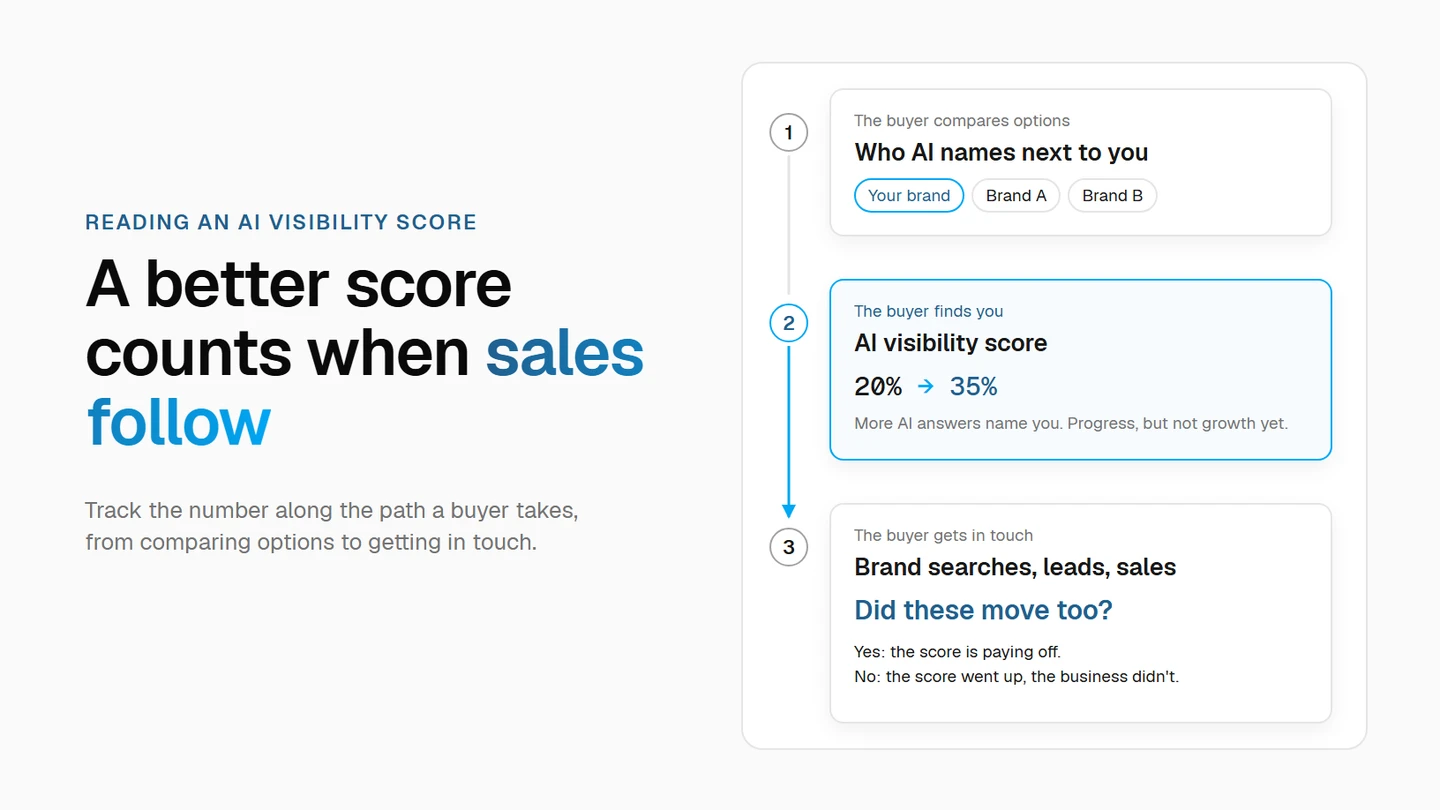
| Step | The question | Numbers to watch | Where they come from |
|---|---|---|---|
| 1. The buyer compares options | Who are they choosing between? | Brands named next to you or instead of you | An AI visibility tool, or asking the assistants yourself |
| 2. The buyer finds you | Can they find us? | Search Console clicks and impressions, rankings, AI mentions, being linked as a source | Google Search Console, SEO and AI visibility tools |
| 3. The buyer gets in touch | Did it pay off? | Searches for your brand name, leads, sales, sign-ups | Analytics, your CRM, and asking customers |
The usual mistake is reporting a step 2 number as if it were a step 3 result.
Where should growth marketers spend their time?
Protect your measurement
Use Search Console and your analytics to check any sudden change in an SEO tool. Treat third-party rankings as a direction, not a verdict, and trust page one positions more than counts of keywords in the top 100.
Track the questions your buyers ask
Pick a small set of real buying questions, the ones a customer would type before choosing a supplier. Track which brands get named, how you're described and which sources are linked, repeated over time. In our data, 10 answers per brand on each assistant is the minimum, and 40 is where a number is solid enough to report.
Fix the information about your business
Publish what buyers and AI assistants both need: honest comparisons, clear product details, prices where you can, your own data and accurate company information. Google says special AI tricks aren't needed, so skip them.
Connect visibility to demand
Watch searches for your brand name, qualified leads, conversions and what customers say. Add "How did you hear about us?" to your forms and sales calls, with AI assistants as an option.
What can you do with AI visibility data beyond the score?
The score tells you where you stand. The data underneath it tells you what to change. Here are six ways to use it in WebGlazer. Each one ends the same way: check whether step 3 of the buyer's path moved.
Start from searches that already bring you customers
Import your Google Search Console queries and check whether AI assistants name you for the same searches. The gaps worth fixing first are the searches where Google sends you clicks but ChatGPT or Gemini recommends a competitor.
Get onto the sources AI already trusts
Every AI answer leans on a handful of websites: review sites, industry lists, comparison articles, forums. The citations view shows which ones each assistant uses for your buyer questions, and the to-do list flags the ones that name your competitors but not you. One placement on a heavily cited source can change many answers at once.
Correct how AI describes you
The sentiment view shows the words AI uses about your brand. Look for old prices, a wrong category or a product you no longer sell, then fix the pages AI reads: your own site first, then the sources it cites about you.
Find the assistant where a competitor wins
Compare your visibility with your competitors' on each AI engine separately. A brand can lead on ChatGPT and be missing on Perplexity, and the fix differs by engine because each one reads different sources.
Spend effort where buyers actually ask
WebGlazer builds buyer questions from real search demand, so you can sort them by how many people search the topic each month. Work on the high-demand questions where you are missing before the niche ones where you already appear.
Ask your own AI assistant for the plan
Connect WebGlazer to Claude or Cursor through MCP (a standard way for an AI assistant to read data from other tools). Then ask in plain words, such as "which cited sites mention our competitors but not us, and what should we publish to get on them?", and get a plan built on your own numbers.
After each change, give it a few weeks of daily checks and look at the same three things: did the AI visibility score move on the engines you targeted, did searches for your brand name rise, and did leads follow?
The bottom line
- Google's link change was mostly an engineering problem for data companies, and most fixed it within days.
- Wrong data in SEO tools is a real, ongoing problem. Check Google's own numbers before you act on a drop.
- An AI visibility score is a sample of answers. Ask how many answers sit behind it and which assistants it covers.
- Normal SEO still works for Google's AI answers, according to Google itself.
- Visibility is only growth when leads and sales move with it.
The teams that do well here won't be the ones with the most keywords or the biggest dashboards. They'll be the ones who know which number answers which question.
Try the AI visibility tool built for growth marketers
WebGlazer checks ChatGPT, Gemini, Perplexity, Copilot and Google AI Mode every day for the questions your buyers ask. See which sources they cite, how they describe you and which competitors they name, then work through a to-do list to get named more often. 7-day free trial.
Start your free trialFrequently asked questions
What is an AI visibility score?
It's the share of AI answers that mention your brand, out of the answers a tool collected for a set of buying questions. A score of 35% means your brand appeared in 35% of those answers. It doesn't mean 35% of real buyers saw your brand.
How many AI answers do you need for a reliable score?
More than most people check. In WebGlazer's study of 56,800 AI answers, one answer put a company in the wrong visibility group 56.6% of the time, and 40 answers brought that to 13.1%. Ten answers per brand on each assistant is a reasonable minimum, and each assistant should be measured separately.
Is my SEO tool wrong about my rankings?
It might be. Since late September 2026, Google has sometimes sent SEO tools results pages with different websites on them, and Ahrefs estimates 5% to 20% of collected results were affected. If Google Search Console, your visits and your leads are steady, the drop is most likely in the tool's data.
Does Google Search Console show AI visibility?
Partly. Since June 2026 it has a report showing how often your pages appeared in Google's AI Overviews and AI Mode, by page, country, device and date. It doesn't show clicks from AI answers, the questions behind them, your competitors, or any assistant other than Google's.
Do I need special optimization for AI search?
Not for Google. In its May 2026 guide, Google called SEO best practices foundational for its AI features and said special AI files or AI-specific rewrites aren't needed. Other assistants choose sources their own way, so check how each one describes you.
How do I know if AI visibility is bringing in customers?
Look at business numbers, not mentions. Track searches for your brand name, qualified leads and sales, and ask new customers how they found you, with AI assistants as one of the answers. If mentions rise and none of those move, visibility isn't paying off yet.