From the WebGlazer blog ·  Martins Mozga · November 2, 2026 · 10 min read
What does Google's /goto change mean for your SEO data?
Since August 2026, Google sends clicks on its search results through its own google.com/goto address. Since September, some SEO tools have also been handed results pages that real searchers never see. Here is what changed, what Ahrefs, Semrush and the other tools say about it, and how to check whether your business actually lost traffic.
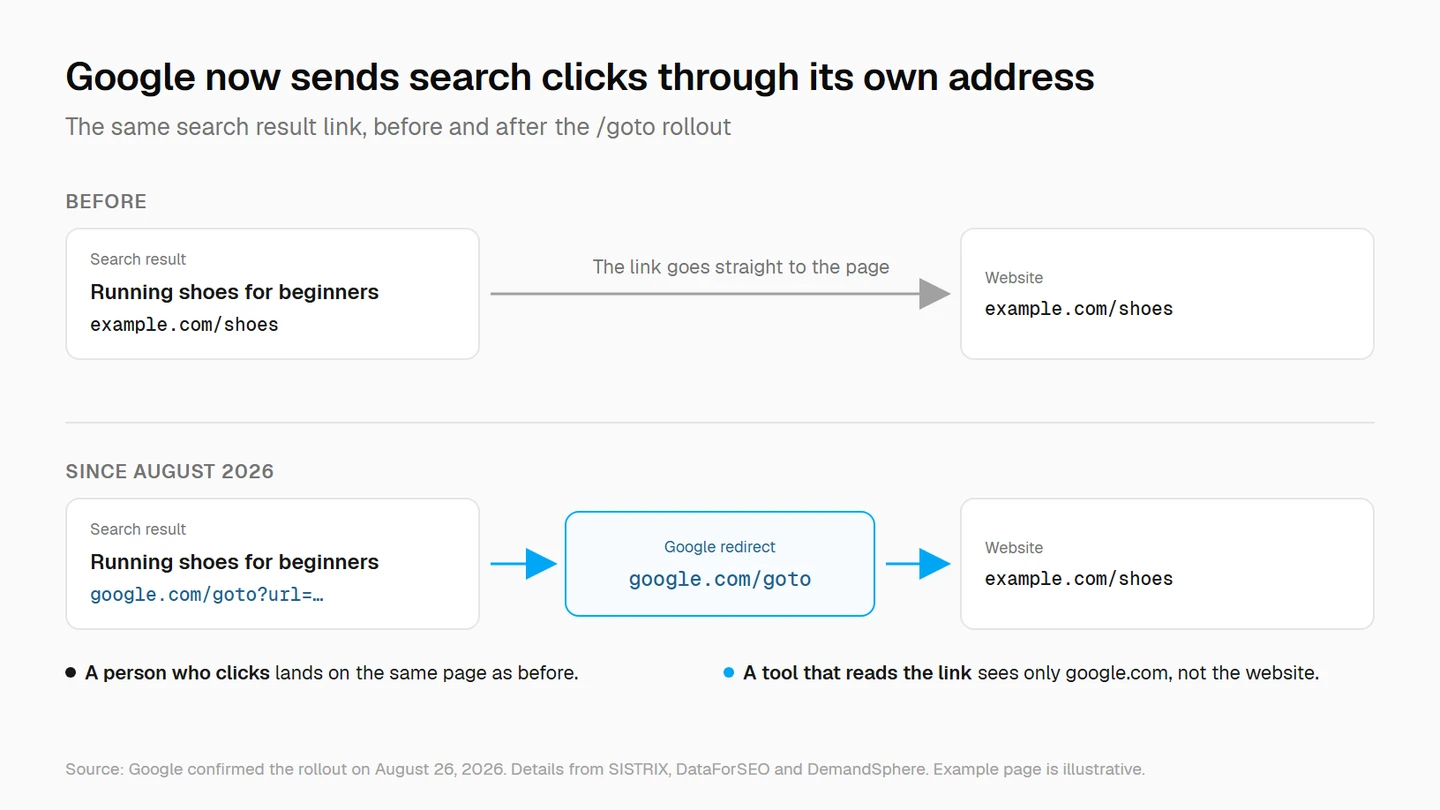
For many searchers, hovering over a Google result no longer shows where the link goes. It points to google.com/goto, followed by a code only Google can read.
For the person searching, nothing changes. They click, and a moment later they land on the page they picked.
For every tool that reads Google automatically, a lot changed. It changed how rank trackers collect positions. It changed which drops show up in SEO dashboards. It changed how AI visibility tools read Google's AI answers. And it changed what marketers should check before they explain a falling chart to their boss.
Your rankings probably didn't move. Your data might have.
Three things worth knowing
/goto changes links, not rankings
Google's redirect changes how links on the results page are written. No study has shown an effect on rankings, and most data providers patched it within days.
Poisoned results are the bigger problem
Some automated requests get a normal-looking results page with different websites on it. Ahrefs puts the share at 5% to 20% depending on the data provider, and Google has not commented.
Check Search Console before you react
If clicks and impressions held steady while a rank tracker fell, the drop is in the tool's data.
What is google.com/goto?
Google.com/goto is a redirect address Google now places in front of the links on its results pages. Instead of linking straight to a website, each result points to a Google URL first, which then forwards the click to the site.
Google confirmed the rollout on August 26, 2026, after testing it over the summer. SISTRIX says it now affects "virtually every link in the search results." DataForSEO found it in AI Overviews, local packs and featured snippets as well as in the regular blue links.
Google hasn't said the change is aimed at SEO tools. Its explanation, quoted by DemandSphere, is general:
We have a long history of deploying technical measures against evolving forms of abuse, and we regularly take steps to protect our services and users.
Most of the industry reads it as a defense against scraping, the automated copying of search results by other companies. Google is also in court with SerpApi, which sells Google results through an API. As Johannes Beus of SISTRIX put it:
We believe Google's main aim is to make it harder for new competitors such as ChatGPT to access its search index and to prevent search results from being used to train open-weight AI models, for example from China. Analysis tools like ours aren't the target, but they are caught up in it.
Does /goto affect your Google rankings?
No published study has shown that /goto changed rankings, clicks or traffic for websites. The redirect lives on Google's results page. It doesn't touch your site, how Google crawls it or how Google ranks it.
The companies that collect Google results for a living say the same. SerpApi reported that the change "did not affect visible result titles, snippets, rankings, or other parsed data." SISTRIX told its customers: "Your rankings and the organic results are not affected."
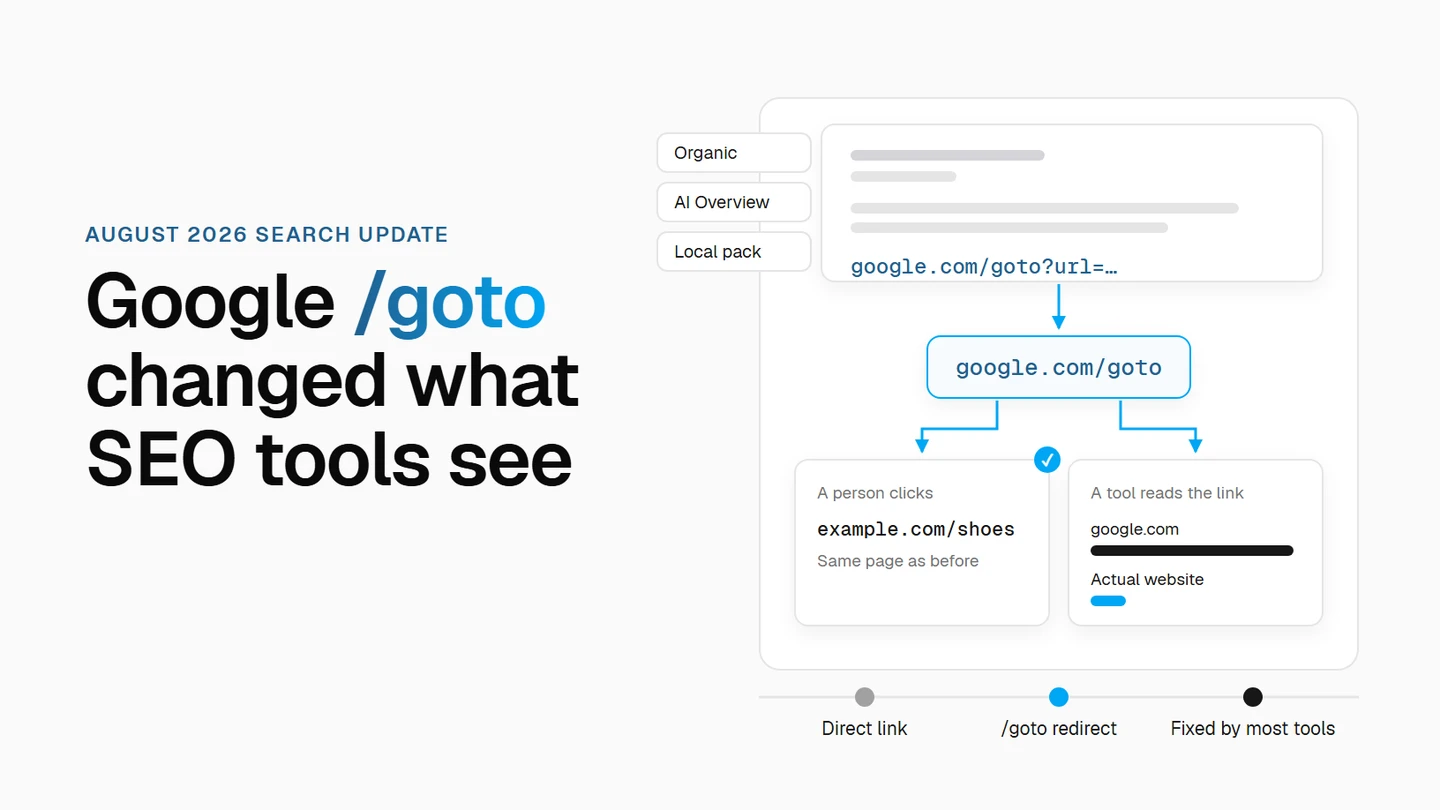
What broke was the link itself. Tools that read a result's link to see which website ranks suddenly saw google.com everywhere. DemandSphere listed what happens when nobody fixes that: your own pages stop being recognized as yours, share of voice is calculated against the wrong domains, and historical charts break on the rollout date.
Most data providers fixed it fast. DataForSEO said on August 27 that only 0.01% of the results pages it returned still had an unresolved organic /goto link, and it fixed the AI Overview links the next day. SerpApi declared the problem solved on September 5.
It didn't stay solved. On October 30, SerpApi's status page reported /goto links coming back in its Google results. It restored direct links for the top three results first and marked the incident resolved on November 2.
Then why did your SEO tool show a drop?
Because of a second change that began in September: Google started answering some automated requests with results pages that look normal but list different websites. The industry calls them poisoned SERPs (a SERP is a search engine results page).
Here's how it plays out:
- Your SEO tool checks Google for a keyword.
- Google returns a results page that looks complete.
- Your website is missing from the top 10.
- Your tool records a ranking loss.
- A real person searching the same keyword may still see your site where it always was.
Nozzle, a rank tracking company, measured this across 56.1 million results pages in 53 countries. Before September 13, 0.28% of the pages it judged were poisoned. Since then the average is 22.6%, with a peak of 43.5% on September 30. On a poisoned page, the tracked site was missing from the top 10 in 60.8% of cases, against 2.7% before.
Nozzle's Derek Perkins explained why this is worse than being blocked:
Google is not refusing these requests, it answers them with a complete page whose results are wrong. A refused request tells a scraper to try again; a poisoned one gets stored as real.
Two caveats matter. Google has not confirmed that it serves different pages to tools on purpose; the "poisoning" label comes from the vendors. And Nozzle sells rank tracking, so its numbers come from an interested party, like every other vendor's.
The timing makes it harder still. Google's September spam update ran from September 24 to October 8, in the same weeks. A drop recorded then could be a real demotion, a blocked request or a page Google served only to a suspected bot.
What's the status at Ahrefs, Semrush and other SEO tools?
Every major SEO data company that has spoken publicly says it is affected, and each says it now filters suspect pages before they reach customer reports. None has published independent tests of how well those filters work. This is where each one stood on November 2, 2026.
| Company | What it reported | What it changed |
|---|---|---|
| Ahrefs | 5% to 20% of search results affected, depending on the data provider (October 22) | Filters reject abnormal results and request replacements. It is also cleaning up past results that may have been affected |
| Semrush | Confirmed that poisoned results affect SEO tools | Added "additional checks" to filter results |
| SISTRIX | Divergent results since September 2026 | Resolves /goto links, publishes only results that pass several checks, and turned off on-demand updates in September |
| AccuRanker | Flagged 30.2% of sampled desktop keyword-days on September 25, and 0.58% on October 17 | Fetches the page again in a new browser session when most of the usual sites are missing |
| SEOmonitor | About 8% of daily Google results incomplete or incorrect; about 10% of keywords affected October 9 to 13 | Re-pulls suspect results; reprocessed affected keywords on October 13 |
| DemandSphere | Wrong results on about 11% of daily rank checks (October 13) | Countermeasures to keep domain matching and share of voice working |
| DataForSEO | 0.01% of returned pages had an unresolved organic /goto link (August 27) | Returns direct links across organic results and AI Overviews since August 28 |
| SerpApi | /goto links came back in its results October 30 to November 2 | Fix deployed November 2. An October 14 update aimed to reduce poisoned results |
Is it hype or a real problem?
Both parts of the story are real, but they're different sizes.
The /goto redirect was a short scramble. DataForSEO fixed it in about two days and SerpApi in about ten. These companies have been here before: when Google stopped returning 100 results per search in September 2025, Ahrefs took about six weeks to restore its top 100 tracking.
Poisoned pages are harder, because a wrong page looks like a right one. A blocked request gets retried. A swapped page gets stored as fact unless a filter catches it. Ahrefs said as much in its own statement:
Search engines regularly make changes, and what works to get accurate data today may not work tomorrow.
The clearest effect so far is on rankings beyond page one. SISTRIX now focuses its analysis on the top 10 and says anything beyond that "can no longer be reliably compared over time."
Did your business actually lose traffic?
Search Console is the place to check, because it measures clicks and impressions inside Google's own systems, where neither /goto nor poisoned pages reach. If your clicks held steady while your rank tracker fell, the drop is in the tool's data.
Compare periods in Search Console
In the Performance report, use Compare to put the last 3 months next to the previous period. Google recommends this as the first step when you investigate a drop.
Check your analytics
Look at organic sessions and conversions for the same weeks. A real loss shows up in visits and leads, not only in positions.
Mark the dates
Add notes to your dashboards for August 26 (/goto confirmed), September 13 to 20 (poisoned pages start in Nozzle's data) and September 24 to October 8 (Google's spam update).
Read page one, not page ten
Top 10 positions are the most stable data any tool has right now. Counts like "keywords in the top 100" can move when Google shortens its result lists, without any change to your visibility.
Ask your vendor three questions
Do you resolve /goto links? Do you detect and re-fetch suspect results? Have you corrected stored history for September and October? If they have, a report you exported in early October may no longer match the tool today.
Nozzle's own rule of thumb is short: if a site "disappears" in a rank tracker and Search Console still shows impressions and clicks, "nothing happened to the site."
Does /goto affect AI visibility tools?
The same question applies to AI visibility tools, ours included. An AI visibility score is the share of a set of buyer questions in which an AI engine names your brand. To get it, a tool asks those questions and reads the answers automatically, and Google's AI Overviews and AI Mode sit on the same results pages Google is now defending.
DataForSEO's numbers show the effect. On August 27, 52.26% of the results pages it returned may have had at least one unresolved /goto link inside the AI Overview, against 0.01% for organic links. Until its fix the next day, a tool reading AI Overview citations from that feed could have seen google.com where the cited website should be.
WebGlazer reads Google AI Mode the same way, through a service that opens the real page. So the questions below apply to us as much as to anyone.
Google's own report helps, up to a point. Since June 3, 2026, Search Console has a report for generative AI features. It counts how often your pages appeared in AI Overviews and AI Mode, by page, country, device and date. It doesn't show clicks from those features, which searches triggered them or who appeared instead of you.
| Question | Search Console's AI report | Where you need another source |
|---|---|---|
| Did my pages appear in Google's AI features? | Yes, impressions by page, country and device | Not needed |
| Which buyer questions mention my brand? | No | Track the questions your buyers ask |
| Which competitors does AI recommend instead? | No | Compare brands across the same questions |
| How does AI describe my brand? | No | Read the answer text |
| What do ChatGPT, Perplexity, Gemini and Copilot say? | No, Google only | Track each engine separately |
Four questions to ask any AI visibility tool before you trust its score:
- Which engines does it read, and does it read the real interface people use or an API? API answers can differ from what people see.
- How many times does it ask each question? The same question gets a different answer each time, so one run is a sample of one.
- Can you see the answer text and the cited sources behind each number?
- What happens when a collection fails or looks wrong? Is it retried, flagged or counted anyway?
For what an AI visibility score does and doesn’t measure, and which numbers a growth team should watch, read what an AI visibility score really tells you.
What should marketing teams do now?
- Treat a sudden ranking drop from September or October 2026 as a data question first. Check Search Console before you change anything.
- Leave your content, schema and site structure alone as far as /goto goes. The redirect lives on Google's page, not on yours.
- Report from first-party data. Search Console and analytics should carry the numbers your budget depends on, with rank trackers as context and competitor comparison.
- Weight page one over page ten. Deep-position data is now the least reliable part of every tool.
- Ask every data vendor, SEO or AI, how it collects and checks its numbers. The better ones already publish the answer.
Google will keep changing how its pages can be read by machines. The safest report is the one whose numbers you can trace back to a source.
Check what AI says about your brand
The free AI visibility checker generates the buyer questions for your category and runs them across AI engines, then shows how often you are named and which competitors appear instead. No account needed.
Run the free checkFrequently asked questions
What is google.com/goto?
It's a redirect address Google places in front of the links in its search results. When you click a result, you go to google.com/goto first and Google forwards you to the website. Google confirmed the rollout on August 26, 2026, and it now covers almost every link on the results page, including AI Overviews, local packs and featured snippets.
Does Google's /goto redirect hurt SEO rankings?
There's no evidence that it does. The redirect sits on Google's results page, not on your site, and SerpApi and SISTRIX both report that rankings, titles and snippets were not affected. What it broke was the ability of SEO tools to read which website a link points to, and most data providers fixed that within days.
What are poisoned SERPs?
They are search results pages that look normal but list different websites, served to some automated requests instead of the real results. Nozzle measured an average of 22.6% of judged pages poisoned since September 13, 2026, against 0.28% before. Google has not confirmed that it does this on purpose.
Are Ahrefs and Semrush rankings accurate right now?
Both say they are affected and are filtering out suspect results. Ahrefs said on October 22, 2026 that 5% to 20% of search results were affected depending on the data provider, and that it is cleaning up past results. Top 10 positions are the most reliable part of any tool's data; check large drops against Search Console before you act.
How do I tell if my organic traffic drop is real?
Compare the last 3 months with the previous period in Search Console's Performance report, then check organic sessions and conversions in your analytics. If clicks, impressions and visits held steady while a rank tracker shows a drop, the drop is in the tool's data. If Search Console shows the same fall, look at Google's September spam update, which ran from September 24 to October 8, 2026.
Does /goto affect AI Overview tracking?
It did briefly. On August 27, 2026, DataForSEO reported unresolved /goto links inside the AI Overview on 52.26% of the results pages it returned, and fixed them the next day. Any tool that reads AI answers automatically depends on that kind of collection, so ask your AI visibility vendor which engines it reads, how often it asks each question, and whether it shows the answer text and sources.