ResearchNovember 9, 2026
Does ChatGPT Give the Same Answers to Everyone? No, and the API Lies About It Too
10 minutes read


No. Ask ChatGPT the same question twice and the two answers share only half of their brands. Gemini and Google AI Mode are no steadier.
The part that matters more for brands is where AI trackers get their answers. Many of them ask the API, the developer connection, instead of the website your buyers use. So we tested both. We asked ChatGPT, Gemini and Google AI Mode the same 1,250 questions five times each on their websites, and once through the ChatGPT and Gemini APIs. That came to 21,250 answers, and we published all of them as open data.
The APIs and the websites don't agree. The ChatGPT API shared only 31% of its brands with the ChatGPT website, and its answers were half as long. The Gemini API got the brands roughly right but cited different sources. Google AI Mode has no API at all, so the website is the only place to see it.
Key takeaways
- Two ChatGPT answers to the same prompt share only 50% of their brands. Gemini app runs share 39% and Google AI Mode runs 38%.
- The ChatGPT API shares only 31% of brands with the ChatGPT website, and 29% of the brands it names never show up there at all.
- ChatGPT API answers are about half as long (169 vs 331 words) and name fewer brands (5 vs 7).
- The Gemini API matches the Gemini app on brands (36% vs 39%) but shares only 14% of the app's cited sources. Google AI Mode has no API.
- If you track your brand in AI search, ask each prompt several times on the real websites.
See the answers your buyers see, not what the API says
Many AI trackers ask the API. WebGlazer reads the real ChatGPT, Gemini, Google AI Mode, Perplexity and Bing AI Mode websites and shows how often you and your competitors are named.
Start your 7-day trialWhy does ChatGPT give different answers to the same question?
ChatGPT writes an answer one word at a time, and at each step it picks from several likely words with a bit of randomness (the temperature setting). Run the same prompt again and it can take a different path from the first sentence on. Several other things pile on top of that randomness.
| Cause | What it changes | Who it affects |
|---|---|---|
| Randomness (temperature) | Wording, order, which brands make the list | Everyone, every time |
| Model version | Style, length, what it knows | Free vs paid users, API users |
| Your phrasing | The whole answer | Anyone who rewords a prompt |
| Memory, chat history, location | Personal details and local results | Logged-in users with memory on |
| Web search on or off | Sources, freshness, brands named | Depends on the question |
The model is often not the one you think. OpenAI says its chat-latest model "points to the latest Instant model currently used in ChatGPT" and recommends a different model for production API use (OpenAI docs). A developer calling the API is usually talking to a different model than you are in the app.
Who you are matters too. ChatGPT uses your rough location from your IP address when it searches, and "if memory is enabled, ChatGPT may use relevant saved memories when rewriting a search query" (OpenAI Help Center). Wording counts as well: "best CRM for agencies" and "which CRM should a small agency use" send it off on different searches.
The one we did not see coming was search itself. With web search switched on, the ChatGPT website searched in only 46% of our answers. The rest came from what the model already knew. The Gemini app searched in 70% of answers and Google AI Mode in 99%. Our AI search statistics for 2026 go deeper into where ChatGPT gets its answers.
Our test: 1,250 prompts, 5 runs each, website and API
We ran the test on 5 and 6 November 2026. Half the prompts (640) are real questions people asked AI search engines, sampled from the public Search Arena dataset. The other 610 are Baltic buyer questions, such as "Who are the best grain trading companies in Estonia?", in English and the local language, plus "What does X do?" questions about 358 real companies. Those are the same companies we ranked in August for our Baltic AI Visibility Index 2026.
Each prompt went to the ChatGPT website, the Gemini app and Google AI Mode five times, logged out, with web search on. It also went once to the ChatGPT API (gpt-5.4-mini with OpenAI's web search tool forced on) and once to the Gemini API (gemini-3.5-flash-lite with Google Search grounding). Then we pulled every brand out of every answer and compared the lists.
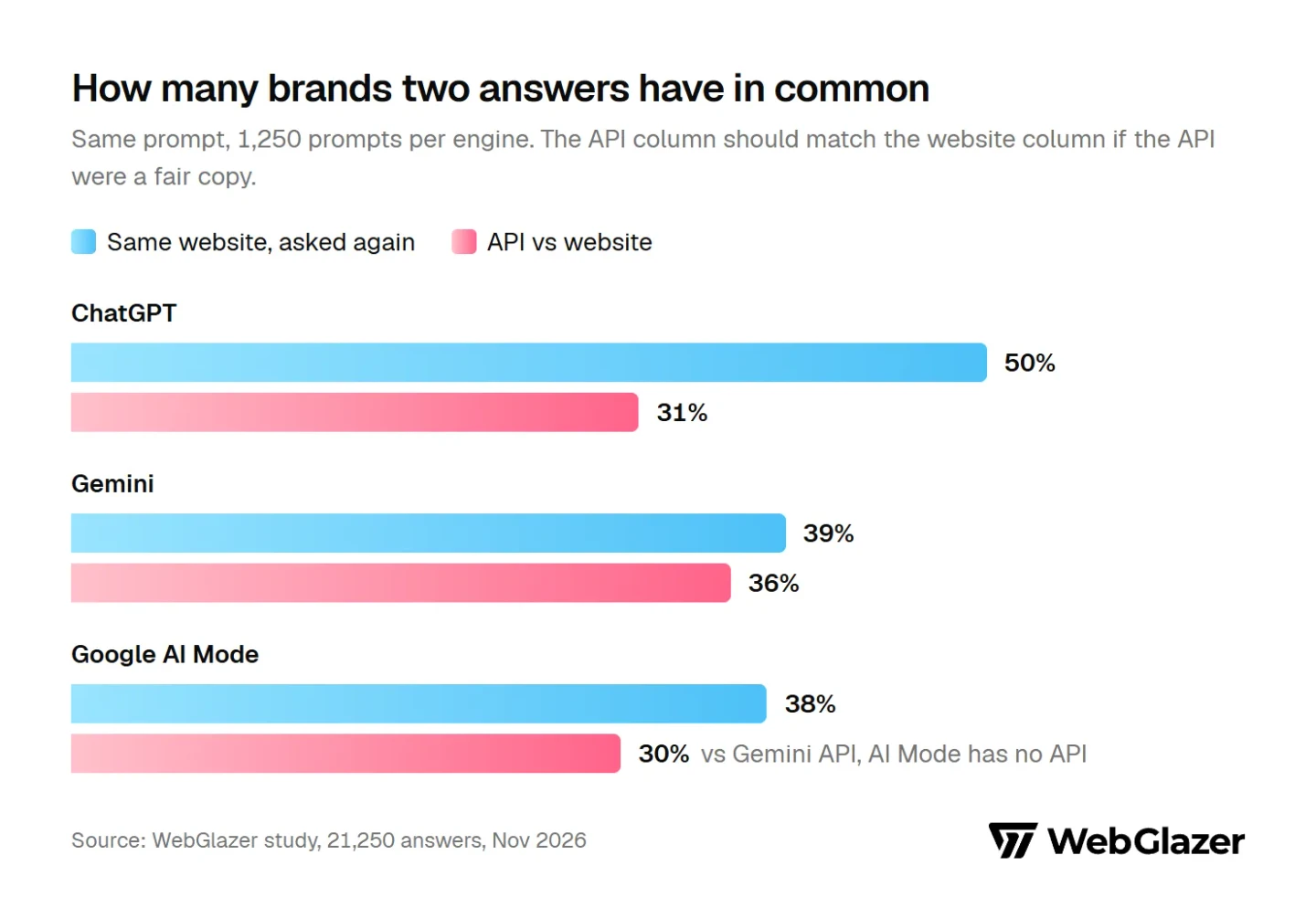
The blue bar is normal change, the same website asked again. The pink bar compares the API with the website. ChatGPT changes about half its brands from one run to the next, and its API drifts 18 points further than that (95% confidence interval 17 to 19). For Gemini the gap is small.
Local questions held up better than global ones. Two ChatGPT website runs shared 59% of brands on Baltic prompts and only 40% on global prompts. The facts were mostly right either way: asked what a Baltic company does, ChatGPT got it right 98.5% of the time on the website and 98.0% through the API. An AI judge scored those answers, and nobody has checked them by hand yet.
What our test does not cover
We scraped the websites logged out, so memory and paid plans played no part, and logged-in users will see more personal answers than ours. We tested one API model per engine and did not test chat-latest, the model behind ChatGPT. Everything comes from one two-day window, and answers drift over time. We did not test Google AI Overviews. An AI model pulled the brands out of the answers, so it will have missed or merged a few names. None of this comes close to explaining a gap as big as ChatGPT's.
Will ChatGPT give two people the same answer?
Usually not word for word, and often not even the same brands. Our two clean runs came from the same place with no memory, and they still shared only 50% of their brands. The brand named first matched in 71% of cases, so the top spot is steadier than the rest of the list.
Real people add memory, location and their own way of asking, so they drift further apart than our runs did. Treat any single answer as one sample.
Is the ChatGPT API the same as ChatGPT?
No. The API doesn't make things up on purpose, it just describes a different market from the one ChatGPT users read about.
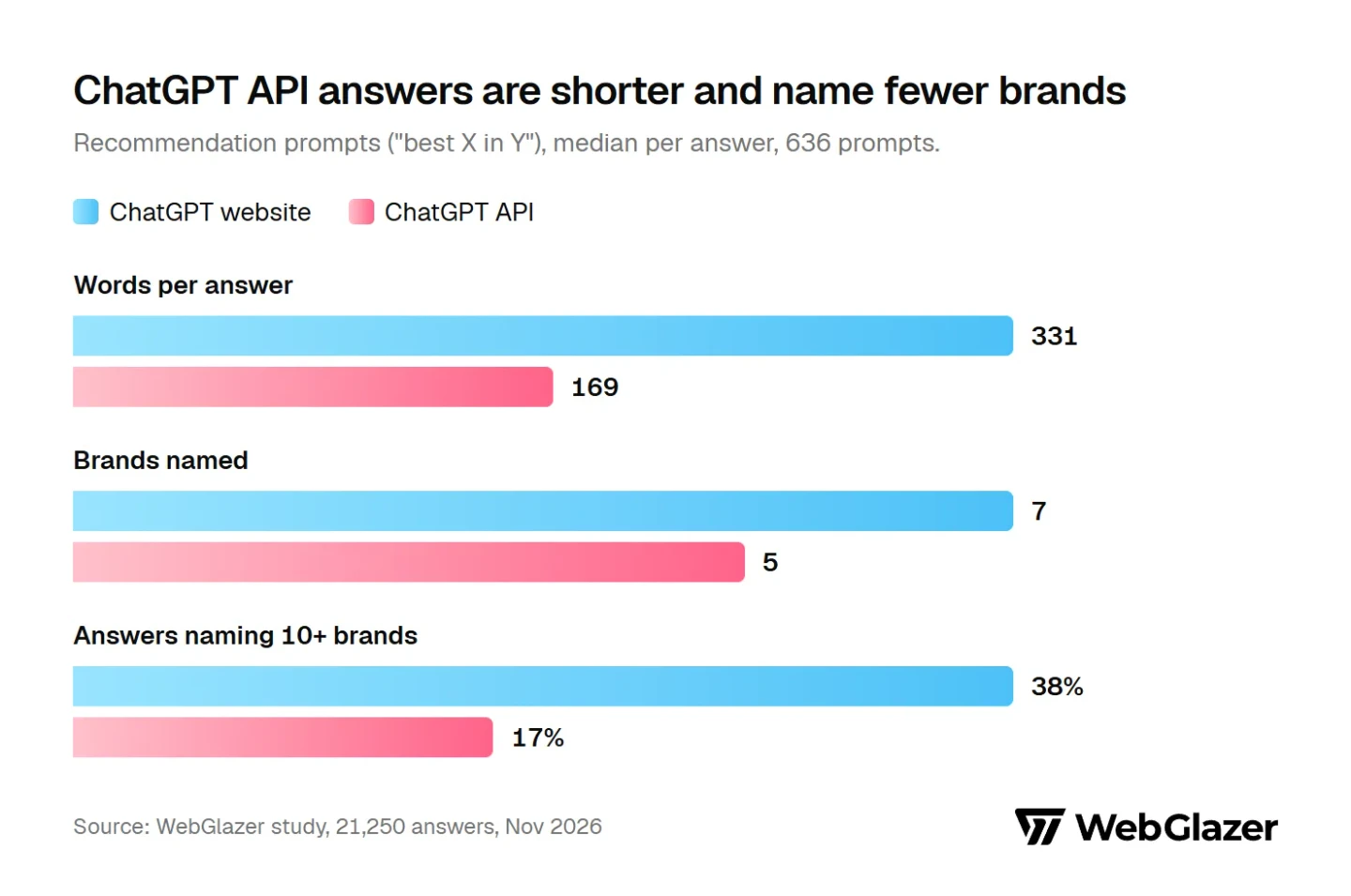
The API shared 31% of brands with the website, where two website runs share 50%. Of the brands the API named, 29% never appeared in any of the five website answers for that prompt. It named fewer brands than the website in 84% of recommendation prompts, and its cited sources overlapped the website's by 23%, against 35% between two website runs.
Developers have run into this too. One wrote on the OpenAI forum: "UI gives a thorough response with 20 (!) resources. API gives 5" (OpenAI Developer Community). A 2026 research paper found the OpenAI API recovers only 26.2% of the pages ChatGPT actually cites (arXiv 2610.15382).
Do other AI platforms vary their answers too?
All of them do, but the API problem looks different on each one.
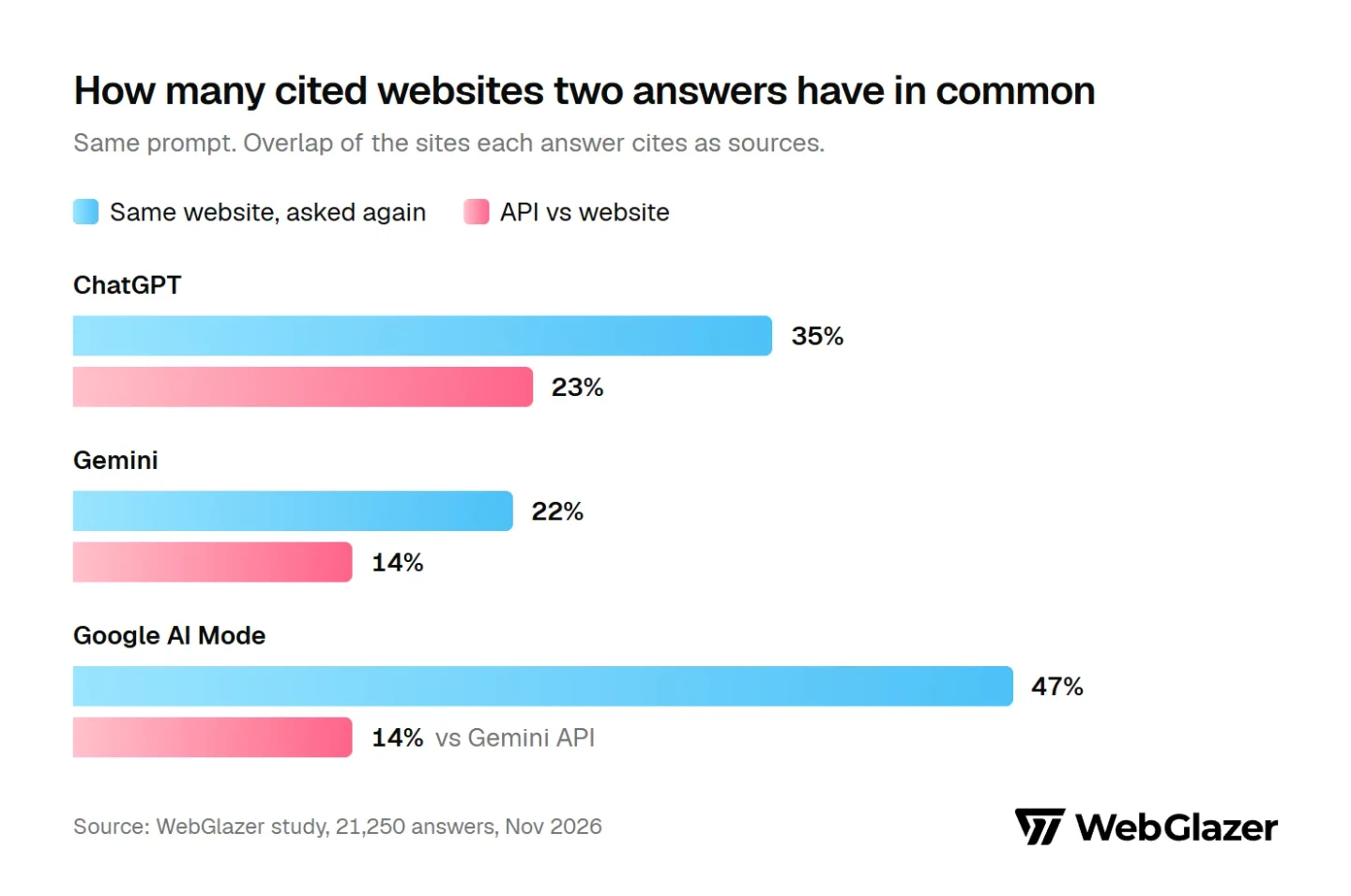
The Gemini app changes a lot between runs (39% brand overlap), and its API lands almost as close (36%). For brands, the Gemini API is a fair stand-in. For sources it falls short, at 14% overlap against 22%. Google AI Mode has no API at all. It is steady about its own sources (47% overlap between runs), but the Gemini API shares only 14% of them, so you can't track AI Mode through Gemini.
Web scraping vs API: which shows the real AI answer?
An API is the official developer connection: you send a prompt and get text back. Web scraping opens the real website (chatgpt.com, gemini.google.com, Google AI Mode) in a browser and records what a user would see.
| API | Scraping the website | |
|---|---|---|
| What you get | What the developer model says | What users actually read |
| Matches users (ChatGPT) | 31% brand overlap | 50% (normal run-to-run change) |
| Google AI Mode | Not available | Available |
| Shopping cards, local results | No | Yes |
| Cost and speed | Cheap, fast | Slower, costs more per answer |
For Gemini, the API is a fair shortcut. For ChatGPT and Google AI Mode, you have to scrape the website to see what your customers see.
Track the real ChatGPT answer, not the API
WebGlazer collects answers from the ChatGPT, Gemini, Google AI Mode, Perplexity and Bing AI Mode websites, the same pages your buyers read.
Start your 7-day trialWhy this matters for brands
If the answer changes every time, one check tells you very little. In our AI visibility audit test, a single check got the answer wrong 56% of the time. Your brand can show up in one run and vanish in the next, and a tracker that asks once through the API can call you visible when ChatGPT users never see you.
Say a buyer asks ChatGPT for "the best payroll software for a 50-person company" and your brand shows up in two of five answers. Roughly 40% of the people asking hear your name. An API tracker that reports 0% sends you chasing the wrong fix, and one that reports 100% lets you relax while a competitor takes the spot. In our data almost a third of the brands the ChatGPT API named never appeared on the website at all, so this happens a lot.
Variation is fine when someone wants campaign ideas or a second draft of an email. It hurts when they ask which tool, agency or supplier to pick, because a shortlist that changes every time decides who gets the call. The upside is that a brand missing from one answer isn't locked out of all of them, and a mention rate is something you can work to raise.
How to get more consistent answers from ChatGPT
You can't switch the randomness off in the app, but you can narrow it. Name the country, the company size and the budget, because vague prompts leave the model more room to wander. Ask for a fixed format, like "list exactly five options with one line each", so answers are easier to compare. Start a new chat for each test and turn memory off, since earlier messages and saved memories both change what comes back. And check whether it searched at all: in our test, more than half of ChatGPT website answers had no sources.
How to measure brand visibility when answers keep changing
One answer can't measure AI visibility. A rate can. Run every prompt three to five times and count how often your brand appears: "named in 3 of 5 answers" is a number you can track, while "named once" is luck. Our guide to the AI visibility score explains what that number tells you and what it misses.
Collect from the real website for ChatGPT and Google AI Mode. Our data only backs the API for Gemini, and only for brands. Then read what the engines actually say about you, since being named with the wrong description is its own problem.
How WebGlazer does it
WebGlazer asks your buyers' questions on the real ChatGPT, Gemini, Google AI Mode, Perplexity and Bing AI Mode websites, the same pages your buyers read, and does not use the APIs. You pick the questions and markets, then see your mention rate per engine next to your competitors, plus the websites each engine cites so you know where to get mentioned. See plans and pricing.
Final thoughts: does ChatGPT give the same answers to everyone?
It doesn't, and it rarely gives you the same answer twice. Gemini and Google AI Mode vary just as much, and the APIs tell a different story again, most of all for ChatGPT. If AI search matters to your business, measure it as a rate across several runs on the real websites. The full dataset and code are open on Hugging Face and GitHub.
Where does your brand stand in ChatGPT today?
See how often ChatGPT, Gemini, Google AI Mode, Perplexity and Bing AI Mode name you and your competitors, read from the real websites.
Start your 7-day trialFrequently asked questions
Can you make ChatGPT give the same answer every time?
Not in the ChatGPT app. Through the API you can lower the randomness, but the answer can still change, and it won't match what app users see.
Does ChatGPT Plus change the answers?
Paid plans can use different models and features, so answers can differ from free accounts. Our test used logged-out ChatGPT.
Is everyone's ChatGPT different?
Yes, more so when you're logged in. Memory, custom instructions, chat history and location all shape the answer. Even our logged-out runs, with none of that, shared only half their brands.
How accurate are AI visibility tools?
It depends on how they collect answers. Tools that ask once through an API can miss or invent brand mentions. Asking several times on the real website gives numbers you can trust.
How does WebGlazer collect AI answers?
It asks your questions on the real ChatGPT, Gemini, Google AI Mode, Perplexity and Bing AI Mode websites and records the answer a buyer would see. It scrapes the websites instead of calling the APIs, which is also the only way to track Google AI Mode, since AI Mode has no API.