9 Peec AI Alternatives for 2026 (Ranked by a Competitor)
Full disclosure up front: we build WebGlazer, one of the tools on this list — and we think we're the best Peec AI alternative for most teams in 2026. That's why we're #1 in the list below. But this isn't a puff piece: we've spent the last six months tracking Peec's product inside-out (onboarding flow, prompt management, billing pages, export schemas, domain explorer), because they're a direct competitor. We'll tell you exactly where Peec is still the right pick and where every other tool on this list wins. The pros and cons are real; the ranking is ours. We've tracked every significant Peec AI competitor in this space — this is the comparison we'd want to read ourselves.
TL;DR — the 9 alternatives at a glance
| # | Tool | Best for | Starting price | Models | Standout feature |
|---|---|---|---|---|---|
| 1 | WebGlazer | Agencies + local businesses wanting execution, not just monitoring | See pricing page | 3 on Basic, all 5 from Standard (ChatGPT, Perplexity, Gemini, Google AI Mode, Copilot) | Closed-loop: measure → diagnose → generate → push → re-measure |
| 2 | Peec AI | Mid-market marketing teams wanting mature workflow | ~€89/mo | 3+ (tier-gated) | Agency pitch projects, competitor aliases/regex |
| 3 | Scrunch AI | B2B tech companies wanting broadest engine coverage | $250/mo | 7 | Persona filtering, Agent Traffic (AI bot visits) |
| 4 | Profound | Enterprise ($100M–$10B ARR) | Custom (enterprise) | 10+ | Revenue attribution + agentic orchestration |
| 5 | AthenaHQ | Mid-market SaaS that needs proof-backed case studies | $95–300/mo | Multi-engine | 25-factor audit + published ROI cases |
| 6 | Nimt.ai | Teams that want to see what AI actually searches for | Not public | Multi-engine | Query Fan-out (AI sub-query visibility) |
| 7 | Azoma | Enterprise CPG / retail (Fortune 500 only) | Enterprise | Multi-engine | Digital-twin simulated prompts |
| 8 | SE Ranking (Visible) | SEO teams bolting GEO onto an existing stack | From ~$52/mo (SEO bundle) | Multi-engine | Integrated with traditional SEO suite |
| 9 | Otterly AI | Solo marketers and small teams on a tight budget | Lite €29/mo (15 prompts) | ChatGPT, Perplexity, AI Overviews, Copilot (Gemini + AI Mode as add-ons) | Lowest entry price; daily tracking from the bottom tier |
Prices listed where publicly disclosed. Enterprise tiers and add-ons on most tools are opaque — budget for a ~2× uplift if your team needs SSO, API access, or extended model coverage.
Why people search for Peec AI alternatives
From reading forum threads, talking to buyers who've evaluated alternatives to Peec AI, and looking at what SERPs actually reward, there are four recurring reasons:
- Price compression at scale. Peec's Starter plan is reasonable at around €89/mo, but the Advanced tier we've seen in the billing UI jumps to €425/mo, and model coverage is gated per tier. Teams tracking 4+ models across multiple countries hit the upgrade wall faster than expected.
- ICP mismatch. Peec is unambiguously positioned for marketing teams at brands and mid-market agencies. If you're a local-business operator, a solo consultant, or an enterprise procurement team, Peec's feature set and pricing shape don't quite fit.
- Monitoring-first, execution-last. Peec's Actions layer groups opportunities into on-page and off-page work — but the docs describe guidance, not automation. If you wanted a tool that writes the content for you, pushes it live, and re-measures, you'll end up bolting 2-3 other tools on top.
- Source-typing rigidity. Peec auto-classifies cited sources (Owned / Competitor / Aggregated / Earned / Social / Paid). Users have reported that when the classifier mis-tags a source, there's no manual override. For niche verticals that can skew analysis materially.
None of these are dealbreakers. They're reasons a buyer might look around — which is what you're doing right now.
What to look for in a Peec alternative
A quick checklist before you pick. Any tool on this list will clear some of these; no tool clears all of them.
- Model coverage. Minimum: ChatGPT, Perplexity, Gemini, Claude. Ideal: also Copilot, Meta AI, and Grok, since enterprise RFPs increasingly list all seven.
- Prompt tracking depth. Not just "how many prompts can I track," but: can I tag by intent, topic, persona, country? Can I bulk-import via CSV? Can the tool suggest prompts I haven't thought of?
- Pricing transparency. If the tool hides pricing behind a demo call, factor that into your total cost — you're trading time for clarity. Transparent tools tend to be more confident in their product.
- Agency / multi-workspace support. Running this for 5+ clients? You need workspaces, roles, client reporting, and white-labeled Looker Studio or PDF exports. Not every tool has this.
- Citation source analysis. Are competitors being cited on Reddit, on their own product pages, or on Listicle-style third-party roundups? That distinction drives your entire content strategy. Source-type classification matters.
- Export and API. CSV export is table stakes. API access for ingesting AI visibility data into your warehouse is the real test of whether the vendor treats you like a platform or a dashboard-in-a-box.
- Revenue attribution. Almost nobody does this well in 2026. If a tool claims it, push for methodology. Most "AI referral" tracking is just GA4 segmentation.
- Execution, not just measurement. Can the tool help you fix gaps it finds — generate optimized content, draft outreach, push updates — or does it stop at the dashboard?
The 9 alternatives, ranked by best-fit
We've ordered these #1 through #9. Our pick (WebGlazer) comes first. The rest are ranked by how well they fit the mid-market and agency buyers most Peec customers are drawn from.
1. WebGlazer — best overall Peec AI alternative
- Website: webglazer.com
- Best for: Agencies running AI visibility for multiple clients, local businesses priced out of enterprise tools, and any team that wants execution and re-measurement bundled in — not just a dashboard.
- Pricing: Separate plan shapes for agencies and local businesses.
- Models covered: All 5 from the Standard plan up: ChatGPT, Perplexity, Gemini, Google AI Mode, Copilot. Basic tracks any 3.
Where it wins
- Closed-loop workflow that Peec doesn't match. Measure visibility → diagnose gaps → generate or adapt content → push into the surfaces AI systems actually use → re-measure impact. Almost every other tool on this list stops at the first two steps and hands you a PDF.
- All 5 models from Standard up. Peec's Advanced plan (~€425/mo) only comes with 3 base models and charges extra to "Add models." Ours includes ChatGPT, Perplexity, Gemini, Google AI Mode, and Copilot on Standard and above; Basic tracks any 3.
- Agency + local-business split pricing. Most competitors jam both ICPs into the same plan structure and force one or the other to overpay. We don't.
- 100+ brands benchmarked, 50+ tracked brand prompts per client, 99% visibility coverage, 24/7 monitoring. Not vanity numbers — that's what's actually running in production today.
- Code-backed audit pipeline. Query discovery, answer collection, citation parsing, two-pass entity extraction, knowledge-graph construction, gap detection, and shareable HTML reports.
- Execution Workflow and Recommended Actions as first-class features — not a "guidance layer" bolted on after the fact.
Where it falls short
- Competitor-alias regex matching is simpler than Peec's today. On our roadmap.
- Revenue attribution is on the roadmap, not shipped. Nobody in the mid-market has this solved yet (including Peec), but we're being explicit about it.
- The long-tail of edge cases a more established product has already debugged will hit us first. We ship fixes fast.
Pick WebGlazer if you want the most complete closed-loop AI visibility product in the mid-market, you run an agency and don't want to pay €400+/mo just to unlock the models your clients need, or you're a local-business operator who's been priced out of every other option on this list. Book a demo.
2. Peec AI — the incumbent you're comparing against
- Website: Peec AI
- Funding: ~$29M raised
- Pricing: Starter ~€89/mo → Pro → Advanced (~€425/mo) → Enterprise. Model coverage gated per tier (Advanced shows 3 base models with an "Add models" upsell).
- Best for: Mid-market marketing teams and agencies that want a polished, mature workflow and don't mind paying for it.
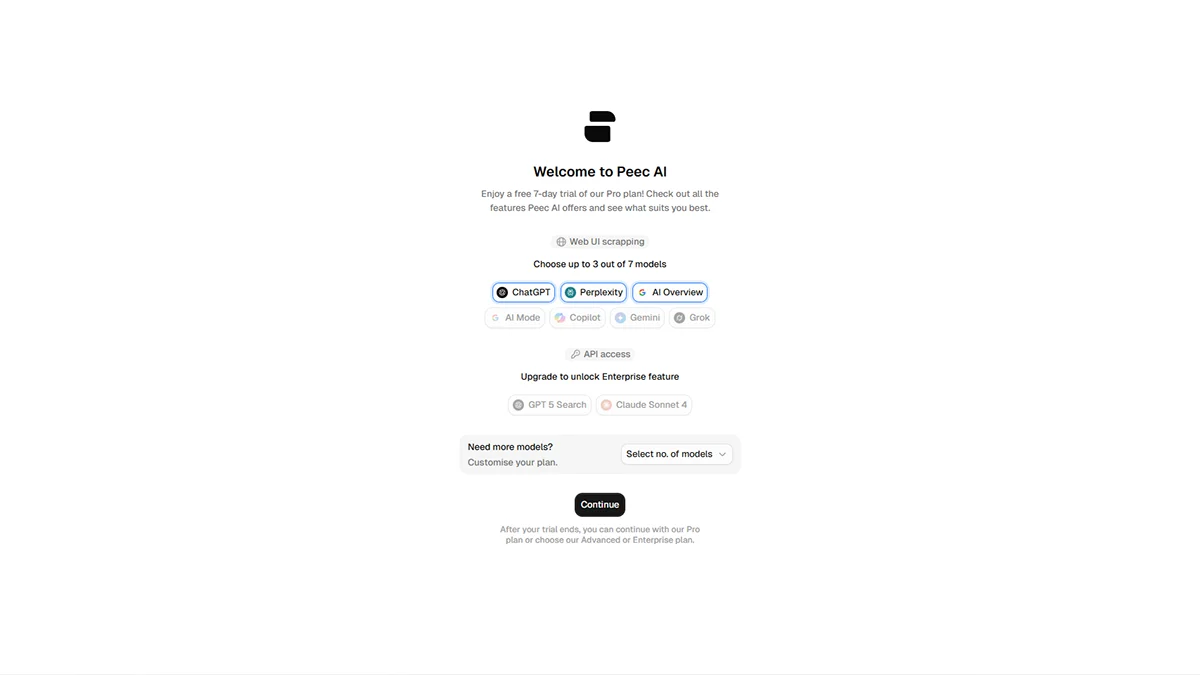
Where it wins
- Workflow maturity. Onboarding, prompt management, competitor setup (with aliases, regex, domain matching), Actions layer, and agency "pitch projects" mode are all packaged tightly. It feels like a product, not a beta.
- Operator tooling. Looker Studio integration, chat export, member roles, API access on higher tiers, Enterprise SSO.
- Competitor setup depth. The aliases / regex / domain matching combo is more sophisticated than most alternatives.
Where it falls short
- Actions layer is guidance, not automation. You still need writers, an outreach motion, and a CMS to actually close the loop. This is the core reason we built WebGlazer.
- Source classifier can't be manually overridden when it mis-tags a citation. Reported by multiple users in niche verticals.
- No revenue attribution. AI visibility ↔ pipeline is a gap.
- Pricing escalates fast. Starter is €89/mo, but real-use Advanced plans hit €425/mo once you need more than 3 models or multiple projects.
- Model coverage tier-gated. You pay per model beyond the base 3.
Pick Peec if you're a 5-30 person marketing team at a mid-market brand, you've made peace with €200-500/mo, and workflow polish matters more to you than execution depth or model coverage.
3. Scrunch AI — broadest engine coverage in mid-market
- Website: Scrunch AI
- Pricing: Core plan $250/mo (125 prompts, 5 topics, 5 personas, 5 page audits, 7-day free trial with card on file). Higher tiers not publicly disclosed.
- Best for: B2B tech companies whose ICP is, in their own words, "growth depends on being discovered online, and needs to win visibility + accurate positioning inside LLM answers."
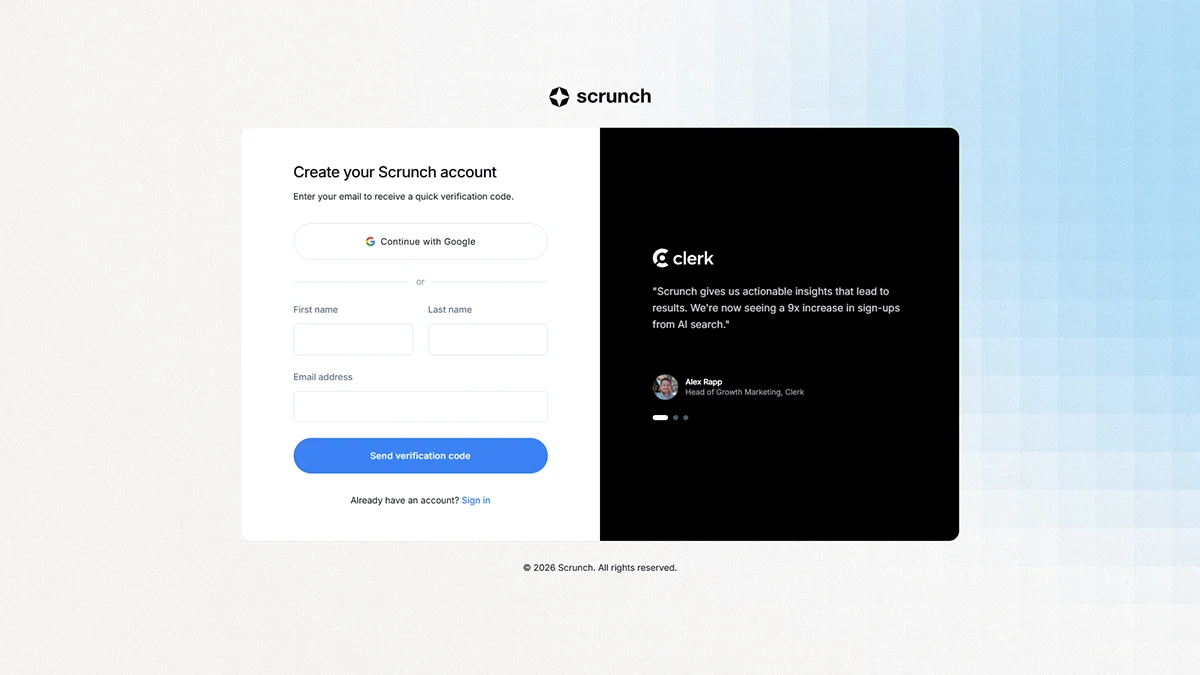
Where it wins
- 7 engines tracked: ChatGPT, Claude, Perplexity, Gemini, Google AI Mode, Google AI Overviews, Meta AI.
- 350+ custom prompts on higher tiers, with 3-day standard refresh (daily for recent prompts).
- Persona filtering — organize prompts by customer persona, journey stage, region.
- Agent Traffic — tracks AI bot visits to your site in real-time (requires CDN integration).
- AI Referrals via GA4 integration.
- Enterprise governance: RBAC, SOC2, multi-brand workspaces, API access.
Where it falls short
- No published revenue attribution case studies.
- Agent Traffic requires CDN integration — not plug-and-play.
- Pricing beyond the $250/mo core plan is opaque.
- Misinformation detection is likely rule-based; accuracy isn't independently validated.
Pick Scrunch over Peec if you're a B2B SaaS company that specifically wants persona-by-persona tracking and you're willing to do the CDN setup for Agent Traffic.
4. Profound — enterprise-only, highest proof
- Website: Profound
- Funding: $58.5M (Sequoia; board seat).
- Scale: 500+ orgs, 2,000 daily active marketers.
- Pricing: Custom enterprise only.
- Best for: Enterprise brands ($100M–$10B+ ARR). Publicly disclosed customers include Ramp, US Bank, Indeed, MongoDB, DocuSign, Chime.
Where it wins
- Four-layer platform: Monitor → Create → Orchestrate → Revenue tracking. Nobody else has all four in one product.
- Create layer auto-generates thousands of AI-optimized content pieces (blog → comparison → social) curated for citation probability.
- Orchestrate layer runs agentic workflows: AI agents managing outreach, influencer partnerships, content seeding.
- Revenue tracking correlates AI visibility to actual customer conversations and pipeline stages. The only tool on this list where that's a real feature, not a roadmap promise.
- Published proof: Airbyte went 9%→26% ChatGPT visibility in 1 week; a single $100K customer conversion was attributed to AI recommendations.
Where it falls short
- Price. If you have to ask, you can't afford it.
- The Airbyte case is likely outlier/survivorship bias; no median customer outcome disclosed.
- Agentic orchestration is nascent — no independent quality validation.
- The "700% AI referral growth" claim is aggregate across portfolio, not per-customer.
Pick Profound over Peec if you have the budget, you care about the full content-generation-to-revenue-tracking loop, and you can close a six-figure enterprise contract.
5. AthenaHQ — strongest mid-market proof
- Website: AthenaHQ
- Pricing: $95–300/mo self-serve; custom enterprise above that.
- Best for: Mid-market SaaS, e-commerce, and tech brands that rank well in Google but are invisible or misrepresented in AI answers.
Where it wins
- 25-factor audit — analyzes freshness, structure, E-E-A-T signals, citation eligibility.
- Playbook generation — content rewrite guidance + schema recommendations + outreach targets.
- LLM traffic tracking via server-side signals.
- AI content agent that auto-generates optimized content variants.
- Published case studies: Lago (3%→33% AI Overview impressions, 3.5%→17% citation rate); Grüns (38% monthly lead growth, 1,561% claimed ROI with 18-day payback). Analyzed 3M+ AI responses to build their mid-market SaaS playbook.
Where it falls short
- Only 2 published case studies. Survivorship-bias risk is real.
- The 1,561% ROI number is extraordinary and unaudited (no public methodology).
- The 25-factor audit is non-standard — the factors aren't publicly listed, so you can't compare apples-to-apples.
- AI agent content quality isn't independently validated.
Pick AthenaHQ over Peec if you specifically want proof-backed outcomes and you're willing to accept that the proof is anecdotal.
6. Nimt.ai — for teams who care about query fan-out
- Website: Nimt.ai
- Pricing: Not publicly disclosed.
- Best for: Content strategy teams who want to see what AI models actually search for internally, not just the prompts users type.
Where it wins
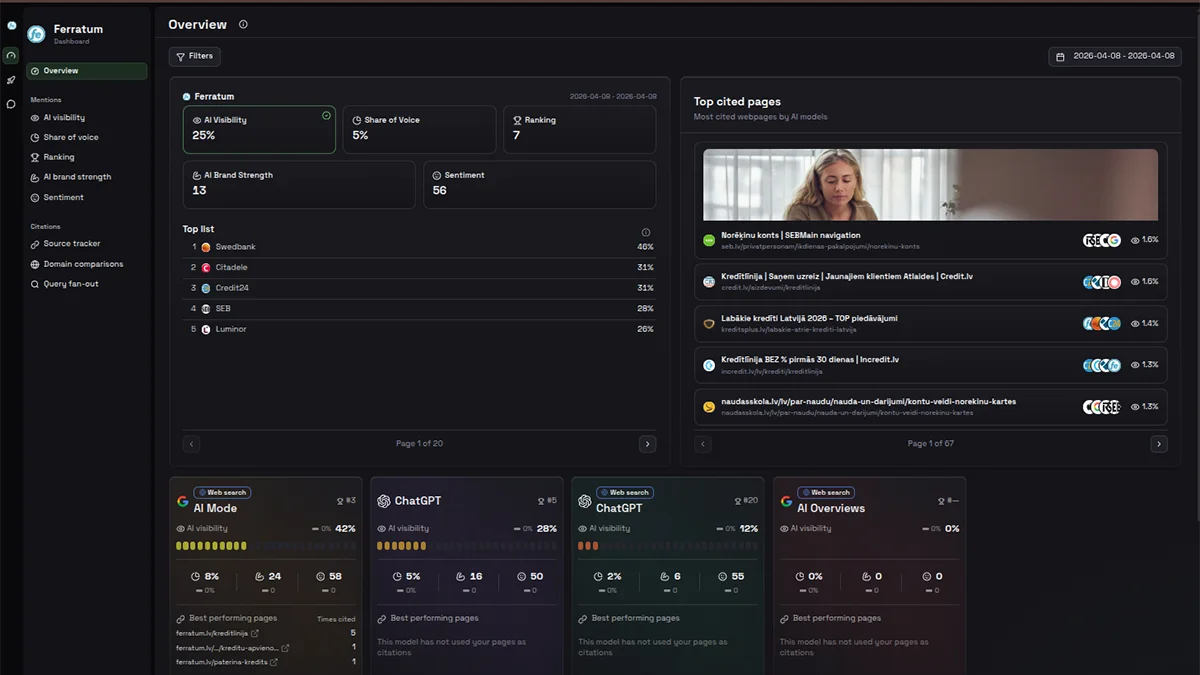
- Query Fan-out — exposes the hidden sub-queries AI models generate internally to answer a prompt. Directly actionable for content strategy. No other tool on this list has this in 2026.
- Sentiment radar chart by tag — topic-level emotional breakdown, more granular than basic sentiment.
- Source Tracker with content-type analysis — tells you if AI prefers Listicles, Guides, Reviews, Product Pages, or Forums for your vertical. Prescriptive format guidance.
- AI Brand Strength — combined proprietary score (Visibility + SoV + Ranking).
- UI scraping method (not API) for more accurate real-user-experience data.
Where it falls short
- Boost (their action layer) is "recommendations," not automation.
- No evidence of revenue attribution or closed-loop execution.
- Funding / team size unknown — harder to assess durability.
- Agency workflow features (bulk import, pitch projects, roles) are less evident than in Peec.
Pick Nimt over Peec if query fan-out visibility is specifically what's blocking your content strategy. Otherwise Peec's workflow polish probably wins.
7. Azoma — enterprise CPG / retail only
- Website: Azoma
- Funding: $4M.
- Pricing: Enterprise only.
- Best for: Fortune 500 retail/CPG brands (current customers: Mars, Colgate, Zappos, P&G).
Where it wins
- Digital-twin mechanism (patented). Builds synthetic customer demographic profiles, runs thousands of simulated prompts through those profiles across major LLMs, identifies exactly where the brand underperforms.
- Reported early profitability — unusual in this category.
- Marquee enterprise logo list.
Where it falls short
- Synthetic prompt testing may not reflect real-user query distributions.
- Optimized content may not influence AI if models don't retrieve fresh content at inference time.
- $4M funding is modest for enterprise SaaS ambitions.
- Not self-serve accessible to non-Fortune-500 buyers.
Pick Azoma over Peec if you're in Fortune 500 CPG or retail. Otherwise it's not in your bracket.
8. SE Ranking (Visible AI) — bolt-on for existing SEO stacks
- Website: SE Ranking (visible.seranking.com)
- Pricing: SE Ranking's main SEO suite starts around $52/mo; AI visibility features are bundled in higher tiers.
- Best for: SEO teams who already use SE Ranking and want to add GEO tracking without onboarding a new vendor.
Where it wins
- Integration with traditional SEO data — keyword rankings, backlinks, and AI visibility in one dashboard.
- Strong brand recognition, established infrastructure, longer track record than any pure-play GEO tool.
- Transparent pricing on the core SEO side.
Where it falls short
- AI visibility is a feature, not the whole product. Depth is shallower than Peec or Scrunch.
- Prompt-management UX is weaker than mid-market GEO specialists.
- Agency workflow is solid for SEO, less tuned for GEO-specific client reporting.
Pick SE Ranking over Peec if you already use SE Ranking for SEO and want one less login. Pick Peec if you specifically need GEO depth.
9. Otterly AI — lightweight and affordable
- Website: Otterly AI
- Pricing: Lite €29/mo (15 prompts) → Standard €189/mo (100 prompts) → Premium €489/mo (400 prompts). 15% off on annual.
- Models tracked: ChatGPT, Perplexity, Google AI Overviews, Microsoft Copilot. Gemini and Google AI Mode are paid add-ons across all tiers.
- Best for: Solo operators, small agencies, and startups who need basic AI visibility tracking without a €89/mo floor.
Where it wins
- Entry price. €29/mo Lite tier is the lowest of anything serious on this list.
- Daily tracking on every tier — even Lite. Most cheaper tools downgrade refresh cadence at the bottom plan.
- Fast onboarding, minimal setup. Marquee customers (XXXLutz, Opera, Avis Budget Group, A1 Telekom) for a tool at this price point.
Where it falls short
- 15-prompt cap on Lite — you'll spend that on a single brand's core tracking set. Anything serious means jumping to €189/mo Standard.
- 4 models on the base plans. Gemini and Google AI Mode are paid add-ons across all tiers — total cost climbs once you need them.
- Feature depth is notably thinner than Peec, Scrunch, or WebGlazer — it's explicitly a "starter" tool.
- No agency pitch projects or enterprise governance.
Pick Otterly over Peec if budget is the only thing that matters and you can live with basic features. Most teams will outgrow Otterly within 6 months.
Head-to-head: WebGlazer vs. Peec AI
Since this post is by the WebGlazer team, you deserve the unblurred comparison:
| Capability | WebGlazer | Peec AI |
|---|---|---|
| Model coverage | 5 included by default | 3+ base, tier-gated |
| Content generation | Code-backed pipeline for content adaptation | Not built-in |
| Closed-loop re-measurement | Re-measure step built into the workflow | Manual |
| Actions / recommendations | Recommended Actions + Execution Workflow | Guidance layer only |
| Pricing for local businesses | Separate plan shape | Not a fit |
| Pricing for agencies | Agency-specific plans | Mid-market aimed |
| Prompt tracking | 50+ tracked brand prompts avg | Mature, with bulk CSV + suggestions |
| Source classification | Citation Sources feature | Auto-typed, no manual override |
| Competitor setup (aliases/regex/domain) | Simpler matching today | Most sophisticated in mid-market |
| Agency pitch projects | Client workspace exists; pitch-projects UX younger | Polished |
| Looker Studio integration | Exports available; native connector on roadmap | Native |
| API access | On request | Enterprise tier |
| Revenue attribution | On roadmap | Not available |
In plain English: WebGlazer covers more models, bundles execution and content generation, and is the only option in this category priced for both agencies and local businesses. Peec has a more polished UX on a few specific surfaces — competitor-alias regex and pitch projects — that matter if those specific features are make-or-break for you. For everyone else, WebGlazer is the better fit.
Frequently asked questions
Is Peec AI worth it?
Yes, for its target audience — mid-market marketing teams at brands, and mid-size agencies that can justify €200-500/mo. Peec has the most polished mid-market workflow on the market today. It's less well-suited to solo operators, local businesses, and Fortune 500 procurement cycles.
What's the cheapest alternative to Peec AI?
Otterly AI's Lite tier at €29/mo is the cheapest serious tool in this category — but it caps you at 15 search prompts and treats Gemini + Google AI Mode as paid add-ons. The next Otterly tier (Standard) jumps to €189/mo for 100 prompts. SE Ranking's broader SEO suite starts at ~$52/mo and bundles AI visibility only in higher tiers. If budget is the top constraint and 15 prompts is enough to start, Otterly Lite is the entry point; expect to outgrow it within 6 months.
Does Peec AI have a free plan?
No — Peec has a Starter paid tier (~€89/mo) but no permanently free plan. A trial is typically available by request. For a genuinely free entry point, AthenaHQ's lower tier starts around $95/mo, and most tools in this category do not offer a free tier because the underlying LLM API costs scale per prompt.
What's the best Peec AI alternative for agencies?
WebGlazer. It's purpose-built for agency workflows — client workspaces, reporting, Execution Workflow, and 5 models included by default without Peec's per-model upcharge. Scrunch AI's enterprise tier is a reasonable second option if you specifically need RBAC and SOC2; Peec's own "pitch projects" feature is polished if you're actively pitching new client work but don't care about execution depth.
What's the best Peec AI alternative for local businesses?
WebGlazer, straightforwardly. It's the only tool on this list with a dedicated local-business pricing plan. Every other option here is priced and positioned for mid-market marketing teams — a single-location business or small multi-location operator will either overpay or be left with features they don't need.
Which Peec AI alternative has revenue attribution?
Only Profound publishes revenue attribution as a real feature, and even then the published cases are anecdotal (Airbyte, a single $100K conversion). No mid-market GEO tool has solved visibility-to-revenue attribution convincingly as of April 2026. Treat any tool's revenue-attribution claims with skepticism and ask for the methodology.
How many AI models should a Peec alternative cover?
Minimum four: ChatGPT, Claude, Gemini, Perplexity. Seven is table stakes for enterprise RFPs: add Copilot, Meta AI, and Grok. Tools that gate model coverage by tier (Peec does this) can double or triple your effective price at scale.
Methodology
- Teardown research on Peec AI conducted across six months, based on: billing pages, onboarding flows, prompt workspace, competitor setup, URL explorer, domain explorer, Actions layer, member/roles, export schemas.
- Competitive research on the other 8 tools drawn from: product documentation, public pricing pages, published case studies, independent review aggregators, and our own hands-on evaluation where trials were available.
- Pricing accurate as of April 2026. Tool features change fast in this category — always check the vendor's current pricing page before deciding.
- WebGlazer is one of the tools listed. This post was written by the WebGlazer team. We've tried to flag every place that bias could sneak in. If you catch something that reads unfairly, email us and we'll update the post.
Next step
If you've narrowed to 2-3 tools, book a demo with each in the same week. Run the same 10-prompt test set across all of them. Compare the citation sources, the action recommendations, and the export quality. That 90-minute exercise will tell you more than any comparison post — including this one. To run the test by hand on one engine first, follow our guide to tracking Perplexity mentions and citations.
Still mapping the category? See the WebGlazer AI visibility tool overview, browse our FAQ on AEO and AI visibility, or check the full blog for more breakdowns.
Book a WebGlazer demo